
endoscopic mini facelift
An endoscopic mini facelift is not a single standardized operation. The name may describe a limited facial lift performed with endoscopic assistance, but the area treated, incision plan, and technique can differ by surgeon. When reviewing options and costs, clarify whether a plan addresses the midface, lower face, or both.
Key Takeaways
- Because the term covers different approaches from one surgeon to the next, patients should ask exactly which areas, incisions, and techniques a proposed plan includes.
- Costs vary widely depending on the extent of lifting, the surgeon's experience, anesthesia, and facility fees, so a detailed written estimate is worth requesting.
- A mini approach generally offers a shorter recovery than a full facelift, yet it addresses limited areas and may not correct more advanced laxity in the neck or jawline.
- Results typically last several years, but aging continues and individual factors such as skin quality and lifestyle influence longevity.
- Reviewing before and after photos from the specific surgeon you are considering helps you judge whether their style of natural-looking results matches your goals.
Dr. Mark Albert is certified by the American Board of Plastic Surgery and is a Fellow of the American College of Surgeons. His practice offers a Mini Facelift. Whether a limited lift is suitable requires an individualized clinical assessment.
What Is an Endoscopic Mini Facelift, and How Does It Differ From a Midface Lift or Traditional Facelift?
The term generally refers to a limited lift that uses a small camera to view tissue beneath the skin through small incisions. A midface lift focuses on the cheek area, while a traditional facelift is planned to address a broader area, often including the lower face and jawline. Terminology varies, so ask which tissues and regions the proposed operation would address.
What the endoscopic technique involves
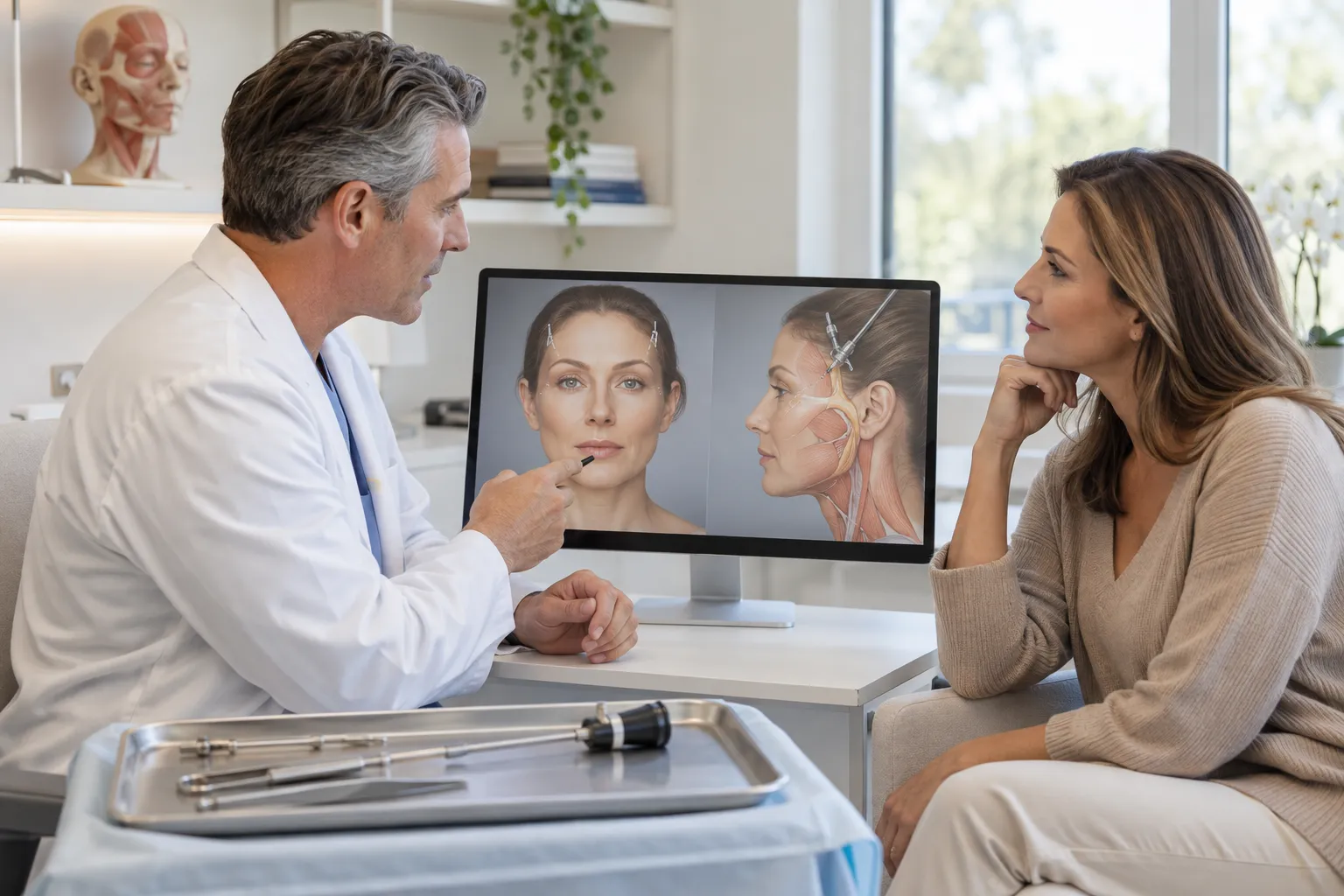
An endoscope is a slender camera that gives the surgeon a view of underlying tissues through small openings. In facial surgery, it can support work beneath the skin without the same incision pattern used in some broader lift approaches. Small incisions do not, by themselves, define the operation or establish what result is achievable. The treatment area, tissue repositioning, anesthesia plan, and incision locations depend on the surgeon’s method and the patient’s anatomy.
Endoscopic mini facelift vs. endoscopic midface lift vs. traditional facelift
These labels are not interchangeable. A midface lift is directed toward the cheek region; “mini” usually signals a more limited treatment plan, while “traditional facelift” commonly refers to a broader lift. Endoscopic assistance describes a viewing method, not a guarantee of scope or outcome. Ask the surgeon to identify the intended treatment area and explain how the plan relates to your concerns.
| Approach or term | Typical focus | What to be clear |
|---|---|---|
| Endoscopic mini facelift | A limited plan using endoscopic visualization | Which facial areas are included, and what incisions are planned? |
| Endoscopic midface lift | Cheek and midface tissues | Does the plan address the lower face or jawline? |
| Traditional facelift | A broader facial lift, often including the lower face | Which changes can the operation address, and which may remain? |
Who is a good candidate for an endoscopic mini facelift?
A limited approach may be discussed with adults whose concerns and anatomy align with a focused treatment area and who understand its limits. It may not address changes outside that area. General health, medical history, skin and tissue characteristics, expectations, and ability to follow recovery instructions factor into an assessment. A consultation is needed to determine whether a Mini Facelift or another facelift plan is appropriate.
How Much Does an Endoscopic Mini Facelift Cost in the US and Internationally?

Published prices are difficult to compare because quotes may cover different services and procedures. That broad range is a reference point, not an individual quote, and does not establish that every estimate includes the same fees.
Cost breakdown: surgeon fees, anesthesia, and facility fees
Request an itemized estimate separating the surgeon’s fee from anesthesia and facility charges. Ask whether preoperative visits, routine follow-up, and any garments or medications are included, and how unexpected costs are handled. A lower headline price may reflect a narrower package rather than a lower total expense.
| Cost component | What to ask |
|---|---|
| Surgeon fee | Which operation and treatment areas does this fee cover? |
| Anesthesia | Is anesthesia included, and who determines the plan? |
| Facility | What facility charges are included in the estimate? |
| Related care | Are follow-up visits and routine recovery needs included? |
How geographic location affects price in the US and internationally
Costs can vary by region, facility, surgeon, and the scope of the operation. International prices may be quoted in another currency or package services that a US estimate lists separately. Travel, lodging, time away from work, and access to follow-up care can add expenses beyond the surgical quote. Compare itemized estimates in context rather than treating an advertised starting price as the total cost.
Why quotes vary and what questions to ask about pricing
Two estimates may describe different treatment areas, anesthesia arrangements, or facility services. Ask what the quote includes, what could change the total, and who will provide care after surgery. If considering an endoscopic midface lift cost estimate, confirm that it covers the same treatment area and services as the quote used for comparison.
What Can You Expect Before and After an Endoscopic Mini Facelift?
Before an endoscopic mini facelift, expect planning focused on your facial anatomy, health, goals, and the areas you want addressed. The name alone does not establish the incision pattern or scope of surgery. Dr. Mark Albert’s Mini Facelift is one option to discuss; whether it fits your needs requires an individualized clinical assessment. Before-and-after photographs can help you understand a surgeon’s approach, but cannot predict your personal outcome.
The consultation and surgical process step by step
At consultation, discuss the facial changes that concern you, your medical history, and expectations. The surgeon can assess your anatomy and explain the proposed treatment area, incision plan, anesthesia, recovery instructions, and relevant risks. Ask what changes the operation is intended to address and what may remain. If surgery is planned, the care team will provide patient-specific preparation guidance and explain follow-up arrangements. The surgical plan and anesthesia are determined for the individual, not by the procedure’s label.
Incision placement and scarring: what to expect
Incisions depend on the technique and treatment area. Endoscopic methods may use smaller openings for camera access, while a limited facelift may involve incisions near the hairline or around the ear. The surgeon should explain their exact locations. Scars are a normal part of surgery; visibility and healing vary with individual factors and aftercare. Ask how incisions may appear as they heal and what wound-care instructions to follow. A small incision does not mean scarring will be invisible.
Recovery timeline week by week
Recovery varies by patient and operation. The outline below is general, not a personal timetable. Follow your surgeon’s instructions about activity, incision care, and follow-up, and contact the care team with concerns.
| Period | General expectations | Practical focus |
|---|---|---|
| First several days | Swelling, bruising, and a feeling of tightness may occur. | Rest and follow the care team’s instructions. |
| About one to two weeks | Some patients resume social activities during this period, though visible healing varies. | Attend scheduled follow-up and ask before returning to strenuous activity. |
| Following weeks | Bruising and swelling can continue to settle; the appearance keeps changing during healing. | Continue incision care as directed and allow time for recovery. |
What visible changes look like as swelling subsides
Early photographs may show swelling or bruising, so they do not represent the settled appearance. As healing progresses, the treated area becomes easier to assess, though the pace differs between patients. A natural-looking result depends on the plan, tissue response, and individual anatomy; no photograph can guarantee a similar result for someone else. The Mini Facelift page describes the practice’s service, while an in-person consultation is needed to discuss expected changes and recovery for your circumstances.
How Long Do Endoscopic Mini Facelift Results Last, and What Risks Should You Know About?
Facelift results can remain visible for years, but no operation stops natural aging or produces a permanent outcome. Longevity varies with the areas treated, surgical technique, tissue characteristics, health, and changes in facial volume and skin over time. Ask what the proposed lift is intended to change and what changes may continue. Decisions should consider whether the expected benefit, recovery, and risks make sense for your goals, not rely on a promised number of years.
Realistic longevity expectations and factors that influence results
How long results remain noticeable depends in part on starting anatomy and the scope of surgery. Healing, skin quality, genetics, sun exposure, and ongoing aging can affect appearance. A smaller treatment area may provide a focused change, while facial changes outside that area can continue. Ask how the surgeon defines a lasting result, which features may change with time, and whether follow-up is part of the care plan. Another patient’s photographs or timeline cannot predict individual results.
Potential risks and complications, honestly discussed
Facelift surgery carries risks, and an endoscopic approach does not remove them. Possible complications include bleeding or a collection of blood beneath the skin, infection, unfavorable scarring, delayed healing, changes in skin sensation, facial nerve injury, asymmetry, and risks related to anesthesia. The likelihood and relevance of each risk vary by patient and operation. Ask which risks apply to your medical history, what steps are planned to reduce risk, and whom to contact if a concern develops after surgery. Seek urgent medical care for severe or rapidly worsening symptoms.
Limitations of a mini approach compared with a full facelift
A limited lift may not address all areas of facial aging. If concerns involve regions outside its planned treatment area, a narrower operation may leave them unchanged. Dr. Mark Albert’s Mini Facelift is a distinct facelift option; its suitability depends on an individual assessment. Ask the surgeon to describe its scope and explain when a broader facelift plan might better match your anatomy and goals.
Potential trade-offs of a limited facelift
Potential advantages
- A focused plan may be appropriate when the areas of concern are limited.
- The operation’s intended scope can be discussed in relation to specific facial features.
Potential limitations
- Changes beyond the treated area may remain unaddressed.
- Results, healing, and complications vary, and no outcome is not assured.
How Do You Choose a Qualified Facelift Surgeon? Insights From Dr. Mark Albert
Choose a surgeon by reviewing credentials, relevant facelift training, communication, and the individualized plan, not by relying on a title or a single photograph. Dr. Mark Albert is certified by the American Board of Plastic Surgery and is a Fellow of the American College of Surgeons. He completed plastic surgery residency and chief residency at the University of Massachusetts Medical School, followed by an aesthetic plastic surgery fellowship at Manhattan Eye, Ear, and Throat Hospital. He directs that fellowship and serves as an Assistant Clinical Professor of Surgery at the Zucker School of Medicine at Hofstra/Northwell.
Credentials and experience to look for in a facelift surgeon
Confirm board certification through the relevant specialty board and ask about the surgeon’s training and experience with the specific facelift approach under consideration. Review photographs representing a range of patients and ask how the surgeon protects privacy and obtains consent. A clear explanation of limitations, risks, anesthesia, and follow-up matters alongside discussion of potential benefits. Learn more about Dr. Mark Albert and his professional background.
Questions to ask during your consultation
Use the appointment to understand the plan rather than seek a not assured prediction. A written list can help you compare answers and discuss uncertainties openly.
- Which facial areas would the proposed operation address, and which would remain unchanged?
- What incision locations, anesthesia plan, and recovery instructions do you anticipate for me?
- What risks are most relevant to my health history, and how will follow-up be arranged?
- What costs are included in the written estimate, and what might be billed separately?
Combination procedures and individualized planning
Planning should reflect facial anatomy, medical history, goals, and tolerance for recovery. If more than one facial area is a concern, ask how each would be assessed and whether a facelift alone can reasonably address the changes you notice. Do not assume adding procedures is necessary or appropriate. Dr. Albert’s Mini Facelift can be discussed as one option, with the recommendation based on an in-person clinical assessment. For individualized guidance, you may request a consultation with Dr. Mark Albert.
Frequently Asked Questions
What is an endoscopic facelift?
An endoscopic facelift uses a slender camera called an endoscope to view tissues beneath the skin through small incisions. The endoscope describes a visualization method, not the scope of surgery, so the treatment area, incision plan, and technique still depend on the surgeon's approach and your anatomy.
What does a mini facelift consist of?
A mini facelift generally refers to a limited lift with a smaller treatment plan than a traditional facelift, often focusing on a specific region of the face. The exact areas addressed, incision locations, and tissue repositioning vary by surgeon, so ask which facial regions a proposed plan includes.
Can I get a facelift without general anesthesia?
Anesthesia planning for a facelift is individualized, and options depend on the procedure, its scope, your health, and your surgeon's method. Some limited approaches may be performed with local anesthesia and sedation, while broader lifts often use general anesthesia. Discuss the appropriate anesthesia plan with a qualified clinician during consultation.
Is a neck lift a better option than a mini facelift?
Neither option is universally better; the right choice depends on your anatomy, the areas you want addressed, and your goals. A mini facelift is a limited treatment plan, and it may not address changes outside its treatment area. An in-person consultation with a qualified clinician is needed to determine which approach fits your concerns.
How much does an endoscopic mini facelift cost?
Request a written, itemized estimate that separates each cost component, and confirm what the quote includes, since a lower headline price may reflect a narrower package rather than a lower total expense.
Who is a good candidate for an endoscopic mini facelift?
Good candidates are adults whose concerns and anatomy align with a focused treatment area and who understand the limits of a limited lift. General health, medical history, skin characteristics, and expectations all factor into the assessment. Candidacy requires an individualized consultation, as no procedure is suitable for everyone.
What is the best non-surgical facelift for a 70 year old?
There is no single best non-surgical option for any age group; appropriate treatment depends on your anatomy, tissue characteristics, health, and goals, and requires evaluation by a qualified clinician. A consultation allows you to learn which options may or may not address your concerns and to make an informed, individualized decision.
Leave a Reply