
composite deep plane facelift
A composite deep plane facelift is an advanced facelift approach that elevates the skin, SMAS, and selected midface soft tissue as one composite flap beneath the SMAS layer. By releasing facial retaining ligaments, the surgeon can reposition descended cheek and lower-face tissues with less reliance on skin tension. The goal is a natural, proportionate change, not a tightly pulled appearance. Candidacy, technique, recovery, risks, and outcomes require individualized clinical assessment.
Key Takeaways
- This advanced surgical technique elevates the skin and underlying soft tissues as a single unit to restore facial volume.
- Releasing specific facial ligaments allows the surgeon to reposition descended tissues without relying on excessive skin tension.
- The procedure aims to create a natural and proportionate aesthetic rather than a tightly pulled look.
- Patients must undergo a personalized clinical assessment to determine their suitability for the operation.
I am Dr. Mark G. Albert, MD, FACS, a board-certified plastic surgeon and Fellow of the American College of Surgeons. The terminology used for advanced facelift surgery is not consistent across practices, so the operative plan matters more than the label. A consultation should connect the name of a technique with the anatomy it addresses, the incision plan, the expected recovery, and its limitations.
What Is a Composite Deep Plane Facelift? A Clear, Patient-Friendly Definition
A composite deep plane facelift lifts more than loose skin. It mobilizes skin together with the SMAS, or superficial musculoaponeurotic system, and selected midface tissues in a connected layer. This permits release of retaining ligaments that hold facial tissue in place, followed by repositioning in a superior-medial direction. The technique may address facial descent, cheek flattening, jowling, and selected neck concerns, depending on the patient’s anatomy and surgical plan. It does not stop aging, correct every facial concern, or create a permanent result.
The Composite Flap, Explained in Plain English
Think of the face as having several soft-tissue layers rather than a single sheet of skin. The SMAS is a fibrous layer connected with facial muscles and supporting tissues. In a composite approach, the surgeon elevates skin and deeper soft tissue together, working in a plane beneath the SMAS. The effect on flap blood supply and access to facial ligaments depends on the surgical technique and the patient’s anatomy.
After the deeper tissues are freed, the malar fat pad and related cheek tissues may be repositioned rather than pulled outward. Skin is then redraped without making it carry the full lifting force. The precise depth, direction, neck treatment, and treatment of the eyelid-cheek junction vary with facial structure, skin quality, prior surgery, and the goals discussed during consultation.
Composite, Deep Plane, Extended Deep Plane, SMAS, and Mini Lift: What Each Term Actually Means
These terms describe related concepts, but they are not interchangeable in every surgeon’s vocabulary. “Deep plane” generally refers to elevation beneath the SMAS with release of selected retaining ligaments. “Composite” emphasizes that skin and deeper tissues remain connected as one flap. An extended deep plane approach may continue the dissection into the neck by releasing cervical retaining ligaments. A SMAS facelift works at the SMAS layer, though the method of folding, tightening, cutting, or repositioning that layer can differ. A Mini Facelift is a more limited facelift option intended for selected patterns of lower-face laxity and requires a separate assessment.
| Term | What it generally describes | Why the distinction matters |
|---|---|---|
| Composite facelift | Skin, SMAS, and selected midface tissue elevated together | Focuses on a connected flap and cheek repositioning |
| Deep plane facelift | Dissection beneath the SMAS with retaining-ligament release | Can permit deeper tissue movement with reduced skin tension |
| Extended deep plane facelift | A deep plane approach extended toward cervical tissues | May include a more direct plan for neck laxity |
| SMAS facelift | Repositioning or modification of the SMAS layer | The exact operation depends on the surgeon’s technique |
| Mini Facelift | A more limited facelift operation | May suit selected lower-face concerns, but is not a substitute for every facelift plan |
From Skin-Only Lifts to Composite Techniques: Why the Approach Changed
Earlier facelift operations focused primarily on tightening skin. Those procedures could improve skin laxity, but skin tension alone may produce a lateral or “windswept” appearance and may not adequately reposition descended cheek tissues. Later SMAS techniques addressed deeper support. Dr. Sam Hamra first described the deep plane facelift in 1990, and composite rhytidectomy was published in the peer-reviewed literature during the early 1990s, as documented by NCBI Bookshelf and the National Library of Medicine.
Modern terminology reflects changes in facial anatomy, surgical planes, and lifting vectors. A deeper operation is also more technically demanding, with important considerations involving facial nerve branches, blood supply, swelling, and recovery. The name of the procedure should never replace a detailed explanation of what will be released, repositioned, preserved, and left untreated. The Mini Facelift remains within the facelift category, though its limited design is appropriate only for selected patients after examination.
How a Composite Deep Plane Facelift Works, Step by Step
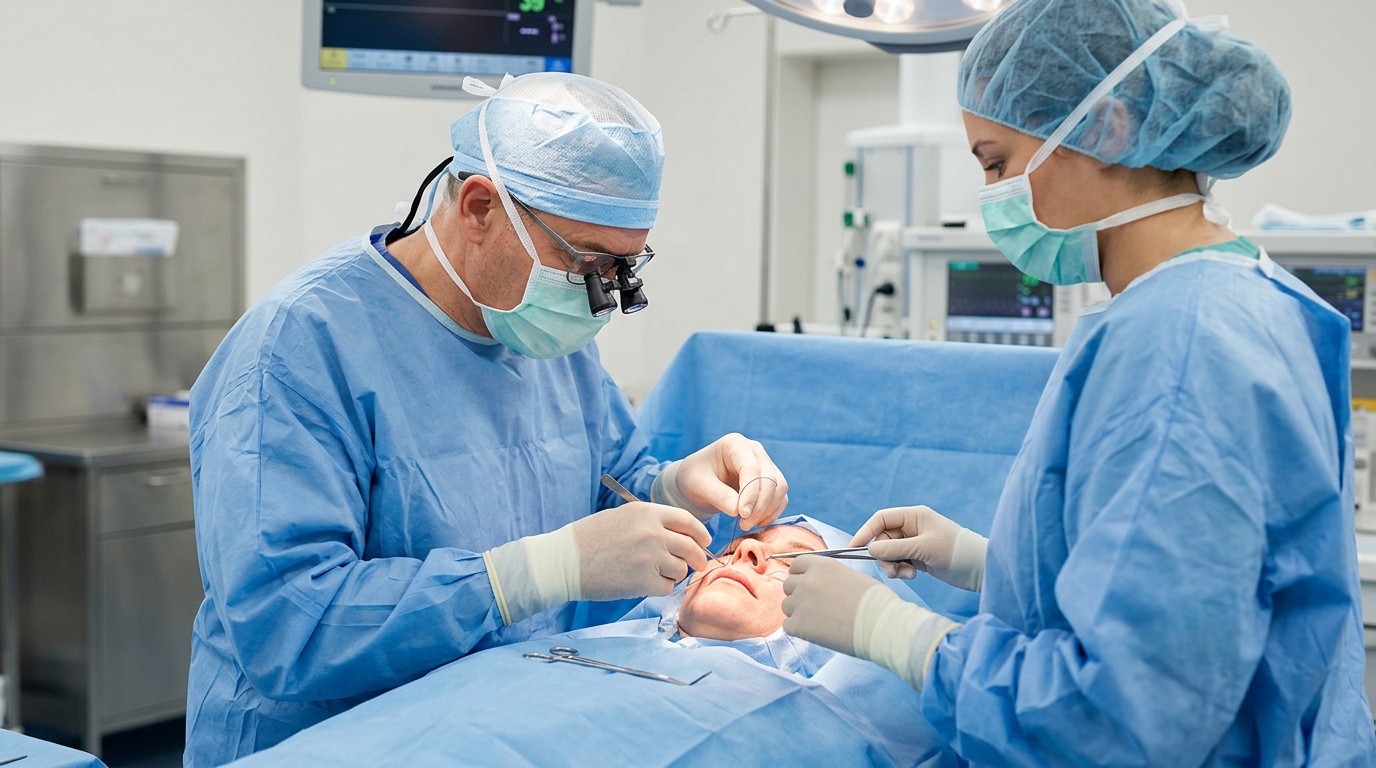
Step by Step: What Happens During Surgery
The operative sequence is individualized, but a composite deep plane facelift commonly follows a structured plan:
- Incisions are planned. Incisions typically follow natural contours around the ear and may extend into the hairline according to the amount of skin laxity and the desired access.
- The skin flap is elevated. The surgeon separates the skin from deeper facial tissues while protecting its blood supply.
- The deeper plane is entered. Dissection continues beneath the SMAS so the composite flap can move as a unit.
- Retaining ligaments are released. Selected zygomatic and mandibular attachments are freed to permit movement of the cheek and lower face.
- Soft tissue is repositioned. The malar fat pad and related tissues may be lifted in a superior-medial direction, with the neck addressed when included in the plan.
- Skin is redraped and incisions are closed. Excess skin is managed after deeper support has been established, rather than using skin tension as the primary lifting force.
Why Releasing Retaining Ligaments Allows Deeper, Tension-Free Repositioning
Retaining ligaments are fibrous attachments that connect facial soft tissue with deeper structures. They help hold the cheek, midface, and lower face in position, yet they also limit how far those tissues can move. Releasing selected attachments creates mobility in the deeper plane. That mobility can allow the surgeon to reposition tissue without pulling the skin tightly across the face.
The zygomatic ligaments near the cheekbone and mandibular ligaments near the jawline may be considered according to the surgical design. Their release requires careful knowledge of facial anatomy because branches of the facial nerve travel through nearby tissue planes. Facial nerve weakness is a potential risk of facelift surgery and may be temporary or permanent. Technique-specific training, careful dissection, and individualized planning are part of risk management, not a guarantee that complications cannot occur.
The Balanced Vector: How Vertical Repositioning Avoids the “Windswept” Look
A conventional lateral pull moves tissue primarily toward the side of the face. A composite deep plane facelift may use a superior-medial vector, meaning the cheek and midface are guided upward and somewhat inward toward their earlier anatomic position. Whether this direction affects the appearance of facial tissues varies with anatomy and the surgical plan.
The vector is not identical for every patient. Skin elasticity, cheek volume, facial width, jowling, neck contour, and prior surgery all affect the design. A natural result depends on proportional repositioning, conservative skin management, and acceptance of the limits imposed by anatomy.
The Septal Reset and the Lid-Cheek Junction
The septal reset refers to release and repositioning near the orbital rim and arcus marginalis, the boundary between the lower eyelid and cheek. In selected patients, this maneuver can help restore continuity at the lid-cheek junction and support repositioning of the midface. It is particularly relevant when aging has created a sharp transition, hollowing, or descent beneath the lower eyelid.
This technique cannot promise correction of hollow eyes or reverse every change from previous eyelid surgery. Prior operations, scar tissue, orbital anatomy, skin quality, and tissue volume all influence feasibility. A facial examination is required to determine whether a septal reset belongs in the surgical plan, whether the neck should be addressed, and which risks and recovery demands apply to that individual.
Who Considers This Procedure, and What Do Recovery and Risks Look Like?
Whether a composite approach is appropriate depends on facial anatomy, skin quality, prior surgery, general health, and the changes a patient hopes to address. A consultation is an opportunity to discuss these factors without treating a procedure name as a diagnosis or promise. Some patients may be considering a more limited Mini Facelift, while others may need a broader plan for midface descent, jowling, lower-face laxity, or the neck. Candidacy, technique, recovery, risks, and outcomes require individualized clinical assessment.
Candidacy: Discussion Points to Bring to Your Consultation
Patients often seek consultation when the cheeks appear lower, the nasolabial area has deepened, the jawline has become less defined, or jowls have developed. A prior facelift does not automatically exclude someone from consideration, though scar tissue, altered tissue planes, and the remaining skin envelope can make planning more demanding. General medical conditions, healing history, tobacco or nicotine use, and current medications also belong in the discussion.
- Which visible concerns are related to midface descent, jowling, skin laxity, or neck changes?
- Has prior facial surgery changed the tissue planes or created scar tissue?
- Is overall health suitable for elective surgery and anesthesia after appropriate medical review?
- Can smoking and nicotine exposure be avoided for the period recommended by the surgical team?
- What degree of improvement is realistic, and which concerns would remain untreated?
- How much time can be reserved for swelling, bruising, activity limits, and follow-up visits?
A limited Mini Facelift may be discussed when concerns are concentrated in the lower face and the planned correction does not require broader tissue release. A deeper composite operation may be considered when cheek descent and more extensive facial laxity are central concerns. The distinction should be based on examination and surgical goals, not on the assumption that a longer or deeper operation is automatically better.
A Typical Recovery Timeline, Week by Week
Recovery varies with the extent of dissection, the areas treated, individual healing, and the surgeon’s instructions. Composite techniques can produce more swelling around the eyes because the midface and lid-cheek region may be mobilized. The following guide is general education, not a personal schedule.
| Time period | What patients may notice | Typical considerations |
|---|---|---|
| First several days | Swelling, bruising, tightness, numbness, and fatigue are common possibilities. Periorbital swelling may be noticeable. | Rest, head elevation, incision care, and prescribed follow-up are usually emphasized. |
| End of week one | Bruising may begin to fade, though facial fullness and uneven swelling can remain. | Early activity restrictions continue, and any sutures or dressings are managed according to the operative plan. |
| Weeks two to three | Social readiness varies, and residual swelling, firmness, altered sensation, or asymmetry may persist. | Work and social plans depend on healing, occupation, and the surgeon’s examination. |
| Weeks four and beyond | Contours generally continue to settle. Scar color, tissue softness, and sensation can keep changing. | Return to exercise and unrestricted activity requires individualized clearance. |
Risks and Limitations to Understand Before Deciding
Facelift surgery is not risk-free. Potential complications include bleeding or hematoma, infection, delayed healing, visible or widened scars, skin or hairline changes, persistent numbness, contour irregularity, and asymmetry. Facial nerve injury is an uncommon but important concern. Weakness may be temporary when a nerve branch is irritated, though permanent injury is possible. The depth and technical demands of surgery make detailed anatomical knowledge and careful postoperative monitoring essential.
Safety perspective: A facelift can reposition selected tissues, but it cannot stop future aging or guarantee a specific appearance. Results may change with time, and some patients may need prolonged observation before the final contour is apparent. Seek prompt medical guidance for rapidly increasing swelling, significant bleeding, fever, worsening pain, breathing difficulty, new facial weakness, or any symptom that concerns you after surgery.
Patients should also understand the limits of tissue repositioning. Skin elasticity, facial structure, healing response, and previous procedures influence contour and longevity. A qualified clinician must review medical history, medications, nicotine exposure, anesthesia considerations, and examination findings before discussing a personalized plan. An in-person consultation is the appropriate setting to review expected scars, follow-up care, activity restrictions, and the balance between potential benefit and surgical risk.
Can a Composite Deep Plane Facelift Improve a Previous Facelift Result?
A composite deep plane facelift may be considered in selected revision cases when a previous facelift left the face appearing laterally pulled, when the cheek has descended again, or when the lid-cheek transition appears hollow or sharply outlined. The technique’s upward and inward repositioning can address a different anatomic plane than a skin-focused operation. It cannot guarantee correction, and revision planning requires an in-person examination of scars, tissue mobility, skin quality, facial nerve function, and the original operative changes.
Lateral Sweep and Hollow Eyes: Why Earlier Conventional Lifts Can Look “Pulled”
A prior facelift may create a lateral sweep when the principal lifting force is directed toward the ears rather than upward toward the cheek and midface. Excessive skin tension can make the face appear tight without restoring volume distribution or midface position. With aging, the lower eyelid may also develop a hollow or skeletonized appearance. This can reflect natural tissue descent, loss of soft-tissue support, orbital anatomy, or changes after an aggressive lower eyelid operation that removed too much fat.
In carefully selected patients, composite techniques may allow the surgeon to release retaining structures, reposition the malar fat pad, and reset the tissue boundary near the orbital rim. These maneuvers can improve continuity between the lower eyelid and cheek, though they do not replace missing tissue in every case or reverse all prior surgical effects. The degree of correction depends on anatomy, scar tissue, nerve function, and the amount of tissue that remains available for repositioning.
What Revision Patients Should Ask a Surgeon
Revision patients benefit from a detailed review of the earlier operation, including incision placement, the areas treated, the timing of healing, and any complications. Bring operative records and photographs when available. Ask whether the proposed plan addresses the deeper cause of the contour concern or only redrapes the skin. It is also reasonable to ask which retaining ligaments may be released, whether the lid-cheek junction requires attention, how facial nerve branches will be protected, and which visible limitations are likely to remain.
Revision perspective: A deeper facelift approach is not automatically the correct answer after an unsatisfactory result. The safest recommendation depends on tissue quality, prior dissection, medical history, and a surgeon’s ability to explain both the intended correction and the reasons it may not be achievable.
How to Evaluate a Composite Deep Plane Facelift Surgeon in New York City

Choosing a surgeon for advanced facelift surgery requires more than searching for a procedure label. Ask how the surgeon evaluates facial anatomy, selects a lifting plane, manages the cheek and neck, and follows patients through recovery. A consultation should include a clear discussion of scars, anesthesia, swelling, nerve-related risks, revision possibilities, and the concerns that surgery will not address. The surgeon should be willing to recommend a different facelift plan when that better matches the patient’s anatomy.
A Surgeon-Evaluation Checklist for Advanced Facelift Techniques
- Board certification: Confirm certification by the American Board of Plastic Surgery, rather than relying on a general use of the term “board certified.”
- Professional standing: Fellowship in the American College of Surgeons, shown by the FACS designation, reflects an additional professional standard.
- Relevant training: Ask about plastic surgery residency, chief residency, and focused fellowship training in aesthetic facial surgery.
- Anatomy-based planning: The surgeon should explain the SMAS, retaining ligaments, midface, jawline, neck, and facial nerve considerations in understandable language.
- Accredited facility: Confirm where surgery and anesthesia will occur and how emergency support is organized.
- Continuity of care: Ask who will provide postoperative assessment, how urgent concerns are handled, and how long follow-up continues.
- Transparent consultation: A careful discussion should address benefits, limitations, alternatives within facelift surgery, expected downtime, and material risks without pressure.
Dr. Mark G. Albert, MD, FACS, is certified by the American Board of Plastic Surgery and is a Fellow of the American College of Surgeons. His training includes plastic surgery residency and chief residency at the University of Massachusetts Medical School, followed by an aesthetic plastic surgery fellowship at Manhattan Eye, Ear, and Throat Hospital. He is Program Director of the MEETH Aesthetic Plastic Surgery Fellowship and an Assistant Clinical Professor of Surgery at the Zucker School of Medicine at Hofstra/Northwell. Credentials do not remove surgical risk, but they provide useful information when evaluating training and professional responsibility.
What Shapes the Cost of a Composite Deep Plane Facelift
The cost of a composite deep plane facelift cannot be responsibly reduced to a universal figure. Fees may reflect the surgeon’s experience, operative complexity, facility charges, anesthesia, preoperative testing, postoperative visits, geographic location, and whether revision surgery or neck treatment is part of the plan. Previous surgery can require additional planning because scar tissue and altered tissue planes may increase technical demands.
During consultation, request a written estimate that separates professional, facility, anesthesia, medication, garment, and follow-up charges when applicable. Ask which services are included if healing requires additional evaluation. A lower quoted fee may not represent the same operation or level of follow-up as a more comprehensive plan. Cost should be considered alongside qualifications, facility standards, communication, and the suitability of the proposed technique for the individual patient.
For patients in New York City or traveling from elsewhere, planning should also account for transportation, lodging, time away from work, and access to the surgical team after returning home. These practical details can affect safety and recovery planning. The appropriate decision follows a private consultation in which medical history, anatomy, goals, and risk tolerance are reviewed directly.
Frequently Asked Questions
What is the downside of a deep plane facelift?
The main downsides of a deep plane facelift are its technical complexity and the considerations of working beneath the SMAS layer, including facial nerve branches, blood supply, swelling, and a more involved recovery than smaller lifts. The operation does not stop aging, correct every facial concern, or create a permanent result. Risks and limitations require individualized clinical assessment.
What is the typical cost of a deep plane facelift?
The cost of a composite deep plane facelift cannot be quoted accurately without an individualized consultation, because the fee reflects the specific operative plan, anesthesia, facility, and the extent of midface and neck work involved. A consultation connects the technique with the anatomy it addresses, so pricing reflects the actual plan rather than a generic label.
Does a deep plane facelift really last 10 years?
No specific timeframe can be promised for a deep plane facelift, and the procedure does not stop aging or create a permanent result. How long the outcome holds varies with individual anatomy, skin quality, prior surgery, and personal aging patterns. Expectations about longevity belong in an individualized consultation.
How painful is a deep plane facelift?
Pain perception after a deep plane facelift varies from patient to patient, so no single comfort level can be promised in advance. Because the operation repositions skin and deeper tissue as one connected flap, swelling and the recovery experience can differ from less extensive lifts. Discomfort management is part of the individualized operative plan reviewed at consultation.
What is the best age to have a deep plane facelift?
There is no single best age for a composite deep plane facelift, because candidacy depends on anatomy, the degree of facial descent, skin quality, and personal goals rather than a birthdate. Patients may notice jowling or cheek flattening at different ages. Suitability is determined through individualized clinical assessment.
Will a deep plane facelift make my face look pulled or windswept?
A composite deep plane facelift is designed to reduce reliance on skin tension, which is what historically created a windswept or laterally pulled appearance in skin-only lifts. By releasing retaining ligaments and repositioning descended tissue, skin is redraped without carrying the full lifting force. Outcomes still vary with anatomy and the specifics of the surgical plan.
Why does the surgical plan matter more than the facelift technique name?
The surgical plan matters more than the name because terminology for advanced facelift surgery is not consistent across practices, and two surgeons may use the same term for different operations. What matters is what will be released, repositioned, preserved, and left untreated. A consultation should connect any technique name with the anatomy it addresses, the incision plan, the expected recovery, and its limitations.
Leave a Reply