
Best Mini Facelift in New York
Choosing the Best Mini Facelift in New York starts with understanding what a limited facelift may address and where its limits lie. A Mini Facelift may suit someone with early signs of facial aging who wants a measured change. The right approach depends on facial anatomy, goals, health, and an in-person assessment. Not the procedure name alone.
Key Takeaways
- A Mini Facelift is a limited procedure designed to address early signs of facial aging rather than more advanced laxity.
- The results a patient can expect depend on individual facial anatomy, personal goals, and overall health.
- An in-person assessment with a qualified surgeon matters more than the name attached to a procedure.
- Readers comparing surgeons in New York should look for board certification, facelift experience, and clear communication about what a limited technique can and cannot achieve.
- Realistic, natural-looking outcomes come from individualized planning rather than a one-size-fits-all approach.
Dr. Mark Albert is certified by the American Board of Plastic Surgery and is a Fellow of the American College of Surgeons. This article offers general education; it cannot determine candidacy or replace a consultation with a qualified clinician.
What Is a Mini Facelift and Who Is a Good Candidate?
A Mini Facelift is an operation planned for a more limited area of facial laxity than a full facelift. It may be considered when changes around the lower face are relatively mild and a person’s goals fit the procedure’s scope. The name does not define one standard technique. Incision placement, tissue support, anesthesia, and the extent of correction vary by surgeon and patient.
How a Mini Facelift Differs From a Full Facelift
A full facelift may address more extensive changes across the lower face and neck, while a mini approach is generally more limited. Neither label guarantees a particular result or recovery experience. A limited operation may not address substantial skin laxity, deeper folds, or neck concerns to the same extent as a broader plan. The choice should follow an examination of facial structure and skin, rather than age alone or a preference for the shortest-sounding procedure.
Mini Facelift vs. Full Facelift vs. Non-Surgical Options: A Comparison
These options differ in how they address facial aging. A surgical facelift repositions or supports facial tissues and removes selected excess skin; non-surgical approaches do not provide the same surgical tissue adjustment. Suitability and expected duration also differ. A consultation can help clarify whether the concern is skin laxity or facial descent, and whether a limited operation is likely to address it.
| Option | General scope | Key consideration |
|---|---|---|
| Mini Facelift | More limited surgical correction | May not address more extensive lower-face or neck laxity |
| Full facelift | Broader surgical correction | Extent and technique are individualized |
| Non-surgical options | Non-operative facial treatment | Do not provide the same tissue repositioning as surgery |
Signs You May (or May Not) Be a Candidate
A person may wish to discuss a limited facelift if lower-face looseness is an important concern and expectations are realistic. More extensive laxity, significant neck changes, certain health conditions, or goals beyond the procedure’s scope may call for further discussion. These are not self-tests: medical history, facial anatomy, healing considerations, and personal priorities all matter. A natural-looking result depends on proportionate planning, not on pulling skin as tightly as possible. Only an in-person clinical assessment can determine whether a particular plan is appropriate.
Mini Facelift Techniques and Anesthesia: What Happens During Surgery
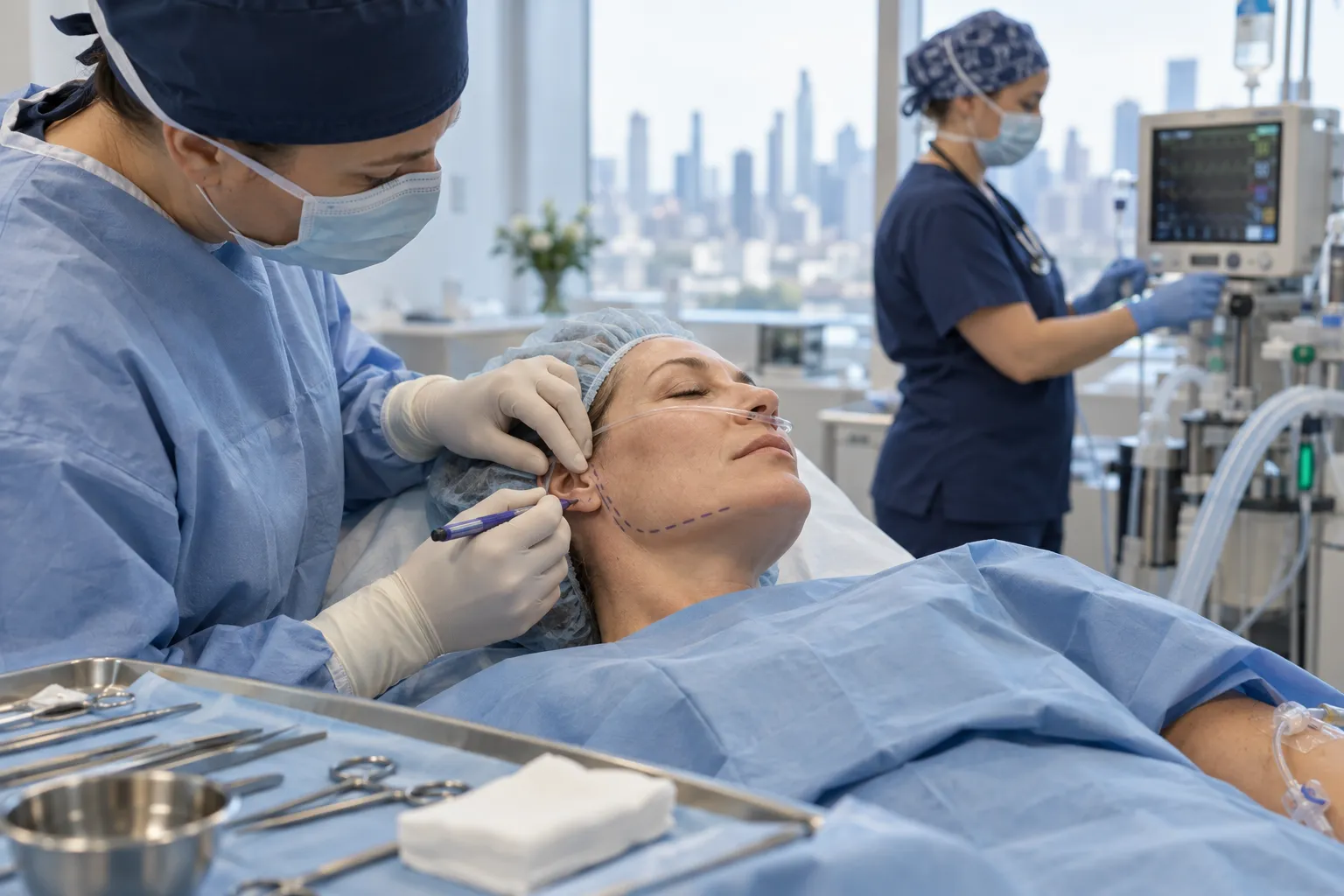
There is no single operation that every surgeon means by “mini facelift.” Technique selection depends on the tissues being treated, the planned incision, the surgeon’s approach, and the patient’s health and preferences. During consultation, ask the surgeon to describe the proposed steps in plain language, explain how they address your concerns, and identify what limitations may remain.
Short-Scar and MACS Techniques vs. SMAS Plication
Short-scar describes an incision pattern with a more limited scar, while MACS refers to a particular approach to lifting and supporting facial tissues. SMAS plication describes folding and securing the superficial musculoaponeurotic system, a supportive layer beneath the skin. These terms describe different elements of surgical planning, not interchangeable promises of a result. Ask which tissues the surgeon intends to address, why that approach fits your anatomy, and how it may affect the areas you hope to change.
Where Incisions Are Placed (and How Scarring Is Minimized)
Incisions are commonly planned around the ear and nearby hairline, with placement adjusted to the operation and individual anatomy. A surgeon may consider natural creases and hair-bearing areas, but surgery can leave scars whose visibility varies during healing. Follow the wound-care instructions provided by your surgical team, and discuss factors that may affect healing or scar appearance before proceeding. No incision pattern can guarantee an invisible scar.
Local vs. General Anesthesia: What to Expect
Anesthesia planning depends on the procedure, the patient’s health, and the surgical team’s assessment. Some facelift techniques may use local anesthesia, while other plans use general anesthesia. Dr. Albert’s Nanolift™ page describes his proprietary technique with awake local anesthesia; this should not be assumed to apply to every Mini Facelift or every patient. Ask who will provide anesthesia, what monitoring is used, and which option is appropriate for your planned operation.
Mini Facelift Recovery in New York: A Week-by-Week Timeline
Recovery after a Mini Facelift varies with the surgical plan, individual healing, and the work or activities a patient hopes to resume. A general recovery estimate is 7 to 14 days, and many patients return to work after about a week. This is a planning guide, not a promise: bruising, swelling, tenderness, and fatigue can affect timing. Before surgery, ask the surgical team for written instructions and a recovery plan tailored to your procedure and health.
Days 1-7: The First Week After Surgery
During the first days, prioritize rest and follow your surgeon’s care instructions. Swelling and bruising may be most noticeable early in recovery, and the face may feel tight or tender. Keep follow-up appointments so your team can assess healing and answer questions. Do not drive or resume other activities until your clinician says it is appropriate. Early swelling can change how the face looks, so this period is not a reliable time to judge the final appearance.
Weeks 2-4: Returning to Work, Exercise, and Social Life
During the second week, some people feel ready to resume desk work and low-demand routines, while visible bruising or swelling may remain. Timing depends on healing and the demands of your job. Increase activity only according to your surgeon’s instructions. Strenuous exercise, heavy lifting, and activities that raise blood pressure may need to wait for your clinician’s approval. By weeks three and four, many patients are gradually returning to more of their usual schedule, though recovery can take longer for some people.
Tips for a Smoother, Less Noticeable Recovery
Plan ahead for time away from work, transportation, and support at home. Follow directions for incision care and activity, and contact your surgical team if you are uncertain about a symptom or instruction. Do not apply products to healing incisions unless your clinician approves them. Seek urgent medical care for severe or rapidly worsening symptoms, such as difficulty breathing, chest pain, or sudden significant swelling. For other concerning changes, contact your surgeon promptly rather than waiting for a routine appointment.
How Much Does a Mini Facelift Cost in New York City?
The cost of a Mini Facelift in New York City depends on the planned operation, surgeon’s fee, facility, anesthesia, and the care included before and after surgery. No single price applies to every patient, and a brief online estimate may not reflect an individualized plan. Request a written quote after consultation, with each fee identified, to understand the full expected expense before deciding.
NYC Price Ranges and What’s Included
The American Society of Plastic Surgeons reported an average U.S. This is a national average for facelift surgery, not a current New York City quote or a specific Mini Facelift price. Ask whether a proposal includes preoperative visits, the operating facility, anesthesia, follow-up care, and routine recovery supplies. Confirm which charges are separate and how the practice handles unexpected needs. A clear estimate lets you compare the total planned cost rather than a headline fee alone.
Cost Breakdown Table: Surgeon, Facility, Anesthesia Fees
Each cost category can vary with the surgical plan and setting. The table identifies common items to ask about; it does not assign fees or establish a standard New York price. Request an itemized estimate from the practice where your surgery would take place, and ask whether fees are due at different stages of care.
| Cost category | What to be clear |
|---|---|
| Surgeon’s fee | Which surgical services and follow-up visits are included? |
| Facility fee | What facility services and operating-room costs are listed? |
| Anesthesia fee | Who provides anesthesia, and how is the fee calculated? |
| Other charges | Are consultations, tests, or recovery-related items billed separately? |
Financing and Payment Options
Payment arrangements differ by practice and financing provider. Ask whether payment is due in full before surgery, whether installment plans are available, and what interest, fees, or eligibility requirements apply. Review the written terms, including the payment schedule and cancellation policy. Financing does not replace a discussion of whether surgery is medically appropriate or financially manageable. Consider the full cost and your recovery plans before deciding whether to proceed.
Choosing the Best Mini Facelift Surgeon in New York: Risks, Questions, and Credentials

Choosing the Best Mini Facelift in New York means looking beyond a procedure name or polished before-and-after images. Confirm that the surgeon is certified by the American Board of Plastic Surgery, performs facelift surgery, and can explain how the proposed plan fits your facial anatomy and goals. You can ask to review photographs of patients with concerns similar to yours, while keeping in mind that individual results vary. A thoughtful consultation should cover realistic limits, possible risks, recovery planning, and your questions without pressure to schedule surgery.
Why Board Certification and Facelift Experience Matter
Board certification in plastic surgery indicates specialty training and examination by the relevant board; it does not guarantee a particular outcome. Ask about the surgeon’s training, facelift experience, and approach to patient safety. Dr. Mark Albert is certified by the American Board of Plastic Surgery and is a Fellow of the American College of Surgeons. He completed plastic surgery residency and chief residency at the University of Massachusetts Medical School, followed by an aesthetic plastic surgery fellowship at Manhattan Eye, Ear, and Throat Hospital. He is Program Director of the MEETH Aesthetic Plastic Surgery Fellowship and an Assistant Clinical Professor of Surgery at the Zucker School of Medicine at Hofstra/Northwell.
Risks and Limitations of a Mini Facelift
A Mini Facelift is surgery. Risks can include bleeding, infection, visible or unfavorable scarring, changes in skin sensation, asymmetry, wound-healing problems, and anesthesia-related risks. The specific risks depend on personal health and the surgical plan. A limited facelift may not address more extensive facial or neck changes, and results cannot be not assured. Discuss your medical history, medications, healing concerns, and whether your goals may call for a different plan. Your surgeon should explain how risks are managed and which symptoms require prompt medical attention.
Checklist: Questions to Ask During Your Consultation
Use the consultation to understand the proposed operation and the care surrounding it. A title or a single photograph cannot establish which Mini Facelift is right for an individual. Look for clear answers about qualifications, risks, facility arrangements, and follow-up.
- What changes can this plan address, and what concerns may remain?
- Why do you recommend this technique for my anatomy and goals?
- What are the material risks in my case, and how are complications handled?
- Who provides anesthesia, and where will surgery take place?
- What follow-up care is included, and whom should I contact with concerns?
- May I review relevant before-and-after photographs and discuss their limitations?
Why Patients Choose Dr. Mark Albert for Facelift Surgery
People researching the Mini Facelift can review Dr. Albert’s approach and credentials before deciding whether to request an appointment. His training, board certification, fellowship leadership, and academic teaching provide context for a personal discussion, not a guarantee of results or suitability. Ask how the recommended operation would address your priorities, what tradeoffs it involves, and which other options within facelift surgery may be appropriate. To discuss your goals, you can request a facelift consultation with Dr. Mark Albert. Candidacy and planning require an individualized clinical assessment.
Frequently Asked Questions
Is a mini facelift worth the money?
A mini facelift may be worthwhile for someone with mild lower-face laxity whose goals fit the procedure's limited scope. Value depends on your anatomy, expectations, and the surgeon's plan, so an in-person consultation with a qualified clinician like Dr. Mark Albert is the best way to determine whether it suits you.
How much does a mini facelift cost in New York?
Mini facelift costs in New York vary by surgeon, technique, anesthesia, and facility fees, and published price ranges may not reflect your individualized surgical plan. The most accurate estimate comes from a consultation, where the surgical team can review your anatomy and goals and provide specific cost information.
How long is recovery after a mini facelift?
General recovery after a mini facelift is often estimated at 7 to 14 days, and many patients plan to return to work after about a week. Swelling, bruising, tenderness, and individual healing can affect this timing, so your recovery plan should come from your surgical team, not a generic timeline.
Is a mini facelift as good as a full facelift?
A mini facelift and a full facelift address different degrees of facial aging, so neither is inherently better. A mini approach may suit milder lower-face changes, while a full facelift may address more extensive laxity in the lower face and neck. The right choice follows an examination of your facial structure and skin.
Is a mini facelift done under local or general anesthesia?
Anesthesia for a mini facelift depends on the planned technique, your health, and your surgical team's assessment. Some approaches may use local anesthesia, while others use general anesthesia. During consultation, ask who will provide anesthesia, what monitoring is used, and which option is appropriate for your specific procedure.
Will a mini facelift fix my neck?
A mini facelift is a more limited procedure and may not address significant neck laxity to the same extent as a broader surgical plan. If neck changes are a primary concern, discuss this openly during consultation, as your anatomy and goals may call for a different or more comprehensive approach.
How do I choose the best mini facelift surgeon in New York?
Choosing a mini facelift surgeon starts with verifying board certification, such as certification by the American Board of Plastic Surgery, along with training, fellowship leadership, and experience in facelift surgery. Look for a surgeon who explains techniques in plain language, discusses limitations honestly, and bases the plan on an in-person assessment rather than procedure names.
Leave a Reply