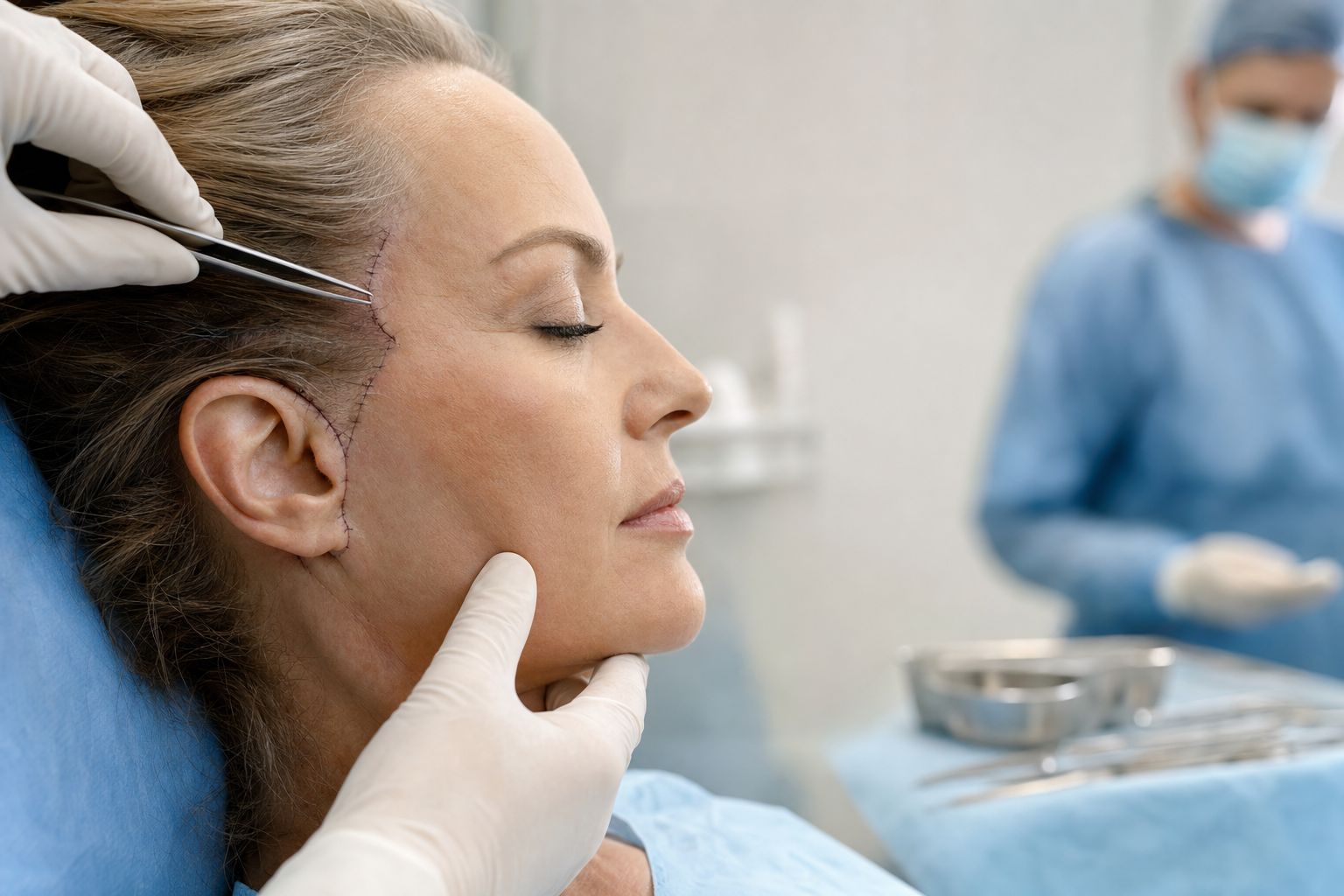
deep plane facelift stitches
Quick answer: deep plane facelift stitches may include both dissolvable sutures beneath the skin and removable sutures or staples at the incision, depending on the surgeon’s closure plan. Deeper sutures support repositioned facial tissue, while superficial sutures bring the skin edges together. Removal timing varies with incision location, healing progress, suture material, and individual instructions. The operating surgeon’s examination and postoperative protocol take priority over generalized online guidance.
Key Takeaways
- Deep plane facelift closures generally involve two layers: dissolvable sutures beneath the skin that hold repositioned facial tissue in its new position, and removable sutures or staples that align the visible incision.
- The deeper sutures perform the structural work of the lift, while the surface stitches simply fine-tune how the skin edges come together during healing.
- Surface stitches are often removed within one to two weeks after surgery, though the exact timing depends on the incision location, the suture material, and how well the tissue is healing.
- Sutures that dissolve on their own spare patients an office visit, but many surgeons still prefer removable stitches at the incision line for the cleanest possible scar.
- Your own surgeon's postoperative schedule always outweighs general timelines found online, since healing varies from patient to patient.
Deep Plane Facelift Stitches: A Direct Answer on Types, Placement, and Removal Timing
A facelift closure is usually planned in layers rather than as one continuous row of visible thread. Deep support sutures may be placed below the skin to help hold lifted tissue in its planned position. Skin sutures may be dissolvable or removed during follow-up visits. Small staples can sometimes be used in hair-bearing scalp, based on the surgeon’s preference and the incision design. Stitch removal is generally a brief office-based step, though individual comfort and healing vary.
Are Deep Plane Facelift Stitches Dissolvable, Removable, or Both?
Both types may be used. Absorbable sutures are designed to break down gradually within the body and can support tissue during early healing. Nonabsorbable sutures may be selected for certain deeper structures or skin closure and can require removal. A surgeon may also use different materials in different areas because the scalp, hairline, ear, and postauricular skin have different movement, thickness, and visibility concerns.
There is no universal stitch count or removal date. The plan depends on the extent of surgery, skin quality, incision tension, medical history, and the appearance of the wound at follow-up. A stitch that remains beneath the surface is not the same as a visible skin stitch, and dissolvable does not mean that a suture is immediately invisible.
Deep Support Sutures vs. Removable Skin Sutures vs. Staples: What Each Layer Does
Each closure material serves a different purpose. Deep support sutures help secure soft tissue beneath the skin, reducing the amount of strain placed directly on the external incision. Superficial sutures align the skin edges with care, while staples can provide efficient closure in selected scalp areas. The material, number, and placement are technical decisions made during individualized surgical planning.
| Closure type | Likely location | Primary purpose | Typical management |
|---|---|---|---|
| Deep absorbable sutures | Below the skin, near repositioned tissue | Support the deeper closure and distribute tension | Gradually absorbed; follow-up still evaluates healing |
| Removable skin sutures | Selected portions of the hairline or ear incision | Precisely align the skin edges | Removed according to the surgeon’s examination |
| Scalp staples | Hair-bearing scalp, when selected | Secure a scalp incision efficiently | Removed during a planned postoperative visit |
Where Stitches Are Placed: Common Incision Zones at the Hairline, Temple, Ear, and Behind the Ear
Incision placement varies by anatomy, hairline position, skin laxity, and the surgeon’s approach. Common zones include the temporal or hairline region, the area in front of or within the natural contours of the ear, around the earlobe, and behind the ear. Some plans continue into the hair-bearing scalp to address tissue movement and closure requirements. The exact route is designed to balance access, tissue repositioning, hairline preservation, and scar visibility.
- Hairline or temple: May provide access while accounting for hair direction and sideburn position.
- Ear region: Follows natural folds when possible, with attention to the tragus and earlobe.
- Behind the ear: May extend into the postauricular crease or scalp based on the amount of tissue requiring repositioning.
- Hair-bearing scalp: May contain staples or sutures when the closure reaches this area.
Why Deep Plane Closure Uses Layers, and How Stitch Care Differs Across Facelift Techniques
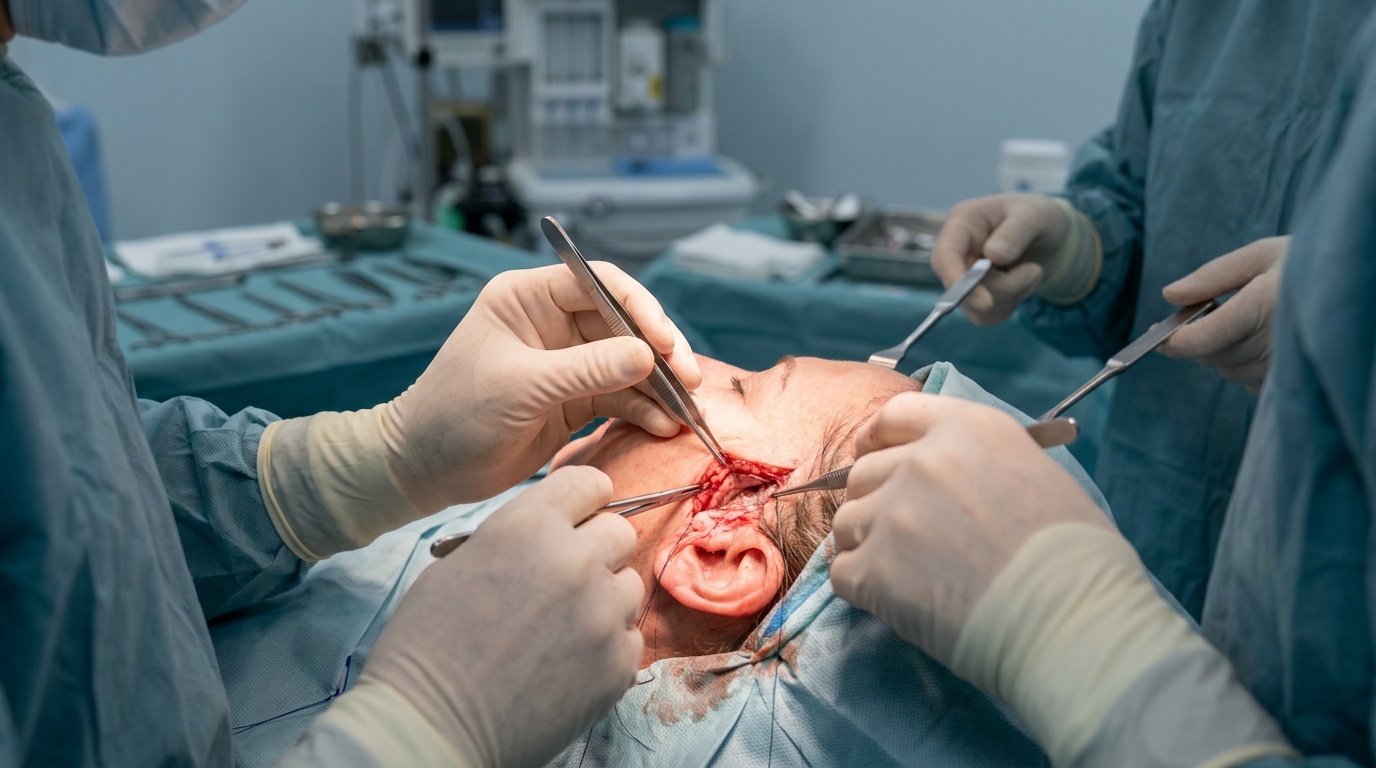
The Role of Deeper Support Sutures in a Tension-Free Deep Plane Closure
A deep plane facelift repositions selected layers beneath the skin, so closure may involve more than the visible incision. Deeper support sutures can help carry tension within the underlying tissue rather than placing all force on the skin edges. This layered method may influence how the incision settles, but it does not guarantee a particular scar, healing speed, or aesthetic result. Bruising, swelling, numbness, skin quality, nicotine exposure, and medical conditions can all affect recovery.
How Incision Design and Stitch Plans Vary by Surgeon, Anatomy, and Hairline
There is no single pattern suitable for every face. A surgeon considers facial structure, neck laxity, hairline shape, sideburn location, skin elasticity, prior scars, and the degree of tissue movement planned. These factors influence incision length, closure layers, suture selection, and whether staples are appropriate. The technique and recovery plan require individualized clinical assessment rather than selection based on stitch appearance alone.
Deep Plane, Mini Facelift, and Nanolift™: High-Level Differences in Incisions, Stitch Needs, and Recovery Variability
Deep plane surgery may involve broader tissue repositioning and a layered closure. A Mini Facelift may use a more limited incision plan when appropriate for the patient’s anatomy and treatment goals. Nanolift™ uses its own individualized planning considerations. None is automatically best for every person, and incision extent does not by itself predict scar quality or recovery. Learn more through the Deep Plane Facelift and facelift surgery service information.
| Technique | Closure planning consideration | What varies |
|---|---|---|
| Deep Plane Facelift | Layered support may be used with broader tissue repositioning | Incision route, external sutures, swelling, and follow-up needs |
| Mini Facelift | More limited access may be suitable for selected anatomy | Extent of lifting, stitch placement, and recovery experience |
| Nanolift™ | Closure follows the specific surgical plan | Incision design, suture materials, and postoperative instructions |
Myth vs. Reality: Stitches, Scars, Dissolvable Sutures, and the One-Week Photo Trap
- Myth: Stitches and scars are the same thing. Reality: Sutures close an incision; a scar is the body’s longer-term healing response.
- Myth: Dissolvable sutures cannot be seen. Reality: A small end, knot, bump, or suture reaction can still occur.
- Myth: Stitch removal means healing is complete. Reality: Deeper tissues and scars continue changing after external material is removed.
- Myth: A polished one-week photograph is a standard recovery benchmark. Reality: Lighting, swelling, makeup, image selection, and individual healing can make early photos unreliable for comparison.
Recovery Timeline for Deep Plane Facelift Stitches: From Surgery Day Through Scar Maturation
Surgery Day Through Day 3: Swelling, Bruising, Tightness, and Early Incision Care
During the first several days after surgery, deep plane facelift stitches are supporting tissue while the incisions begin to seal. Swelling and bruising are often most noticeable during this early phase, and the face may feel tight, numb, tender, or as though the skin is gently pulling. Small areas of dried blood or crusting can appear near the hairline, ear, or behind the ear. These findings can be unsettling, especially when viewed in a mirror, but early appearance does not predict the final result.
Incision care during this period should follow the written instructions from the operating surgeon. Those instructions may address dressing changes, cleansing, ointment, sleeping position, compression, and permitted activity. Do not pull at a visible thread, remove a crust, or adjust a dressing without guidance. Keep hands clean before touching the area, and protect the incisions from unnecessary friction. Nicotine exposure can interfere with wound healing, so the surgical team’s directions regarding smoking and nicotine should be followed carefully.
The First Follow-Up Visit: How and When Stitches Are Commonly Assessed or Removed
The first postoperative appointment allows the surgeon or clinical team to examine incision edges, swelling, bruising, drainage, skin color, and the position of any external sutures or staples. A follow-up may occur within the first several days, though timing varies according to the operation, closure materials, and the surgeon’s protocol. More than one visit is often needed because wound healing, suture management, and scar development change over time.
If removable sutures or staples are ready to come out, the process is usually performed in the office with sterile instruments. Patients may notice brief tugging, pressure, or a short-lived pinching sensation. Comfort varies, and the clinician can pause to examine the area carefully. Removal does not mean that the incision has completed healing. Deeper absorbable sutures may continue supporting tissue, while the skin remains vulnerable to stretching, friction, sun exposure, and delayed healing.
Weeks 2 to 6: Hair Washing, Makeup, Exercise, and Returning to Social Life, Following Your Surgeon’s Protocol
As the second week begins, bruising and swelling commonly improve in stages rather than disappearing at once. Numbness, firmness, tightness, and occasional pulling can remain around the cheeks, jawline, ears, and hairline. Hair washing, shampoo selection, makeup use, and care near the incision should begin only according to the surgeon’s directions. Some patients feel comfortable appearing in public before all swelling has resolved, while others prefer additional privacy during this period.
Exercise and other activities that increase blood pressure or place tension on the face may remain restricted for a period selected by the operating surgeon. A gradual return to work, social events, and normal routines depends on healing, discomfort, responsibilities, and personal comfort. A limited procedure such as a Mini Facelift may have a different incision plan and recovery protocol, yet no technique provides a universal schedule. Follow-up examinations should guide each change in activity.
Months 3 to 12: Scar Maturation, Numbness, and Why Early Appearance Is Not the Final Result
During the following months, scars often progress through normal phases of settling, softening, and color change. Areas around the ear and hairline can remain firm or sensitive, and altered sensation may improve gradually as small nerve branches recover. The pace differs among patients and can be influenced by skin characteristics, medical history, incision location, and healing behavior. Scar maturation takes substantially longer than the initial suture-removal period.
Photographs taken during the first postoperative week can be misleading. Lighting, makeup, camera angle, swelling, and selective timing may make recovery appear easier or more uniform than it feels in daily life. Early asymmetry or fullness may change as fluid resolves and repositioned tissue settles. Keep scheduled visits, protect healing skin as directed, and contact the surgical team for personalized guidance rather than judging progress against an online image.
Normal Healing vs. When to Call Your Surgeon: A Stitch-Side Checklist
Expected Sensations and Incision Changes: Tightness, Numbness, Crusting, and Small Bumps
Early healing can include tightness, numbness, mild tenderness, pulling, swelling, bruising, and temporary firmness near the incision. Small areas of crusting, dried blood, or a raised knot may also occur as the skin closes and absorbable material settles. These changes can be more noticeable around the ears, hairline, temples, and behind the ears. They often evolve gradually, so an incision may look different from one day to the next. Do not scratch, trim, pull, or try to remove a thread or crust unless the operating team directs you to do so.
Changes Worth a Call to Your Surgical Team: Redness Spreading, Drainage, a Loose Stitch, or a Separating Incision
Contact your surgical team promptly if redness expands beyond the incision, warmth or swelling increases rather than improves, drainage develops, an unpleasant odor appears, or pain becomes progressively stronger. A loose external stitch, visible suture end, wound edge that appears to separate, persistent bleeding, or delayed skin healing also deserves individualized review. These findings do not establish a complication by themselves, but they can occur with infection, hematoma, wound separation, or other healing concerns. Send photographs only through the communication method your practice provides, and follow the operating surgeon’s instructions instead of attempting home treatment.
Symptoms That Require Urgent or Emergency Care
Seek urgent medical attention for severe or rapidly worsening one-sided pain, significant asymmetric swelling, heavy bleeding that does not stop with the instructed pressure, fainting, chest pain, difficulty breathing, or sudden neurologic symptoms. If you believe an emergency is occurring, call 911 or go to the nearest emergency department, then notify your surgical team when it is safe. General education cannot assess an incision remotely. Continuity of care matters, so keep after-hours contact information accessible throughout recovery.
Consultation Questions and Surgeon Selection: Getting Clear Answers About Your Stitches and Scars

Patient Questions Answered: How Many Stitches Are Used, Does Removal Hurt, and Are Staples Used?
There is no meaningful universal stitch count. The number depends on incision length, closure layers, facial anatomy, tissue movement, and the surgeon’s technique. Ask whether your plan includes absorbable sutures, removable skin sutures, staples, or a combination. Removal is generally a short clinical step involving gentle lifting and cutting of external material, although sensation varies by person and incision location. If a stitch surfaces early, do not pull it. Contact the practice so the team can decide whether observation, trimming, or removal is appropriate.
Your Consultation Checklist: Stitch Materials, Removal Plan, Scar Placement, Wound Care, and After-Hours Contact
- Which closure materials will you use, and which ones may remain beneath the skin?
- Where will the incisions travel around the hairline, ear, earlobe, and scalp?
- Which sutures or staples require removal, and how will readiness be assessed?
- What cleansing, hair-washing, dressing, sleeping, and activity instructions apply?
- How many follow-up visits may be needed for incision checks and scar monitoring?
- Whom should I contact after hours if I notice drainage, bleeding, separation, or increasing swelling?
How to Compare Facelift Surgeons: Board Certification, Facility Accreditation, Consistent Photography, and Postoperative Availability
Look for a surgeon certified by the American Board of Plastic Surgery, operating in an appropriately accredited facility, and providing clear informed consent. Review consistent before-and-after photography rather than relying on a single highly selected image. Ask about facelift training, experience with incision planning, anesthesia arrangements, wound care, and access to postoperative evaluation. Dr. Mark G. Albert, MD, FACS, is certified by the American Board of Plastic Surgery and is a Fellow of the American College of Surgeons. He is founder and chief surgeon of Albert Plastic Surgery.
Full-Face Planning: What a Facelift Can and Cannot Address
A facelift addresses selected laxity of the face and neck, with planning based on skin quality, soft-tissue descent, facial proportions, and personal goals. It does not correct every facial concern, including brow position, eyelid changes, skin texture, or lip concerns. A Mini Facelift, Nanolift™, or Deep Plane Facelift requires its own clinical assessment. Candidacy, technique, recovery, risks, and outcomes require individualized clinical assessment.
Frequently Asked Questions
How long does it take to look normal after a deep plane facelift?
Deep plane facelift recovery often takes several weeks before swelling and bruising settle enough for a more typical appearance, though healing varies by patient. Stitches, incision location, skin quality, medical history, nicotine exposure, and the extent of tissue repositioning can affect recovery. Your surgeon should guide activity, wound care, and follow-up timing.
How are deep plane facelift scars one week after surgery?
Deep plane facelift scars may appear red, swollen, bruised, or slightly uneven one week after surgery. Incisions commonly extend around the ear, hairline, temple, or behind the ear, and visible sutures or staples may still be present in selected areas. Early appearance does not predict the final scar, so follow your surgeon’s wound-care instructions.
What are the worst days of recovery after a facelift?
Facelift recovery symptoms are often most noticeable during the first several days, when swelling, bruising, tightness, and discomfort can be more pronounced. Deep plane facelift recovery varies, and symptoms may fluctuate rather than improve in a perfectly steady pattern. Contact your surgical team promptly about worsening pain, increasing redness, drainage, fever, or other concerning changes.
How painful is a deep plane facelift?
Deep plane facelift discomfort is commonly described as pressure, tightness, soreness, or numbness, though pain levels vary among patients. Layered closure and deeper support sutures can contribute to a tight or unfamiliar sensation during early healing. Your surgeon should provide individualized instructions for comfort measures and explain which symptoms require an examination.
What is the downside of a deep plane facelift?
Deep plane facelift downsides can include swelling, bruising, temporary numbness, incision-related concerns, scarring, infection, bleeding, nerve injury, asymmetry, and the possibility of revision surgery. Recovery and results vary with anatomy, technique, health, and healing response. A consultation with a qualified plastic surgeon is needed to discuss risks and whether the approach fits your goals.
When are deep plane facelift stitches removed?
Deep plane facelift stitch removal is scheduled according to incision location, suture material, wound healing, and the surgeon’s examination. Deep absorbable sutures generally remain beneath the skin and gradually break down, while selected skin sutures or scalp staples may be removed during a postoperative visit. Do not remove or trim closure material yourself.
Can deep plane facelift stitches affect how scars heal?
Deep plane facelift stitches can help support repositioned tissue and align incision edges, yet stitch type alone does not determine scar quality. Skin tension, incision design, genetics, nicotine exposure, medical conditions, and wound care also influence healing. Your surgeon can assess the incisions and recommend care based on their appearance and your recovery.
Leave a Reply