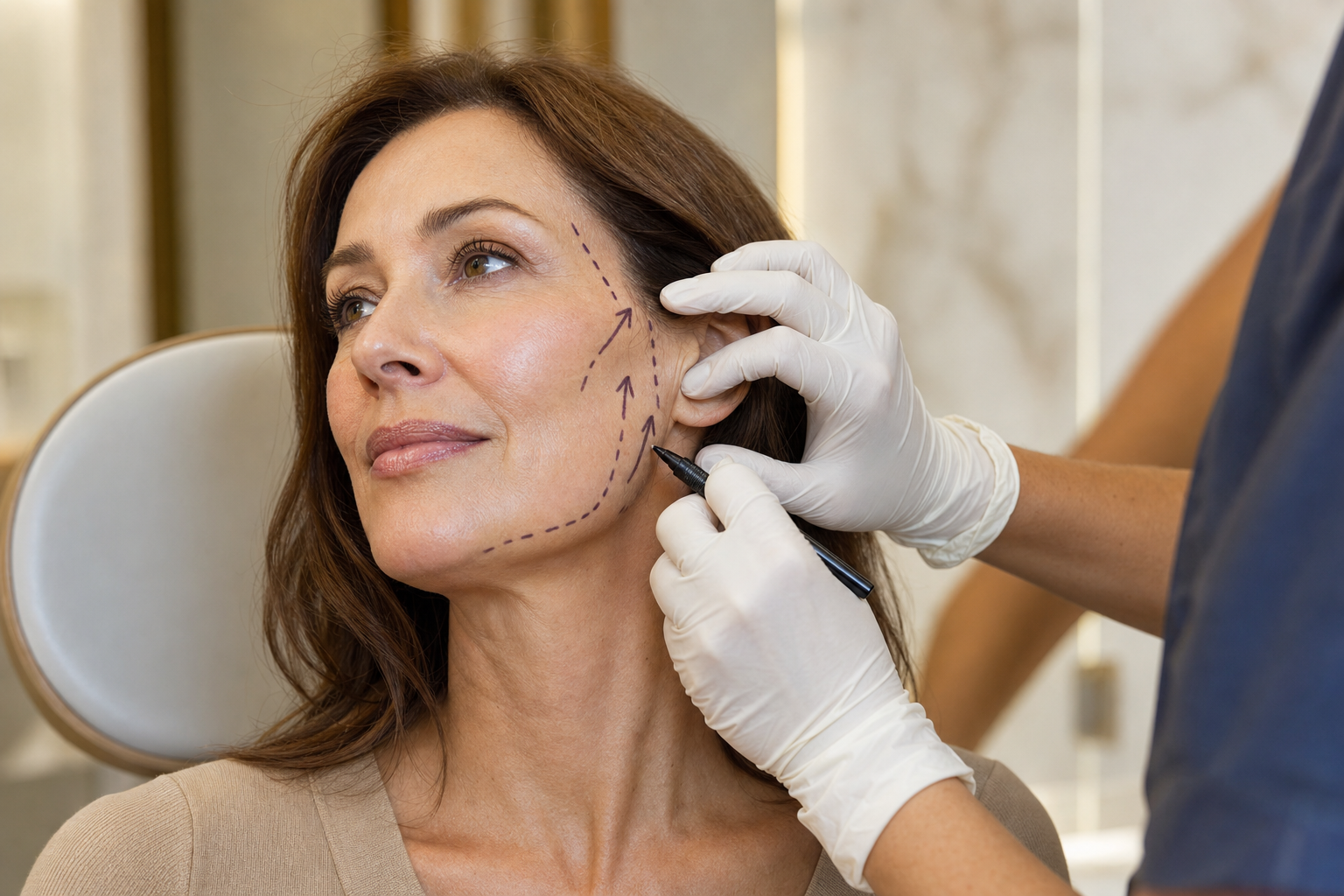
deep plane vertical facelift
A deep plane vertical facelift addresses facial aging by repositioning deeper facial tissues upward rather than relying primarily on skin tightening. The goal is to restore the relationship among the cheek, jawline, jowls, and neck while limiting skin tension. This approach may help avoid a windswept appearance, visible distortion, or artificial fullness, though candidacy and technique require an in-person evaluation.
Key Takeaways
- The deep plane technique releases and lifts tissues beneath the SMAS layer, which allows the cheek and midface to move as a unified structure instead of relying on tension at the skin level.
- A vertical vector may redirect descended tissue upward and may improve cheek contour, jawline definition, and jowls; incision and tissue movement can affect hairline or ear position depending on the operation.
- Placing the lift on deeper support layers rather than the skin itself helps results look rested and natural instead of pulled, windswept, or overly full.
- Most patients experience swelling and bruising during the first two weeks, with a gradual return to social activities and exercise over the following weeks.
- The best candidates show meaningful descent of the cheek and jawline, and an in-person examination is required to confirm that this approach matches your anatomy and goals.
Understanding the Deep Plane Vertical Facelift: A Foundation for Natural Rejuvenation
What Is a Deep Plane Vertical Facelift?
A deep plane vertical facelift mobilizes skin with the superficial muscular aponeurotic system, commonly called the SMAS, and selected deeper soft tissues. The surgeon releases retaining ligaments that tether these layers to the facial skeleton. The composite tissue envelope can then move upward with less dependence on skin traction.
“Vertical” describes the principal direction of repositioning. Aging tissues commonly descend downward and inward, producing cheek flattening, deeper folds beside the nose and mouth, jowls, and a less defined jawline. An upward vector more closely follows the direction in which youthful facial support is restored than a predominantly lateral pull.
The Evolution: From Traditional Facelifts to Vertical Deep Plane Techniques
Earlier facelift methods often focused on removing excess skin and applying surface tension. Modern deep plane surgery developed from the anatomical work of Sam Hamra, including his foundational 1990 description of deeper facial tissue mobilization. Current techniques emphasize the SMAS, facial ligaments, tissue planes, and the direction of elevation.
Terminology varies among surgeons. Deep plane, high SMAS, and vertical techniques may describe different operative plans, and the names alone do not establish how a surgeon will perform the operation. Consultation should cover the intended dissection plane, ligament release, vector, incision design, anesthesia plan, and limits of correction. At Albert Plastic Surgery, Dr. Mark G. Albert, MD, FACS, evaluates these factors individually as a board-certified plastic surgeon and Fellow of the American College of Surgeons.
Addressing the Core of Facial Aging: Beyond Skin-Deep
Facial aging involves more than loose skin. The cheek fat compartment may descend, ligament attachments may become more apparent, and the lower face may lose definition. Repositioning deeper tissues can address this structural descent more directly than skin excision alone. It does not erase every wrinkle, change skin texture, reverse sun damage, or correct all fine lines. Skin quality, facial volume, bone structure, and natural asymmetry remain relevant.
The Anatomical Blueprint: How Vertical Lifting Works

The Role of Facial Retaining Ligaments: Key Release Points
Retaining ligaments connect facial soft tissue to deeper structures and help maintain facial contours. With age, they can contribute to fixed folds and resistance to upward movement. Deep plane dissection may selectively release the zygomatic retaining ligaments in the cheek and masseteric retaining ligaments along the lower face. The composite flap can then move as a unit, reducing the need to stretch skin independently.
Ligament release requires knowledge of facial anatomy. The surgeon must account for branches of the facial nerve, the parotid region, blood supply, fat compartments, and the thickness of each tissue layer. The release pattern varies with facial structure, prior surgery, tissue descent, and the desired distribution of lift.
Sub-SMAS Dissection: Mobilizing Deeper Tissues
The SMAS is a fibrous layer connected with facial muscles and soft tissue. A sub-SMAS approach places dissection beneath this layer, allowing mobilization of tissue that a skin-only operation cannot reach. The purpose is not indiscriminate fullness, but repositioning descended tissue toward a more appropriate relationship with the cheek, nasolabial region, jawline, and neck. For an overview of the procedure, see the deep plane facelift procedure.
The Vertical Vector: Respecting Natural Anatomy and Gravity
A vertical vector directs movement upward, often supporting the midface and jowl region without concentrating force at the temples or preauricular skin. Research discussed in Facial Plastic Surgery literature has reported approximately twice the anatomical elevation in these regions with vertical vectors compared with diagonal pull vectors. This is anatomical research, not a guarantee of an individual result.
Vector selection remains individualized. A surgeon may use different directions across facial zones because the cheek, lower face, and neck do not age in precisely the same way. The objective is proportion, not maximal movement. Excessive tension or an overly uniform vector can contribute to an unnatural expression, hollowing, or distortion.
Restoring the Midface and Lower Face Architecture
As cheek soft tissue descends, the lower-eyelid-to-cheek transition may lose support, while the nasolabial fold and jowl become more pronounced. Upward mobilization can improve midface and lower-face continuity by repositioning the tissue envelope. It may also improve jawline contour when laxity is driven by descent rather than skin quality alone.
| Anatomical feature | Surface-focused lift | Deep plane vertical approach |
|---|---|---|
| Primary tissue acted upon | Skin and superficial support | Composite skin and SMAS-related tissue |
| Movement direction | Often lateral or diagonal | Predominantly upward, adjusted by facial region |
| Ligament treatment | May leave deeper tethering intact | May release selected zygomatic and masseteric attachments |
| Primary anatomical aim | Reduce visible skin laxity | Reposition descended facial architecture with less skin tension |
Patient Candidacy and Realistic Expectations for Vertical Deep Plane Facelifts
Who Is a Candidate for Vertical Deep Plane Facelift?
A vertical deep plane facelift may suit an adult with visible descent of the cheek, jowls, lower face, or neck, particularly when laxity reflects changes beneath the skin. Candidacy depends on facial anatomy, skin elasticity, medical history, prior procedures, healing capacity, and personal goals. A consultation with Dr. Mark G. Albert, MD, FACS, assesses facial balance, tissue movement, retaining ligaments, asymmetry, and structural aging. Neither age nor a photograph establishes suitability.
A more limited operation may be considered when laxity is localized. Albert Plastic Surgery maintains a dedicated Mini Facelift service page. A Mini Facelift is within the client-directed facelift scope, yet it is not automatically interchangeable with a deeper operation. Candidacy, technique, recovery, risks, and outcomes require individualized assessment.
What a Deep Plane Vertical Facelift Can Address, and What It Cannot
By releasing selected facial attachments and repositioning the deeper tissue envelope upward, this operation may improve descended cheek contours, jowls, lower-face laxity, and some nasolabial fold prominence. It can support a more defined relationship among the midface, jawline, and neck. The degree of change depends on anatomy and tissue descent. A vertical vector restores position rather than creating maximum tightness.
Surgery does not remove every fine wrinkle, correct sun damage, change skin texture, replace lost skeletal support, or stop future aging. It may not fully correct asymmetry or every crease around the mouth. Skin quality and facial volume remain separate considerations, and a qualified surgeon should explain which concerns are structural and which may remain after healing.
Distinguishing Skin Quality from Structural Aging
Structural aging involves descent of soft-tissue compartments, stretched ligamentous support, and changes in facial contour. Skin aging involves thinning, reduced elasticity, pigmentation, rough texture, and fine lines. Deep tissue repositioning addresses structural change more directly. Skin with limited elasticity may still show residual creasing after redraping, and removing additional skin does not necessarily restore youthful facial architecture.
Setting Realistic Expectations: Avoiding Distortion and Unnatural Fullness
A natural result depends on proportion, measured movement, and appropriate skin redraping. Excessive lateral traction can create a pulled or windswept appearance, while indiscriminate fullness can look unlike the patient’s normal anatomy. Vertical repositioning respects facial support, but it does not eliminate risks of contour irregularity, asymmetry, nerve injury, scarring, bleeding, infection, or an unsatisfactory result.
Potential Benefits and Limitations
Pros
- Addresses selected deeper tissue descent rather than relying only on skin tension.
- May improve cheek, jowl, and jawline relationships through upward repositioning.
- Can support a proportionate appearance when the vector matches the patient’s anatomy.
Cons
- Does not erase all wrinkles, skin damage, or texture changes.
- Requires detailed anatomical evaluation and an individualized surgical plan.
- Involves operative risks, visible healing, swelling, scarring, and variable outcomes.
The Surgical Journey and Recovery: What to Expect
The Consultation Process: Personalized Planning
The consultation makes the plan specific to your anatomy. Dr. Mark G. Albert, MD, FACS, reviews facial proportions, skin elasticity, soft-tissue descent, asymmetry, hairline position, and the relationship among the cheek, jawline, and neck. Medical history, prior facial surgery, medications, nicotine exposure, and healing factors also require discussion. Photographs and examination help determine whether a deep plane operation, a Mini Facelift, or another facelift treatment plan is appropriate. Candidacy, technique, recovery, risks, and outcomes require individualized clinical assessment.
Ask which tissue plane the surgeon expects to enter, which retaining ligaments may require release, and how the vertical vector will adapt to your face. Request information about incision placement, anesthesia, facility arrangements, postoperative supervision, scar care, activity restrictions, and warning signs. A sound recommendation addresses your concerns without promising a particular result.
Surgical Procedure Overview: Incisions, Dissection, and Closure
Facelift incisions are typically designed around natural contours near the temple, ear, and hairline, with the pattern adjusted for anatomy and planned tissue movement. The surgeon elevates the skin, accesses the selected deeper plane, releases appropriate attachments, and repositions tissue upward. Skin is redraped without excessive traction, and redundant skin is managed conservatively. Layered closure supports contour and reduces strain on skin edges. Incisions may fade substantially, though scars remain permanent and are affected by skin type, tension, and healing.
Post-Operative Recovery: A Detailed Timeline
Recovery varies with dissection, tissue response, general health, and postoperative instructions. Early swelling, tightness, bruising, numbness, and uneven appearance can change considerably during healing. Your surgical team should provide individualized instructions rather than a generic schedule.
| Recovery phase | Common considerations | Patient priorities |
|---|---|---|
| First several days | Swelling, bruising, tightness, fatigue, and temporary numbness | Follow wound-care instructions, rest, keep scheduled evaluations, and report concerning changes |
| First few weeks | Bruising generally settles, while firmness and altered sensation may persist | Gradually resume activities only when cleared and protect healing incisions |
| Following months | Swelling continues to refine, scars mature, and facial sensation may normalize gradually | Attend follow-up visits and allow tissues time to settle before judging the result |
Managing Swelling and Bruising: Navigating the Early Stages
Sleep positioning, activity limits, incision care, and prescribed follow-up are central to early recovery, but instructions differ by surgeon and operation. Do not add medications, supplements, compression, or topical products without direct guidance. Contact the surgical team promptly for increasing pain, spreading redness, drainage, fever, sudden one-sided swelling, shortness of breath, or any concerning symptom. Early tightness and photographs do not represent the settled outcome.
Long-Term Healing and Final Results
Facial tissues mature gradually. Firmness, numbness, scar coloration, and small contour differences may improve over an extended healing period. Follow-up visits assess incision quality, nerve function, swelling, and facial balance. Aging continues after surgery, and the operation cannot prevent future changes or correct every aspect of skin quality. The appropriate recommendation matches the location of structural descent, skin condition, and your willingness to accept surgery, recovery, scarring, and uncertainty. A Mini Facelift may suit selected, localized laxity, while deeper correction requires a different assessment and operative plan.
Frequently Asked Questions
Is a deep plane facelift the same as a vertical facelift?
A deep plane facelift and a vertical facelift are related terms, but they do not always describe the same operation. Deep plane refers mainly to the tissue plane and ligament release, while vertical describes the primary direction of elevation. Surgical details vary, so consultation should address the planned dissection, vector, and areas of correction.
Is a deep plane facelift available in the USA?
A deep plane facelift is available in the United States, including through Albert Plastic Surgery in New York City with Dr. Mark G. Albert. The procedure is not a single standardized operation, and technique, anesthesia, risks, recovery, and candidacy require an individualized clinical evaluation before surgery.
What are the cons of a deep plane facelift?
The potential disadvantages of a deep plane facelift include a more involved operation, swelling and bruising, scarring, temporary or lasting changes in sensation, asymmetry, infection, bleeding, nerve injury, and an outcome that may not match expectations. Deep plane surgery also does not correct every wrinkle, skin-quality concern, or volume change.
Does a deep plane facelift really last 10 years?
A deep plane facelift may provide long-lasting improvement, but no surgeon can guarantee that results will last exactly 10 years. Continued aging, sun exposure, genetics, weight changes, skin quality, and the surgical plan affect durability. Follow-up procedures or nonsurgical treatments may be considered as facial changes continue.
What is the best age to have a deep plane facelift?
The best age for a deep plane facelift depends on facial aging, tissue descent, skin quality, health, and personal goals rather than a fixed number. Candidates commonly seek treatment when cheek descent, jowls, or neck laxity become bothersome. Dr. Albert determines suitability through an in-person examination and discussion of risks.
How is a deep plane vertical facelift different from a mini facelift?
A deep plane vertical facelift repositions selected deeper facial tissues with an upward vector, while a mini facelift generally addresses a more limited degree or location of laxity. The procedures are not automatically interchangeable. Albert Plastic Surgery offers both options, and the appropriate operation depends on anatomy, aging patterns, goals, and clinical assessment.
What does a deep plane vertical facelift not correct?
A deep plane vertical facelift primarily addresses descended facial tissues, cheek position, jowls, and selected jawline or neck concerns, but it does not erase every wrinkle or reverse sun damage. Fine lines, skin texture, facial volume, bone structure, and asymmetry may require separate consideration, and outcomes vary among patients.
Leave a Reply