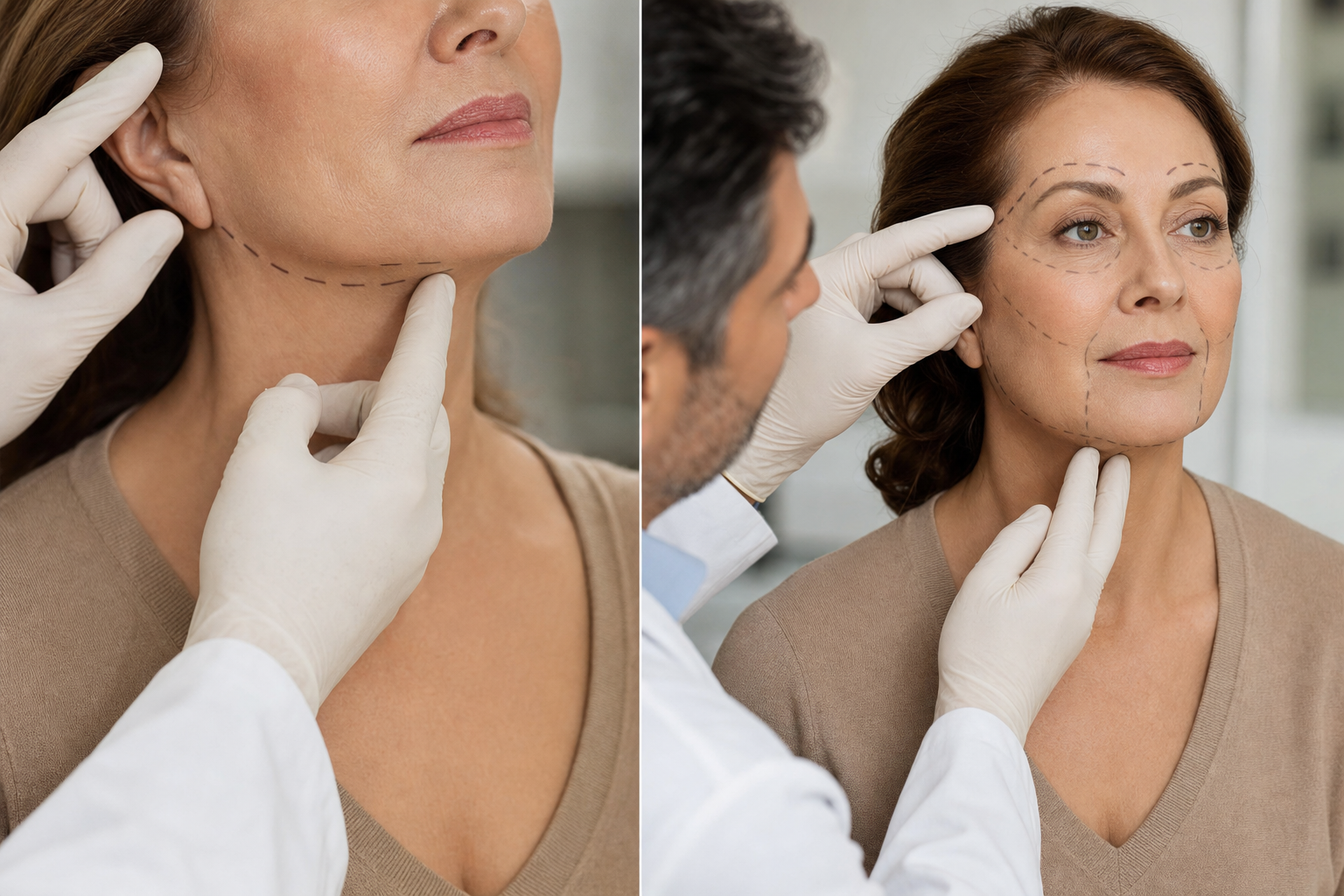
difference between mini facelift and full face lift
The difference between mini facelift and full face lift depends on the location and degree of facial laxity, the tissues requiring support, and the result a patient hopes to achieve. A mini facelift may provide focused improvement for early jowling or limited lower-face laxity, while a traditional or deep plane facelift may address more extensive changes across the cheeks, jawline, and neck. Age alone does not determine the appropriate choice.
This comparison is general education, not individualized medical advice. At Albert Plastic Surgery, Dr. Mark G. Albert, MD, FACS, reviews facial anatomy, skin quality, soft-tissue descent, and personal goals before recommending a surgical plan. Dr. Albert is certified by the American Board of Plastic Surgery and is a Fellow of the American College of Surgeons.
Understanding Facelift Differences: Mini vs. Full, and Beyond
A Concise Answer: What Sets Facelifts Apart?
A mini facelift generally uses a more limited approach to improve selected areas of the lower face. It may suit early jowls, mild cheek descent, or modest skin laxity. A full facelift typically offers broader access and more extensive repositioning of facial tissues for pronounced laxity, deeper folds, or changes extending toward the jawline or neck. The difference between mini facelift and full face lift includes treatment area, incision design, tissue support, recovery demands, and the degree of visible change possible.
Why “Mini” and “Full” Aren’t Always Standardized
“Mini facelift” and “full facelift” describe procedures rather than universally defined operations. Surgeons may use different incision patterns, tissue planes, suspension methods, and definitions. One surgeon’s mini facelift may involve more tissue work than another surgeon’s limited lift. Consultation should explain the facial zones treated, deeper layers repositioned, incision placement, and concerns outside the operation’s scope.
The Core Goal: Addressing Facial Aging with Precision
Facelift surgery addresses structural signs of aging, including descended cheek tissue, jowling, loose facial skin, and reduced jawline definition. It does not stop future aging, change every facial feature, or guarantee a particular appearance. Natural-looking surgery respects facial proportions and avoids excessive tightness. The question is which operation fits the patient’s anatomy without treating areas that do not require surgery.
How We Evaluate Facelift Options for Your Unique Anatomy

Our Approach: Anatomy, Goals, and Realistic Outcomes
Facelift planning begins with an in-person examination rather than a procedure name. I assess cheek position, nasolabial and marionette folds, jowls, skin elasticity, facial volume distribution, and the relationship between the lower face and neck. We discuss how much change feels appropriate. Someone seeking subtle improvement may have different priorities from someone concerned about substantial tissue descent.
Key Factors in Surgical Planning: Beyond Age
Age is only one part of the assessment. Genetics, sun exposure, weight stability, skin behavior, bone structure, prior facial surgery, general health, and healing history can influence the plan. The difference between mini facelift and full face lift becomes clearer when these factors are considered together. A shorter operation or smaller incision is not automatically better if it cannot address the patient’s concerns.
Consultation Essentials: What to Discuss with Your Surgeon
A useful consultation should allow time for examination, questions, and discussion of limitations. Patients may wish to ask:
- Which areas of my face show laxity, and which areas would the proposed lift treat?
- What tissue layers would be repositioned, and why is that approach appropriate for my anatomy?
- Where would incisions be placed, and how might scars mature?
- What recovery restrictions, swelling, bruising, and follow-up care should I anticipate?
- Which changes are realistic, and which concerns would remain after surgery?
- What are the material risks, limitations, and reasons the plan might need to change?
Candidacy, technique, anesthesia, recovery, risks, and outcomes require individualized clinical assessment. A qualified, board-certified plastic surgeon should explain these details directly and provide continuity of care before and after surgery.
Comparing Your Facelift Choices
Mini Facelift: Focused Improvement for Specific Concerns
Best for: selected patients with early or limited lower-face laxity, mild jowling, or modest loss of jawline definition.
Mini Facelift is directly within the client-directed facelift scope. It may use shorter incisions and a focused treatment area, though technique varies. Neck laxity, significant loose skin, and advanced descent may not be adequately addressed through a limited approach. The goal is proportional improvement, not simply the smallest operation.
The Traditional Facelift: Addressing Broader Signs of Aging
Best for: patients with established laxity involving the cheeks, lower face, jowls, and jawline.
A traditional facelift generally permits broader access to facial tissues and more comprehensive skin redraping. The surgeon may work with deeper supporting structures rather than relying on skin tension alone. This can suit aging that is not confined to one region. Careful planning aims to preserve facial movement, expression, and individual character without creating a tight or excessive appearance.
Full Facelift with Neck Lift: Comprehensive Rejuvenation
Best for: patients whose aging extends from the midface and jawline into the neck.
When the neck shows meaningful skin laxity or weakened contour, a broader facelift plan may include that region. Neck work depends on anatomy and goals. Patients should ask whether the operation addresses the transition from cheek to jawline to neck, rather than assuming every operation called “full” includes the same areas.
Deep Plane Facelift: Advanced Tissue Mobilization
Best for: selected patients whose facial aging may benefit from repositioning deeper soft-tissue layers as a connected unit.
A Deep Plane Facelift involves a specific anatomic plane beneath selected facial retaining structures. Mobilizing deeper tissues may redistribute descent with less dependence on skin traction. This is an advanced technique, not a universal upgrade or automatic solution. Anatomy, surgeon training, tissue laxity, and desired change determine whether it is appropriate.
Nanolift™: A Refined Approach within Our Practice
Best for: carefully selected patients seeking a focused facelift approach based on their pattern of early aging.
Nanolift™ and a mini facelift should not be selected by name alone. Within our practice, Nanolift™ refers to a refined approach planned around anatomy and the degree of correction needed. Its scope, tissue work, and expected recovery require direct discussion. The deciding factor is an accurate examination and a realistic understanding of what facelift surgery can and cannot accomplish.
Facelift Procedure Comparison: Key Differences at a Glance
The difference between mini facelift and full face lift is most apparent in treatment area, tissue support, incision pattern, and recovery. A limited operation may suit localized laxity, while a broader facelift may fit descent affecting the cheeks, jawline, and neck. Since procedure names are not standardized, the table offers a general framework rather than a substitute for examination.
Treatment Areas and Tissue Work
A Mini Facelift commonly concentrates on the lower face, including early jowling and mild jawline definition loss. It may not provide enough access for substantial neck laxity or extensive loose skin beneath the chin. A traditional facelift addresses a broader lower face and may reposition supporting tissues. A Deep Plane Facelift uses a deeper plane in selected patients, while Nanolift™ is planned within Albert Plastic Surgery according to the individual pattern of aging.
Incision Placement and Scarring
Incisions vary with technique, skin laxity, hairline and ear anatomy, and neck treatment. A mini approach may use a more limited incision, though a shorter scar does not necessarily mean a simpler operation or better result. Broader lifts require access for safe tissue repositioning and skin redraping. Scars are permanent marks that generally mature over time; their appearance reflects healing biology, placement, tension, and aftercare.
Recovery Expectations and Downtime
Recovery depends on dissection, tissue-plane technique, anesthesia, healing, and daily demands. A focused lift may involve less swelling or a shorter interruption of routine for some patients, but this cannot be assumed. Comprehensive surgery can produce more bruising, swelling, tightness, and temporary sensory changes. Patients should plan for follow-up, activity restrictions, incision care, and a gradual return to work and social activities.
Longevity and Continued Aging
The visible benefit of any facelift changes as normal aging continues. Skin quality, genetics, sun exposure, weight fluctuations, and degree of correction influence later changes. A broader operation may address more extensive laxity, while a limited lift may suit localized concerns. Neither stops aging or guarantees permanence. The key question is whether tissue correction matches current anatomy and long-term expectations.
Potential Risks and Limitations
Risks include bleeding, infection, adverse scarring, delayed healing, sensory changes, asymmetry, contour irregularity, hair or skin changes, nerve injury, revision surgery, and anesthesia or medical complications. A mini facelift is not automatically lower-risk because its incision or treatment area is smaller, and a full facelift is not inherently unnatural when appropriately planned. Candidacy, technique, recovery, risks, and outcomes require individualized clinical assessment.
| Consideration | Mini Facelift | Traditional or Full Facelift | Deep Plane Facelift | Nanolift™ |
|---|---|---|---|---|
| Typical scope | Focused lower-face laxity and early jowling | Broader cheek, jawline, and lower-face aging | Selected patterns requiring deeper tissue mobilization | Refined, anatomy-specific correction within the practice |
| Neck concerns | May be limited for substantial neck laxity | May address the neck when included in the surgical plan | Neck treatment depends on the overall design | Scope is determined during consultation |
| Incision and tissue work | Often more limited, with technique variation | Broader access and skin redraping | Work through a deeper facial plane | Focused approach selected for the patient’s anatomy |
| Recovery considerations | May involve less extensive swelling, not not assured | More areas may require healing and observation | Recovery varies with tissue mobilization and extent | Individualized expectations and follow-up |
Making Your Informed Decision: What Matters Most

When a Mini Facelift May Be Considered
A mini facelift may suit aging concentrated in the lower face, with early jowling, mild laxity, or limited jawline definition loss. It may be reasonable for focused correction when the neck and midface do not require broader treatment. A shorter incision or limited operation is not automatically right; the lift must adequately support the treated tissues.
When a Traditional or Deep Plane Facelift Might Be Appropriate
A traditional facelift or Deep Plane Facelift may suit widespread descent involving the cheeks, lower face, jowls, and possibly neck. Choice depends on tissue plane, skin elasticity, retaining ligaments, facial proportions, and desired change. The difference between mini facelift and full face lift is best evaluated through these anatomic details, not presumed age or a wish for the least extensive procedure.
The Role of Combined Procedures
When aging extends across connected areas, a plan may address more than one region in the same operation. Patients should ask which areas are included, why each is treated, and how the plan affects anesthesia, incision care, swelling, activity restrictions, and follow-up. Combined treatment must reflect medical history, safety, and clear understanding of the tradeoffs.
Understanding Realistic Expectations and Limitations
Facelift surgery can reposition descended soft tissue and remove or redrape selected loose skin. It cannot stop aging, correct every concern, or guarantee a specific appearance. A natural result should remain consistent with anatomy and expression. Scars, swelling, altered sensation, asymmetry, and possible residual laxity should be discussed before consent.
Navigating Post-Procedure Care and Long-Term Results
Recovery requires incision care, examinations, activity limits, and patience as swelling settles. Instructions vary with the operation and healing pattern. Long-term results also reflect genetics, skin behavior, sun exposure, weight changes, and continued aging. Follow-up with the operating surgeon helps identify concerns early and supports decisions about future care.
Frequently Asked Questions About Facelift Surgery
Can a mini facelift address neck laxity?
It may provide limited improvement when neck changes are mild, but a focused lift may not adequately treat substantial loose skin or muscle laxity. The answer depends on examination.
Will a facelift look unnatural?
Technique, tissue support, skin redraping, and planning influence appearance. A facelift is not intended to create excessive tightness, though no surgeon can guarantee a particular result.
How long does recovery typically take for each type?
Recovery varies with surgical extent, anesthesia, tissue handling, health, and healing. A limited procedure may involve less downtime for some patients, while broader surgery can involve more swelling and restrictions.
What are the main risks associated with facelift surgery?
Risks include bleeding, infection, delayed healing, visible scarring, sensory changes, asymmetry, contour irregularity, nerve injury, anesthesia complications, and revision surgery.
How do I choose a qualified facelift surgeon?
Confirm American Board of Plastic Surgery certification, review training and facelift experience, and ask about anatomy, technique, risks, recovery, and follow-up. Dr. Mark G. Albert, MD, FACS, is certified by the American Board of Plastic Surgery and is a Fellow of the American College of Surgeons. Consultation is necessary to determine whether any facelift approach suits your needs.
Frequently Asked Questions
What are the downsides of a mini facelift?
Mini facelift downsides can include limited correction, visible scarring, surgical risks, and the possibility that neck laxity or advanced facial descent remains. A mini facelift may not provide the broader tissue support possible with a traditional or deep plane facelift. Candidacy, technique, recovery, risks, and expected outcomes require an individualized consultation.
What is the most natural-looking facelift?
The most natural-looking facelift is the procedure that matches a patient’s anatomy, degree of laxity, and desired amount of change. Mini, traditional, and deep plane facelifts can all produce natural-looking results when facial tissues are repositioned appropriately rather than pulled excessively. Outcomes vary, and no technique guarantees a particular appearance.
What is the average cost of a mini facelift?
The average cost of a mini facelift varies according to surgical technique, anesthesia, facility fees, geographic location, and the areas treated. A limited facelift may not include neck surgery or other procedures that affect the total fee. A consultation with a qualified plastic surgeon provides a personalized estimate and a discussion of risks and limitations.
What is the best age for a mini facelift?
The best age for a mini facelift depends on facial laxity, skin quality, health, and personal goals rather than a specific number. Mini facelifts may suit selected patients with early jowling or limited lower-face laxity. An in-person examination is needed to determine whether a mini facelift or broader operation fits the anatomy.
What procedure takes 10 years off your face?
No facelift procedure can reliably or permanently take 10 years off a person’s face. A mini facelift, traditional facelift, deep plane facelift, or facelift with neck work may address selected signs of facial aging, though results and longevity vary. Dr. Mark G. Albert evaluates facial structure, tissue descent, skin quality, and goals before recommending a plan.
Leave a Reply