
rhytidectomy vs deep plane facelift
When comparing rhytidectomy vs deep plane facelift, rhytidectomy is the medical name for facelift surgery, while a deep plane facelift is one way to perform it. The meaningful comparison concerns surgical planes, tissue release, and restoration of facial support.
Key Takeaways
- Rhytidectomy is the medical term for any facelift, while a deep plane facelift describes a specific surgical technique within that category.
- The main differences between facelift methods involve the depth of tissue dissection and how facial support structures are repositioned.
- Deep plane facelift releases deeper layers of tissue to lift and secure the face, which can produce more natural and durable results.
- Choosing the right facelift technique depends on the patient's anatomy and the surgeon's approach to restoring facial support.
Dr. Mark Albert considers facial anatomy, laxity location, skin quality, facial proportions, and goals. A consultation is needed to determine whether a traditional SMAS-based approach, deep plane facelift, or Mini Facelift is appropriate. Candidacy, technique, recovery, risks, and outcomes require individualized assessment.
Understanding Rhytidectomy vs. Deep Plane Facelift: A Guide from Dr. Mark Albert
Introduction to Facelift Surgery: Rhytidectomy and Its Evolution
Rhytidectomy addresses age-related laxity in the face and neck. It may involve skin elevation, deeper soft-tissue repositioning, SMAS treatment, and refinement of the platysma-SMAS continuum. The term does not identify one operation; plans vary with anatomy, elasticity, jowling, neck laxity, midface descent, and surgeon preference.
Earlier techniques relied more on skin elevation and tension. Modern approaches consider deeper support, retaining ligaments, facial movement, and tissue direction. A deep plane facelift releases selected structures beneath the SMAS so larger soft-tissue segments can move together rather than merely tightening the skin.
Why This Comparison Matters: Navigating Modern Techniques
“Facelift,” “rhytidectomy,” “SMAS facelift,” and “deep plane facelift” do not describe identical operations. Incisions may look similar, while the dissection plane, ligament release, tissue vector, and structural support differ. Understanding these distinctions helps patients ask useful questions.
How We Evaluate Facelift Techniques: Criteria for Natural, Lasting Results
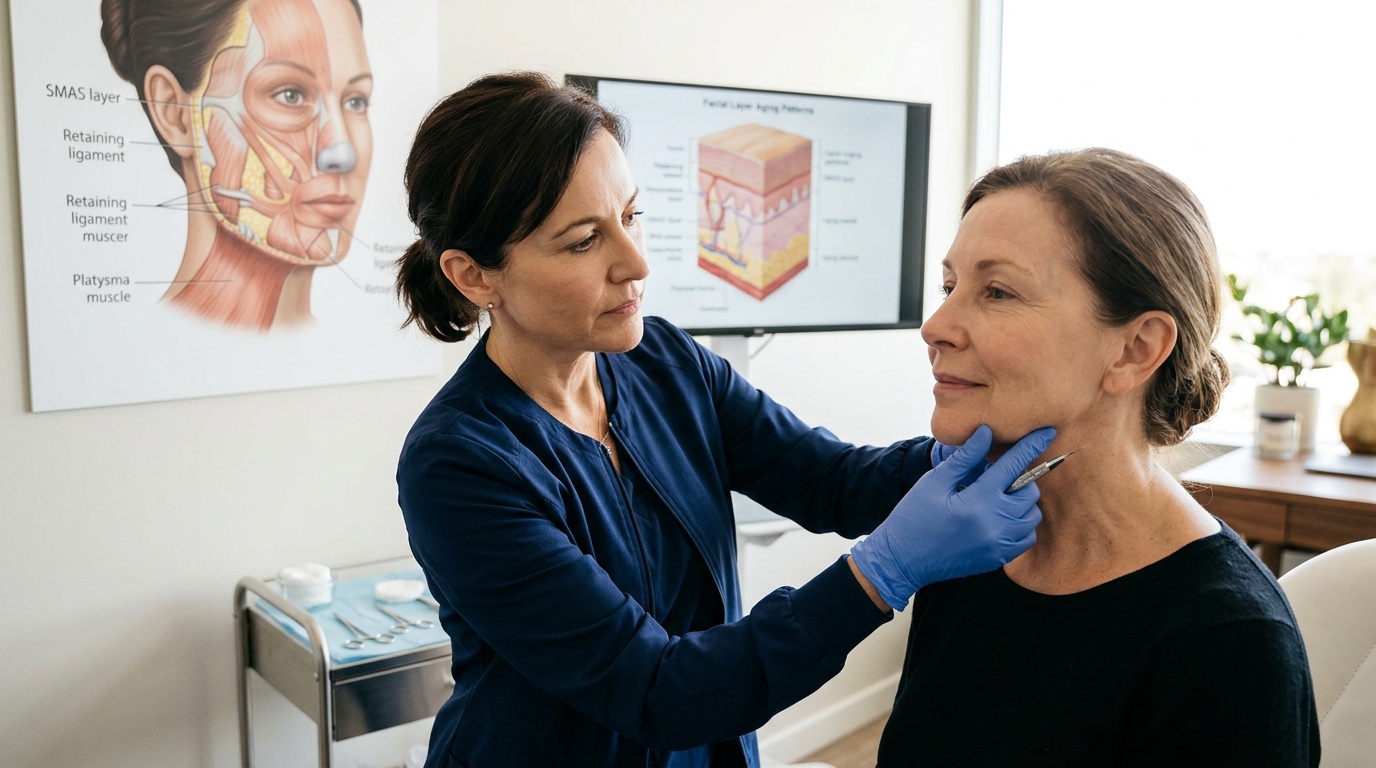
Anatomical Understanding: The Foundation of Effective Facelifts
Facial aging may involve the SMAS, platysma, fat compartments, retaining ligaments, and the relationship between cheek and lower face. Zygomatic cutaneous ligaments anchor the midface, while masseteric ligaments contribute to lower-cheek and jawline support. A surgical plan must account for these structures.
Addressing Age-Appropriate Laxity: Beyond Simple Skin Tightening
The location and degree of laxity matter more than age alone. One patient may have early jowling with good elasticity; another may have midface descent, neck laxity, or weakened support. A Mini Facelift may suit selected patients with limited lower-face laxity, while broader changes may require a more comprehensive operation. Examination establishes the appropriate scope.
Achieving Natural Aesthetic Vectors: Avoiding the “Operated On” Look
Natural rejuvenation depends on tissue direction and depth. Pulling skin laterally without restoring deeper support can create tightness, hairline changes, or an unnatural expression. Deep-plane repositioning may move connected layers vertically or obliquely according to anatomy. The objective is balanced correction across the cheek, nasolabial region, jawline, and neck.
Longevity and Structural Support: The Deep Plane Advantage
Durability depends on tissue quality, age, smoking, sun exposure, weight changes, technique, and healing. A peer-reviewed retrospective study indexed in PubMed under PMID 9727459 reported secondary tuck rates of 11.4% for the traditional SMAS rhytidectomy group studied. This does not predict an individual result or revision risk.
Deep plane surgery repositions deeper tissue with less reliance on skin tension and may provide longer-lasting correction in selected patients. No facelift stops aging or guarantees permanence. Patients should ask which tissues will be released and supported.
- Anatomy: Does the plan address the SMAS, platysma, cheek, ligaments, and neck?
- Proportion: Does it account for the midface, lower face, jawline, and neck?
- Movement: Is the goal natural expression rather than visible tightness?
- Limitations: Does the consultation explain that surgery cannot correct skin texture and dynamic upper-face lines?
- Safety: Are anesthesia, healing, bleeding, infection, nerve injury, scarring, asymmetry, and revision discussed?
Dr. Mark Albert’s Approach: Deep Plane Facelift
The Deep Plane Facelift: Anatomical Dissection and Sub-SMAS Mobilization
Dr. Mark Albert approaches deep plane surgery through anatomy beneath the SMAS. Controlled dissection permits mobilization of facial soft tissue, including the cheek, lower face, and selected neck structures according to laxity and the planned operation. The approach requires knowledge of facial compartments, nerve anatomy, ligaments, and the cheek-jawline transition. Deeper surgery is not automatically preferable or identical for every patient.
The Critical Role of Retaining Ligament Release
Retaining ligaments anchor soft tissue to deeper structures. When they restrict movement, pulling the outer layer may produce limited repositioning or excess skin tension. Selective release of zygomatic cutaneous and masseteric ligaments can mobilize a broader tissue unit. This is a principal anatomical difference between these techniques.
Midface and Nasolabial Fold Redefinition with Deep Plane
Midface descent may flatten the cheek and deepen the nasolabial fold. Moving cheek tissue as a connected unit may address descent more directly than lateral skin tightening. Results vary with bone structure, soft-tissue volume, elasticity, and fold depth; surgery cannot erase every crease or restore an earlier appearance.
Candidacy for Deep Plane Facelift: Who Benefits Most?
Potential candidates may have jowling, cheek descent, lower-face or neck laxity, and loss of definition beyond the skin surface. Good health, realistic expectations, compliance with instructions, and understanding of risks matter. Age, medications, nicotine, prior surgery, healing factors, and desired change must be reviewed. Dr. Mark Albert can assess whether deep plane, another facelift scope, or a Mini Facelift fits the examination.
Natural Outcomes and Aesthetic Vectors in Deep Plane Surgery
The intended result is a refreshed, recognizable, mobile face. Deep-plane repositioning may reduce outward skin pull and improve cheek-to-jawline transitions. Swelling, firmness, temporary asymmetry, and changing scars can affect early recovery.
Dr. Mark G. Albert, MD, FACS, is certified by the American Board of Plastic Surgery and is a Fellow of the American College of Surgeons. He completed plastic surgery residency and chief residency at the University of Massachusetts Medical School, followed by an aesthetic plastic surgery fellowship at Manhattan Eye, Ear, and Throat Hospital. Candidacy and technique still require consultation.
Traditional Rhytidectomy Techniques (SMAS Plication/Imbrication)
Understanding Traditional Rhytidectomy: SMAS Plication and Subcutaneous Techniques
Traditional rhytidectomy may combine skin elevation with SMAS treatment. A subcutaneous approach works beneath the skin; SMAS plication folds and secures the SMAS with sutures, while imbrication overlaps part of the layer. These methods can improve jowling, lower-face laxity, and selected neck changes. Skin removal and redraping depend on elasticity, laxity, and desired correction.
The distinction in rhytidectomy vs deep plane facelift concerns deeper mobilization. Traditional SMAS methods generally fold or reposition the SMAS without broadly releasing cheek-retaining ligaments. Facial nerve anatomy, skin quality, platysma-SMAS support, and proportions guide planning.
Limitations in Midface and Ligamentous Support
SMAS plication can support the lower face, but cheek descent may remain limited when zygomatic cutaneous and masseteric ligaments restrict movement. Nasolabial folds and the lower-eyelid-to-cheek transition may not fully respond to a lateral lower-face lift. This does not make a traditional approach unsuitable; it means technique should match the aging pattern.
Potential for Skin Tension and Less Natural Movement
When deeper support is limited, greater skin traction may be needed. Excess tension can contribute to a pulled appearance, widened scars, hairline changes, or reduced softness during expression. Conservative SMAS treatment and skin redraping can still produce natural results in selected patients.
Candidate Considerations for Traditional Approaches
A traditional SMAS-based facelift may suit patients whose concerns center on jowls, lower-face laxity, or neck definition. The Mini Facelift may suit selected patients with localized laxity. Examination determines scope.
Pros
- Can address selected jowling and lower-face laxity through SMAS support.
- Offers a familiar framework with variable surgical scope.
- May suit aging concentrated in the lower face and neck.
Cons
- May provide less direct mobilization of descended midface tissue.
- Can rely more on skin redraping when deeper support is limited.
- Does not correct skin texture, upper-face movement, or every aging concern.
Rhytidectomy vs. Deep Plane Facelift: A Direct Comparison

Key Differences in Surgical Approach and Anatomy
Rhytidectomy is the broad term; deep plane facelift identifies a specific technique. Traditional SMAS surgery may fold, overlap, or reposition the SMAS through more limited dissection. Deep plane surgery proceeds below the SMAS and selectively releases retaining ligaments so cheek and lower-face tissue can move together. Neither label determines quality; judgment, precision, and selection matter.
Comparison of Midface and Lower Face Rejuvenation
Traditional SMAS treatment can improve jowls, lower-face heaviness, and selected neck changes. Deep plane mobilization may address cheek descent more directly and influence cheek fullness, nasolabial folds, marionette lines, jawline definition, and neck contour. Results vary with skeletal structure, descent, elasticity, and asymmetry.
| Feature | Traditional SMAS rhytidectomy | Deep plane facelift |
|---|---|---|
| Primary working plane | Often subcutaneous, with plication or imbrication of the SMAS | Below the SMAS, with mobilization of connected facial soft tissue |
| Ligament treatment | Usually more limited release of retaining structures | Selective release of structures such as zygomatic cutaneous and masseteric ligaments |
| Midface effect | May be limited when cheek descent is tethered centrally | May provide more direct repositioning of descended cheek tissue |
| Lower-face focus | Jowls, jawline laxity, and selected neck changes | Cheek, lower face, jawline, and neck according to the surgical plan |
| Skin tension | May carry more of the visible tightening when deeper support is modest | Designed to reduce dependence on outward skin traction |
| Recovery considerations | Swelling, bruising, tightness, and scar maturation vary by operative scope | Swelling, bruising, firmness, and recovery also vary with the extent of deep dissection |
Aesthetics: Natural Movement vs. Skin Tension
A natural facelift preserves recognizable character and expression. Traditional surgery can do so when tissue is repositioned conservatively and skin is not the sole source of lift. Deep plane surgery shifts deeper tissue with less outward pull, potentially supporting smoother cheek and jawline movement. The goal is proportionate correction.
Longevity and Revision Rates
A retrospective study indexed under PMID 9727459 reported an 11.4% secondary tuck rate in the traditional SMAS rhytidectomy group studied. Longevity is influenced by support, healing, age, sun exposure, weight changes, and technique. Deep plane surgery may provide durable repositioning in selected patients, but it does not stop aging or eliminate revision.
Recovery Timelines and Expectations
Both approaches involve staged recovery. Swelling, bruising, tightness, asymmetry, numbness, and firmness vary with operative extent and healing. Patients should follow instructions and promptly report increasing pain, expanding swelling, fever, drainage, or facial-movement changes.
Dr. Mark Albert compares techniques through examination of the skin envelope, SMAS and platysma, midface, jawline, neck, medical history, and desired change. The Mini Facelift may suit localized laxity, while broader descent may require another plan. Consultation is required.
Navigating the 40s Grey Area and Post-Operative Recovery Realities
The “Grey Area” in Your 40s: When Is Facelift Surgery Appropriate?
No age establishes candidacy. In the 40s, some patients have early jowling or mild neck laxity, while others have more substantial changes. The decision depends on laxity, elasticity, proportions, health, and goals. A Mini Facelift may suit limited laxity; broader cheek, jawline, or neck descent may require more comprehensive surgery.
Staged Recovery: What to Expect from Day 1 to 6 Months
Early appearance is not the final result. Day 1 commonly includes dressings, swelling, bruising, tightness, numbness, and limited activity. During the first days, edema can make the face look uneven or unfamiliar.
- Days 1 to 4: Rest, head elevation, wound care, and adherence to instructions are emphasized.
- Days 5 to 14: Bruising and swelling often remain visible; return to social activity follows clinical guidance.
- Weeks 3 to 8: Firmness, numbness, scar color, and mild asymmetry may change.
- Months 3 to 6: Softness, contour, sensation, and scars continue to mature.
Managing Early Post-Operative Swelling and Bruising, Days 5 to 14
During days 5 through 14, swelling may obscure contour and bruising may change color as it resolves. The face can feel firm or tight. Patients should avoid unapproved massage, strenuous exercise, heat, or medication changes and attend follow-up visits.
What Facelift Surgery Can and Cannot Address: Skin Quality and Upper Face
A facelift primarily addresses laxity and descent of the cheek, lower face, jawline, and included neck. It does not reliably correct sun-damaged texture, fine lines, pigmentation, dynamic wrinkles, forehead concerns, brow position, or upper-eyelid concerns.
Making an Informed Decision: Consultation with Dr. Mark Albert
Dr. Mark Albert examines facial movement, skin, midface, jowling, neck laxity, scars, medical history, and desired change. Patients should ask which layer will be repositioned, whether ligaments require release, how scars and restrictions will be managed, and which concerns surgery will not address. Bleeding, infection, nerve injury, healing problems, asymmetry, anesthesia, and revision should also be discussed.
The Mini Facelift may suit selected patients with localized laxity, while deeper or more comprehensive surgery may address broader descent. Dr. Albert can explain the options during an in-person consultation with a qualified plastic surgeon.
Frequently Asked Questions
What is the best age for a rhytidectomy?
Rhytidectomy has no single best age because candidacy depends more on facial laxity, skin quality, health, and personal goals than on a number. Patients may consider surgery when jowling, cheek descent, or neck laxity becomes bothersome. A consultation with Dr. Mark Albert helps determine whether a facelift, deep plane facelift, or Mini Facelift fits the anatomy.
What is the easiest facelift to recover from?
The easiest facelift to recover from varies by the procedure performed, the extent of correction, and each patient’s healing response. A Mini Facelift may involve a more limited operation for selected patients, while a deep plane or comprehensive rhytidectomy addresses broader laxity. Recovery, risks, and activity restrictions require individualized guidance from the surgeon.
Which is better for me, a vertical restore or a deep plane facelift?
A vertical restore and a deep plane facelift cannot be ranked as universally better because the appropriate choice depends on the tissues requiring correction and the surgeon’s plan. A deep plane facelift releases selected structures beneath the SMAS to reposition connected facial tissues. Consultation is needed to compare vectors, ligament release, neck treatment, risks, and recovery.
What is the new facelift everyone is getting?
The deep plane facelift is a modern rhytidectomy technique that has received significant attention, but it is not appropriate for everyone. Deep plane surgery works beneath the SMAS and may reposition the cheek, lower face, and selected neck tissues with less reliance on skin tension. Treatment should be selected after an examination of anatomy, laxity, and goals.
What is the most regretted cosmetic surgery?
No single cosmetic surgery is the most regretted for every patient, and regret can reflect expectations, complications, recovery, or dissatisfaction with the result. Facelift surgery cannot stop aging, correct every skin-texture concern, or guarantee symmetry. Careful consultation should cover alternatives, limitations, scarring, bleeding, infection, nerve injury, healing, and possible revision.
Is a deep plane facelift the same as a rhytidectomy?
A deep plane facelift is one type of rhytidectomy, which is the medical term for facelift surgery. Rhytidectomy may use a traditional SMAS-based approach, a deep plane technique, or another individualized plan. The main differences involve the surgical plane, retaining-ligament release, tissue movement, facial proportions, neck treatment, recovery, and risks.
Leave a Reply