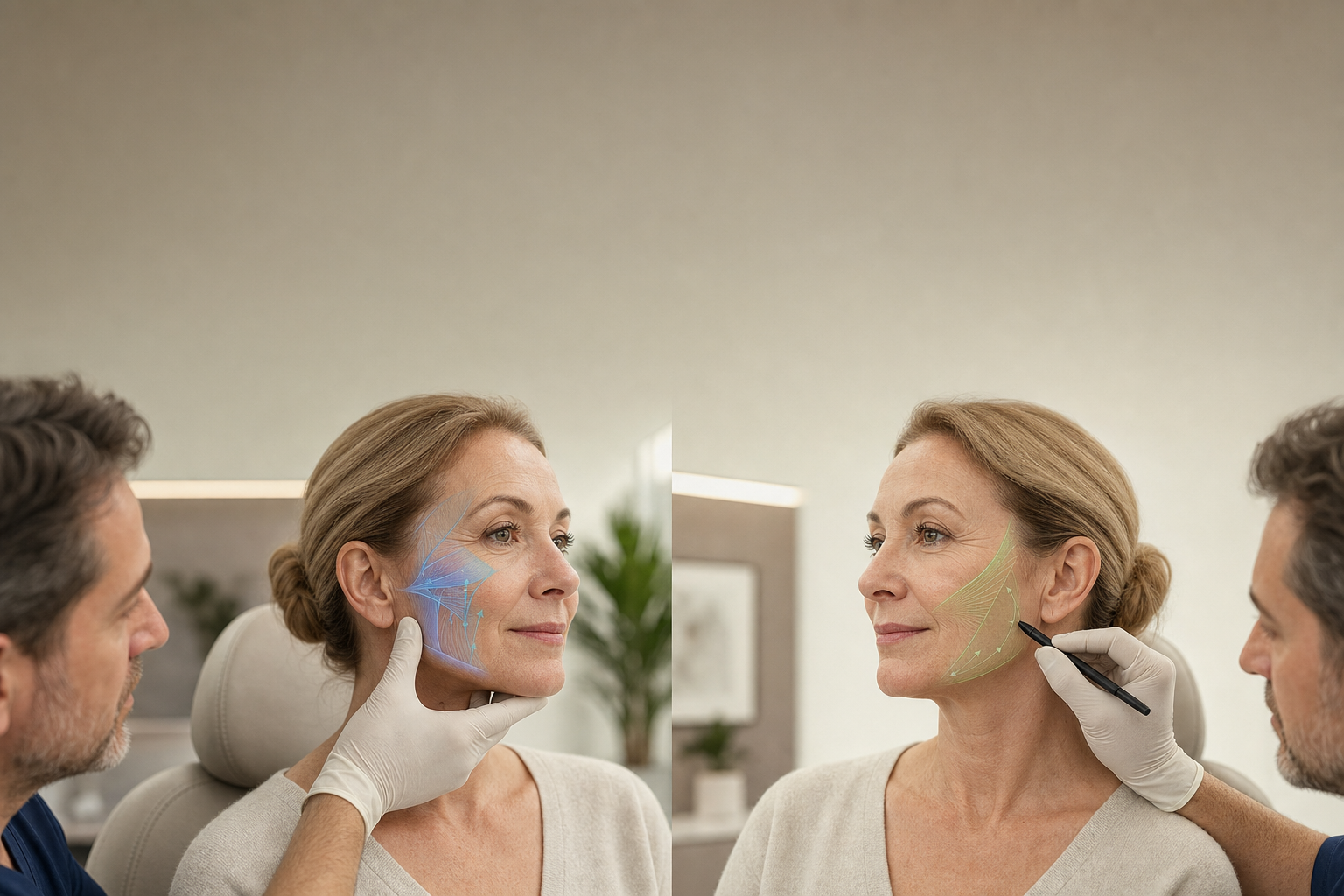
deep plane facelift vs smas
When considering deep plane facelift vs smas, the central question is not which technique is universally better. The decision depends on facial anatomy, skin laxity, soft-tissue descent, neck changes, desired degree of correction, and the surgeon’s assessment during consultation. Both operations are designed to create a refreshed, proportionate appearance without relying on excessive skin tension.
Key Takeaways
- The choice between a deep plane and SMAS facelift depends on how much your facial tissues have descended and how your neck has changed, not on one method being superior for everyone.
- A thorough consultation with your surgeon will determine which technique best addresses your specific degree of skin laxity and soft tissue sagging.
- Both procedures prioritize repositioning deeper facial layers to achieve a natural, balanced look rather than relying on pulling the skin tight.
- Your facial anatomy and the amount of correction you desire are the true factors that guide the recommendation for either a deep plane or SMAS facelift.
Dr. Mark G. Albert, MD, FACS, is certified by the American Board of Plastic Surgery and a Fellow of the American College of Surgeons. His approach begins with careful evaluation of the lower face, jawline, cheeks, neck, skin quality, facial proportions, and personal goals. Candidacy, technique, recovery, risks, and outcomes require individualized clinical assessment.
What is deep plane facelift vs smas?
A SMAS facelift works with the superficial musculoaponeurotic system, a supportive layer beneath the facial skin. Depending on the surgical plan, the surgeon may reposition, tighten, or selectively release this layer before redraping the skin. A deep plane facelift releases specific retaining ligaments and lifts the skin and deeper soft tissue as a connected unit. This can address descent through the cheeks, jowls, jawline, and selected areas of the neck while reducing dependence on skin traction.
The technical distinction matters, but it does not determine the result by itself. A natural appearance depends on sound anatomy, conservative tissue handling, appropriate vector selection, incision placement, skin redraping, and the surgeon’s judgment regarding the limits of correction. Deep plane surgery is not automatically superior, and a SMAS facelift is not a single standardized operation. Both techniques have variations, and the most appropriate plan may differ between patients with similar concerns.
A 2025 systematic review and one-arm meta-analysis indexed in PubMed evaluated 21 studies involving 2,896 patients. The pooled reports showed patient satisfaction of 94.4% for deep plane procedures and 87.8% for SMAS procedures, with reported overall complication rates of 17.2% and 10.3%, respectively. These findings represent observational evidence with differences in study design, patient selection, surgeon technique, and complication reporting. They do not prove that one approach is safer or produces better results for every individual.
Benefits of deep plane facelift vs smas

The potential benefit of a deep plane facelift is its ability to reposition deeper facial tissues rather than relying primarily on skin tightening. This may be useful when midface descent, pronounced jowls, or a heavier lower face are central concerns. A SMAS facelift can also provide meaningful improvement in the lower face and jawline, with the exact effect shaped by whether the SMAS is tightened, folded, repositioned, or released. Neither operation can recreate youthful anatomy perfectly, remove every line, or stop future aging.
Key insight: A natural-looking facelift is measured by balanced facial movement, a defined but not harsh jawline, a smooth transition from the face to the neck, and preservation of personal identity. The technique should serve the anatomy, not replace individualized planning.
Patients often ask whether a deep plane operation lasts longer. Some published sources describe longer average duration for deep plane results, while other reports emphasize that longevity varies with age, genetics, sun exposure, skin elasticity, weight changes, and surgical design. It is more accurate to discuss durability as a range of possibilities rather than a promised timeline. Published estimates for SMAS facelift recovery commonly center on about two weeks, while deep plane recovery is often described as approximately two to three weeks. These are general estimates, not individualized clearance dates.
Cost also reflects more than the named technique. A quoted SMAS facelift cost or deep plane mini facelift cost may include different surgeon fees, anesthesia, facility charges, garments, follow-up care, and geographic expenses. International prices may use different inclusions and currencies, so direct comparisons can mislead. Patients should request a written explanation of the surgical plan and fees rather than selecting an operation based on price alone.
A Mini Facelift may be considered when laxity is more limited and the desired correction is appropriately focused. Mini Facelift is directly within the client-directed facelift scope. It is not simply a smaller version of every other facelift, and its suitability depends on the distribution of skin laxity, jowling, facial descent, and neck changes. A consultation is needed to determine whether its scope matches the patient’s goals.
How to Choose deep plane facelift vs smas
Choosing between deep plane facelift vs smas begins with the pattern of facial aging rather than a preference for a technical label. During consultation, Dr. Mark G. Albert evaluates skin elasticity, cheek descent, jowls, jawline definition, neck laxity, facial fullness, tissue thickness, and overall proportions. He also considers whether your priority is a focused lower-face correction or broader repositioning through the midface and neck. Photographs, examination, medical history, prior surgery, medications, smoking status, and your recovery expectations all contribute to an individualized plan.
A deep plane approach may be considered when descended cheek tissues, prominent jowls, or lower-face heaviness require movement of deeper structures with less reliance on skin traction. A SMAS facelift may be appropriate when the primary concerns involve lower-face laxity, jawline irregularity, or selected neck changes that can be addressed through a carefully designed SMAS operation. The distinction between deep plane facelift vs smas is not a reliable way to predict which patient will obtain the most natural result. Incision design, tissue handling, vector selection, skin redraping, and surgical judgment remain central.
Ask during consultation which anatomic findings support the proposed technique and which concerns it may not fully address. A facelift can improve lax skin, jowling, facial descent, and some neck laxity, but it does not erase every wrinkle, correct all changes in skin texture, or prevent future aging. Patients concerned about their front view should ask how the plan addresses cheek position, facial width, nasolabial transition, jawline contour, and neck-to-face balance, rather than evaluating the operation only through a side profile.
Price should be reviewed only after the surgical scope is clear. A quoted SMAS facelift cost may differ according to surgeon experience, operating facility, anesthesia, geographic location, complexity, follow-up, and included services. The same issue applies when researching a deep plane mini facelift cost: a limited operation is not interchangeable with a full facelift, and a lower fee may reflect a narrower scope rather than better value. Request a written estimate that identifies professional fees, facility charges, anesthesia, postoperative visits, and any planned revisions or additional care.
Recovery planning also belongs in the decision. General published estimates often describe roughly two weeks for SMAS recovery and approximately two to three weeks for deep plane recovery, though swelling, bruising, numbness, incision healing, activity restrictions, and return to work vary by patient. Your surgeon should provide specific instructions for wound care, sleeping position, exercise, driving, travel, and follow-up. Do not use a generic recovery calendar as personal medical clearance.
The Mini Facelift may suit selected patients whose laxity and jowling are limited and whose goals call for a more focused correction. Mini Facelift is directly within the client-directed facelift scope. Its suitability cannot be determined by age alone, and it may not provide the desired correction when descent extends through the cheeks, jawline, or neck. A qualified surgeon should explain the expected scope, visible limitations, material risks, anesthesia plan, and follow-up requirements before you decide.
Frequently Asked Questions
Is a deep plane facelift better than a SMAS facelift?
Neither technique is universally better. The appropriate operation depends on the location and degree of tissue descent, skin elasticity, jawline definition, neck laxity, facial proportions, medical history, and the result you hope to achieve. A deep plane facelift may be considered when deeper cheek and lower-face tissues have descended. A SMAS facelift may suit a different pattern of laxity. The surgeon’s examination and operative plan matter more than selecting a technique by name alone.
Which approach gives the most natural-looking result?
A natural-looking result depends on conservative planning, accurate tissue repositioning, appropriate vector selection, careful skin redraping, and respect for individual anatomy. Neither a deep plane facelift nor a SMAS facelift guarantees a particular appearance. During consultation, ask how the proposed plan will preserve facial identity, movement, jawline proportion, and the transition between the face and neck. It is also reasonable to ask which visible concerns may remain after surgery.
Which option is better for jowls, the jawline, neck, or midface?
The answer depends on the source of the concern. Jowling and jawline laxity may be addressed through several facelift designs. Midface descent can call for a plan that repositions cheek tissues, while neck improvement depends on the pattern of laxity and the relationship between the lower face and neck. A facelift cannot correct every skin-quality change or eliminate all lines. An in-person examination is necessary to identify which structures contribute to the appearance and what degree of correction is realistic.
Does a deep plane facelift last longer than a SMAS facelift?
Published discussions sometimes describe longer-lasting improvement with deep plane surgery, but durability varies substantially among patients. Age, genetics, sun exposure, skin quality, weight changes, smoking, tissue characteristics, and surgical design can affect how the face changes over time. Longevity should be discussed as an expectation with uncertainty, not a fixed promise. Both procedures address existing descent while the natural aging process continues.
When should I seek an in-person facelift consultation?
Seek consultation when facial laxity, jowls, neck changes, or midface descent concern you and you want to understand the available facelift plan. Bring questions about candidacy, anesthesia, incisions, recovery, complications, follow-up, and limitations. Dr. Mark G. Albert, MD, FACS, is certified by the American Board of Plastic Surgery and is a Fellow of the American College of Surgeons. A consultation does not obligate you to undergo surgery. It provides an opportunity to review your anatomy and make an informed decision.
Leave a Reply