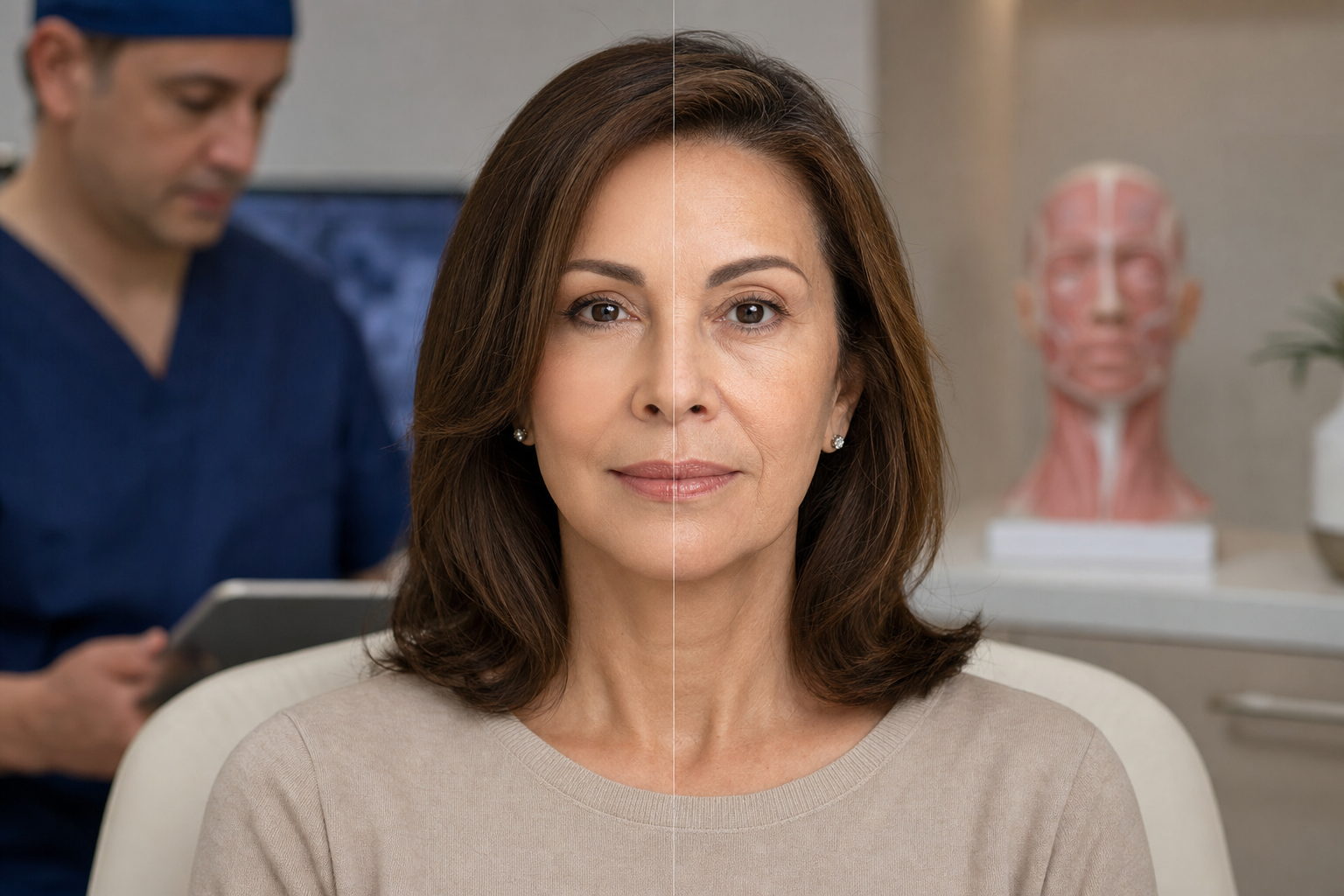
deep plane facelift vs regular facelift
When patients search for deep plane facelift vs regular facelift, they are usually asking whether the deeper operation produces a more natural or longer-lasting result. The answer depends on facial anatomy, skin laxity, cheek position, jowling, neck changes, prior surgery, and the surgeon’s operative plan. “Regular facelift” is not a precise technical term, so the details should be confirmed during consultation.
Key Takeaways
- Deep plane facelifts target deeper facial layers to reposition sagging cheeks and jowls, often producing a more natural appearance than superficial techniques.
- The term "regular facelift" is not a standard medical description, so patients should ask their surgeon for the specific technique and tissue layers involved.
- Your facial anatomy, degree of skin laxity, and prior surgeries determine whether a deep plane or more superficial lift will give you the best outcome.
- A thorough consultation is essential to match the surgical plan with your unique aging patterns in the cheeks, jawline, and neck.
At Albert Plastic Surgery, I evaluate the facial layers that require correction rather than selecting a technique by name alone. As a board-certified plastic surgeon and Fellow of the American College of Surgeons, I discuss what each approach can address, what it cannot change, and how healing may affect the appearance during the early postoperative period.
What is deep plane facelift vs regular facelift?
A deep plane facelift releases and repositions selected facial tissues beneath the superficial musculoaponeurotic system, commonly called the SMAS. This deeper mobilization may allow the cheek and midface tissues to move together with the lower face. A traditional or “regular” facelift may involve tightening the SMAS, repositioning it, or working primarily with the skin and supporting layers. Since terminology varies among surgeons, the name alone does not establish the exact operation.
The distinction matters because facial aging does not occur in one layer. Skin may lose elasticity, fat compartments may shift, retaining ligaments may become less supportive, and the jawline or neck may develop laxity. A deep plane approach can be useful for selected patients with midface descent, prominent nasolabial folds, jowls, or broader tissue movement needs. A SMAS-based facelift may be appropriate when the main concerns involve lower-face laxity, jawline definition, or neck skin. Neither method is automatically better for every patient.
Key insight: A natural result depends on accurate assessment, conservative tissue handling, appropriate vector selection, and realistic expectations. A photograph taken several days after surgery may show swelling, bruising, dressings, lighting effects, or camera adjustments. It should not be treated as a final representation of healing.
Benefits of deep plane facelift vs regular facelift

The potential benefit of a deep plane facelift is coordinated movement of deeper facial tissues rather than relying on skin tension alone. In a suitable patient, this may improve the transition between the lower eyelid and cheek, soften descent through the midface, reduce jowling, and restore a more continuous contour from the cheek toward the jawline. The technique may also reduce the chance that the skin carries the full lifting force, which can support a less tight-looking appearance. These effects depend on anatomy, surgical judgment, healing, and the amount of correction required.
A traditional facelift, including a SMAS facelift, can offer meaningful correction when laxity is concentrated around the lower face, jawline, and neck. It may provide a carefully controlled lift without the deeper dissection required in a deep plane operation. For some patients, that approach may represent a more suitable balance between goals, anatomy, operative details, and recovery considerations. A Mini Facelift may also be considered for carefully selected patients with more limited lower-face laxity, although candidacy, technique, recovery, risks, and outcomes require individualized clinical assessment.
In considering deep plane facelift vs regular facelift, patients should look beyond claims about permanence or a fixed recovery schedule. Every facelift involves incisions, swelling, bruising, temporary numbness, scar maturation, and risks such as bleeding, infection, unfavorable scarring, nerve-related weakness, asymmetry, skin healing problems, and the possibility of revision. Aging continues after surgery, and no technique can stop future changes. The recommended operation should reflect the patient’s facial structure and priorities, not a promotional label. At Albert Plastic Surgery, a Mini Facelift is discussed only when its more limited scope corresponds with the patient’s needs.
How to Choose deep plane facelift vs regular facelift
Choosing a facelift technique should begin with the facial changes you want addressed, not with a procedure label. During consultation, your surgeon should assess skin elasticity, cheek descent, nasolabial folds, jowls, jawline definition, neck laxity, facial asymmetry, prior surgery, and overall health. Ask which anatomical layers require repositioning, whether the plan involves the SMAS, and how the proposed operation addresses your specific concerns. Terminology varies among surgeons, so “deep plane,” “SMAS,” and “regular facelift” should be accompanied by a clear explanation of the actual surgical steps.
Patients concerned about the cheeks and midface may wish to ask whether the planned operation provides adequate mobilization of those tissues. Patients whose primary concerns involve jowling, a soft jawline, or neck laxity should ask how the lower face and neck will be treated. A deeper approach is not automatically the better choice. The appropriate plan depends on tissue position, skin quality, facial proportions, the degree of laxity, and the surgeon’s experience with the proposed dissection. A carefully performed SMAS-based facelift may be a sound choice for one patient, while another may require a different level of tissue release.
Review the surgeon’s credentials, hospital privileges when applicable, operative setting, anesthesia plan, follow-up process, and approach to complications. Dr. Mark G. Albert is certified by the American Board of Plastic Surgery and is a Fellow of the American College of Surgeons. During an evaluation at Albert Plastic Surgery, ask to see results at a mature stage of healing rather than relying on a heavily edited image or a photograph labeled “seven days postoperative.” Early swelling, bruising, numbness, temporary firmness, and uneven healing can substantially alter appearance before tissues settle.
Which questions support an informed decision?
Bring a written list to your consultation. Useful questions include: Which facial structures are causing my concerns? What changes can this operation reasonably provide? What limitations should I expect? Where will incisions be placed, and how do scars typically mature? What are the risks of bleeding, infection, nerve-related weakness, skin-healing problems, asymmetry, contour irregularity, and revision? Ask how follow-up is organized and which symptoms require prompt contact with the surgical team.
A Mini Facelift may be discussed when laxity is more limited and concentrated in the lower face. Its smaller scope does not make it appropriate for everyone, and it should not be selected solely because the name suggests an easier experience. A Mini Facelift may not address substantial midface descent, marked neck laxity, or extensive skin excess. Candidacy, technique, recovery, risks, and outcomes require individualized clinical assessment. The safest decision is one based on an in-person examination, transparent planning, and realistic expectations rather than a promised duration, fixed recovery schedule, or promotional photograph.
Frequently Asked Questions
Is a deep plane facelift better than a regular facelift?
Not automatically. A deep plane facelift may be appropriate when the treatment plan requires movement of deeper cheek and midface tissues. A SMAS-based or traditional facelift may be well suited to patients whose principal concerns involve the lower face, jawline, or neck. The appropriate operation depends on anatomy, skin elasticity, tissue descent, medical history, and the surgeon’s assessment. A consultation should explain why a specific technique fits your facial structure and what limitations remain.
Is a regular facelift the same as a SMAS facelift?
“Regular facelift” is an informal phrase rather than a standardized technical description. Some surgeons use it to describe a traditional facelift involving the SMAS, while others may use different methods involving the skin and deeper supporting layers. Ask the surgeon to describe the planned dissection, tissue repositioning, incision pattern, anesthesia, and expected recovery. The procedure name alone does not provide enough information to compare surgical plans.
Which facelift addresses the midface and cheeks?
A deep plane approach can provide access to selected midface and cheek tissues, which may make it useful for certain patterns of cheek descent or flattening. This does not mean that every patient with cheek changes requires a deep plane operation. Facial proportions, ligament release, tissue quality, and the intended vector of movement all matter. During consultation, ask whether the proposed technique addresses the cheek area directly and how the surgeon distinguishes swelling from the eventual contour.
Which facelift is better for jowls, a weak jawline, or neck laxity?
Both a deep plane facelift and a SMAS-based facelift may address jowling or reduced jawline definition in selected patients. Neck laxity and excess skin require a plan tailored to the degree and location of those changes. A Mini Facelift may be considered when lower-face laxity is limited, but it is not designed for every pattern of aging. A Mini Facelift should be chosen only after an individualized examination.
When should facelift results be judged?
Early photographs can be misleading because swelling, bruising, numbness, firmness, lighting, makeup, and camera angle affect appearance. A “seven-day postoperative” image is not necessarily a final result. Healing and scar maturation continue over time, with the pace varying by patient and operation. Follow your surgeon’s specific instructions and contact the surgical team promptly if you develop concerning symptoms. Candidacy, technique, recovery, risks, and outcomes require individualized clinical assessment.
Leave a Reply