
facelift scars behind the ears
Facelift scars behind the ears usually follow the crease behind each ear and may extend into the hairline. Their position and appearance depend on the surgical plan, skin and hair characteristics, and healing. Dr. Mark Albert, MD, FACS, is certified by the American Board of Plastic Surgery and a Fellow of the American College of Surgeons. His Facelift service page describes facelift surgery in New York City with Dr. Albert.
Key Takeaways
- Incisions placed behind the ears are designed to follow natural creases and, in some cases, extend into the hairline so the resulting scars blend with surrounding anatomy.
- How these scars ultimately look depends on several factors, including the surgical technique, your skin quality and hair pattern, and the way your body heals.
- Scars typically mature over many months, gradually softening and fading from their initial pink or raised appearance.
- Protecting healing incisions from sun exposure and following all postoperative care instructions can support a smoother recovery.
- Every patient's healing timeline is different, so questions about your incision placement and recovery should be discussed during a consultation with a qualified plastic surgeon.
No incision can be promised to become invisible. Knowing where it sits and how it typically changes can help you set realistic expectations. The Facelift incision plan, recovery, risks, and expected outcomes require individualized clinical assessment.
Where Facelift Scars Behind the Ears Are Placed: And Why
The path of the incision: earlobe, retroauricular crease, and hairline behind the ear
A facelift incision commonly runs around the ear, passing near the earlobe and into the crease behind it. Depending on the planned lift, it may continue along the hairline behind the ear. “Retroauricular” means behind the ear. The incision’s length and route vary with the areas being treated, hair density and style, skin quality, and previous incisions.
Why surgeons hide facelift incisions behind the ear
The crease and nearby hairline can help conceal an incision when the ear is viewed from the front or side. The scar may still be noticeable when hair is pulled back, cut short, or wet. Incision placement must also provide access to the tissues being adjusted while respecting the ear’s natural shape and hairline. The aim is a carefully positioned incision, not a promise that no one will see it.
How incision patterns differ: mini facelift, deep plane facelift, and neck lift
Incisions are tailored to the operation and areas addressed. A Mini Facelift may use a more limited pattern than a more extensive facelift. A Deep Plane Facelift involves a different approach to deeper facial tissues, but the incision still must be planned around the ear and hairline. A neck lift may include an incision behind the ear when the surgical plan addresses the neck. These names do not determine one fixed scar pattern; the surgeon explains the proposed locations during consultation.
| Surgical approach | General incision-planning consideration |
|---|---|
| Mini Facelift | A more limited pattern may be appropriate when the planned treatment area is narrower. |
| Deep Plane Facelift | The incision is planned to provide access for the selected deeper-tissue approach. |
| Neck lift | An incision behind the ear may be included when the neck is part of the plan. |
Incision placement for women and men: sideburns, beard line, and short hair
Hairline planning matters across genders and hairstyles. The surgeon considers the sideburn, hair density, beard-bearing skin, and how the incision may look with short or pulled-back hair. Shifting hair-bearing skin can alter the sideburn or hairline position; careful planning aims to preserve natural contours. Bring photos of your usual hairstyle and discuss how you wear your hair. These details help shape an individualized plan but cannot guarantee a particular scar appearance.
Facelift Scars Behind the Ears: A Week-by-Week Healing Timeline
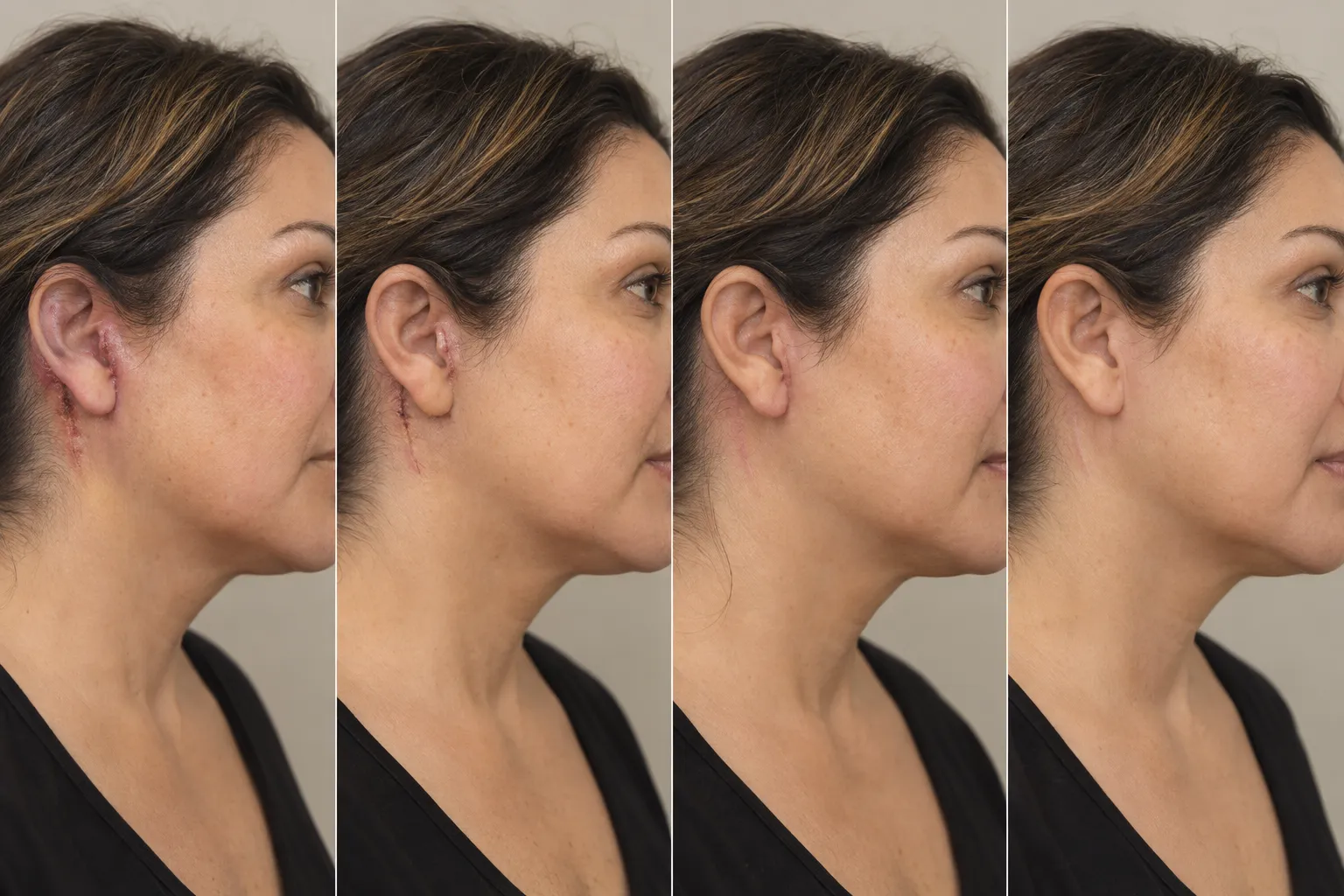
Healing changes gradually, and the early appearance is not the final scar. Facial skin has a strong blood supply, which supports healing, while scar maturation generally takes 6 to 12 months. These stages are broad expectations, not a diagnosis or a schedule every patient follows. Your surgeon’s instructions and assessment take priority because the incision pattern and individual healing affect what you see.
Days 1-7: what the incision looks like right after surgery
During the first week, the incision may look red or swollen, and bruising or dried blood may be present. Dressings, sutures, or crusting can make it look more prominent than it will later. Keep the site protected as directed and avoid judging the scar’s final color or width at this stage. Contact your surgical team about new or worsening symptoms rather than relying on a photo comparison for reassurance.
Weeks 2-4: redness, firmness, and the peak of “is this normal?” worry
At two weeks, facelift scars after 2 weeks may still be pink or red, slightly raised, firm, or tender. Some bruising and swelling may remain. By four weeks, facelift scars after 4 weeks can still have visible color and firmness as the incision settles. Appearance alone does not establish whether healing is normal; your surgeon can evaluate changes in person. People searching for face lift scars pictures or facelift scars behind ears pictures should remember that lighting, camera angle, skin tone, and timing make images difficult to compare.
Months 3-6: fading, softening, and hair regrowth behind the ear
Over the following months, scar tissue often becomes softer and less conspicuous, though its color can continue to change. Hair may help cover the area as it grows, depending on incision position and individual hair growth. Changes are gradual rather than uniform. If the scar seems to be widening, becoming more raised, or changing in a way that concerns you, ask your surgeon to assess it.
Months 6-12: mature scars and realistic long-term expectations
Between six and twelve months, scars commonly continue to mature, fade, and soften. A mature scar may remain visible at close range or when the hair is parted. Skin tone, healing history, and incision placement influence the result, so before-and-after photos cannot predict an individual outcome. Follow-up helps your surgeon assess the scar and discuss whether its appearance is changing as expected.
Why Scars Behind the Ears Are the Least Predictible, and What Makes One Heal Badly
The area behind the ear can be challenging for an incision to heal because it bends, moves, and can stay warm or damp beneath hair. Skin tension, friction from clothing or glasses, and pressure during sleep may also affect the incision. The visible scar reflects both the surgical plan and the body’s healing response. A concerning appearance does not show whether the cause was technique or individual healing; an in-person assessment is needed.
Skin tension, moisture, and friction behind the ear
Skin behind the ear is folded against the head, so moisture and rubbing can be harder to avoid than on an exposed, flat area. Tension matters, too. When closure places too much pull on the skin, the scar may widen or become raised. A well-planned lift aims to support tissues at deeper levels so the skin edges can be brought together with less strain. Healing still varies, and careful closure cannot guarantee a particular scar.
What causes a bad facelift scar: widening, hypertrophy, pigment change, and hair loss
People may describe a scar as a “bad facelift scar” when it becomes wider, thickened, unusually colored, or noticeable in the hairline. A hypertrophic scar is raised but remains within the original incision boundaries. Pigment may become darker or lighter than nearby skin, and hair loss can occur where an incision crosses hair-bearing skin. These changes have different causes and may need different assessments. Early redness or firmness alone does not establish the final appearance.
Pixie ear and hairline distortion: technique factors, not just healing luck
A pulled-down or elongated earlobe, sometimes called pixie ear, can occur when the earlobe bears excess tension or is attached in a way that alters its natural contour. Hairline distortion may follow if skin is pulled or repositioned without attention to hair-bearing boundaries. Deep-layer support and a closure that avoids relying on the skin for lift are important planning principles. Anatomy and healing differ, so discuss the proposed incision and earlobe position with your surgeon before surgery.
Patient factors: skin quality, pigment, and healing history
Skin quality, natural pigmentation, prior scars, and personal healing history can influence how a new incision matures. Hair density, hairstyle, and previous incisions also shape planning. Share any history of raised or widened scars, pigment changes, or delayed wound healing during consultation. Dr. Mark Albert can explain how these factors relate to a proposed Facelift plan, but candidacy, technique, risks, and expected outcomes require individualized clinical assessment.
Factors that can help or hinder healing
Helpful considerations
- Deep-tissue support can reduce reliance on skin tension for the lift.
- Incision planning can account for hairline, earlobe shape, and personal healing history.
Possible challenges
- Moisture, rubbing, and pressure may irritate the healing area.
- Scar width, thickness, color, or hair growth cannot be predicted with certainty.
Caring for Scars Behind the Ears: A Practical Aftercare Checklist
Follow the operating surgeon’s written instructions rather than applying a general scar-care routine to a fresh incision. The timing of washing, dressing changes, taping, and topical products depends on the closure and wound healing. Keep follow-up appointments so the surgical team can check the incision and adjust guidance. If instructions are unclear, ask the team before changing wound care or starting a scar treatment.
First six weeks: cleaning, taping, and protecting the incision
Use this checklist as a prompt to follow your own care plan:
- Clean the area only as directed, and pat it dry without rubbing.
- Use dressings or tape only when your surgeon instructs you to do so.
- Limit friction from collars, hair tools, glasses, or pressure on the ear.
- Do not pull at crusts, sutures, or adhesive strips unless your care team advises it.
- Contact the surgical team about increasing redness, drainage, wound separation, or worsening discomfort.
Silicone gels, sheets, and scar massage: what helps and when to start
Silicone products and scar massage are not appropriate for every incision at every stage. Do not place them on an open or unhealed wound, and wait for the surgeon to confirm massage is suitable. Ask which product, if any, fits your incision and when to begin. A product cannot prevent every scar change, and using it too early may irritate healing skin.
Sun protection behind the ears and around the hairline
Once the incision has closed and your surgeon approves sun exposure, protect the area with a covering or sunscreen suitable for healed skin. The crease behind the ear and hairline can be easy to miss, especially when hair is worn up. Sun exposure may affect scar color during maturation. Ask your clinician when protection is appropriate for your healing stage.
When a scar may need more: steroid injections, laser, or revision
If a scar remains raised, widened, discolored, or distorted after healing, arrange an evaluation rather than choosing treatment from photographs or online advice. Depending on the finding and timing, a clinician may discuss options such as steroid injections, laser treatment, or surgical revision. Each has limitations and risks, and none is suitable for every scar. Seek prompt medical advice for wound separation, drainage, spreading redness, fever, or rapidly worsening symptoms.
Reading Scar Photos Critically and Your Scar Questions, Answered
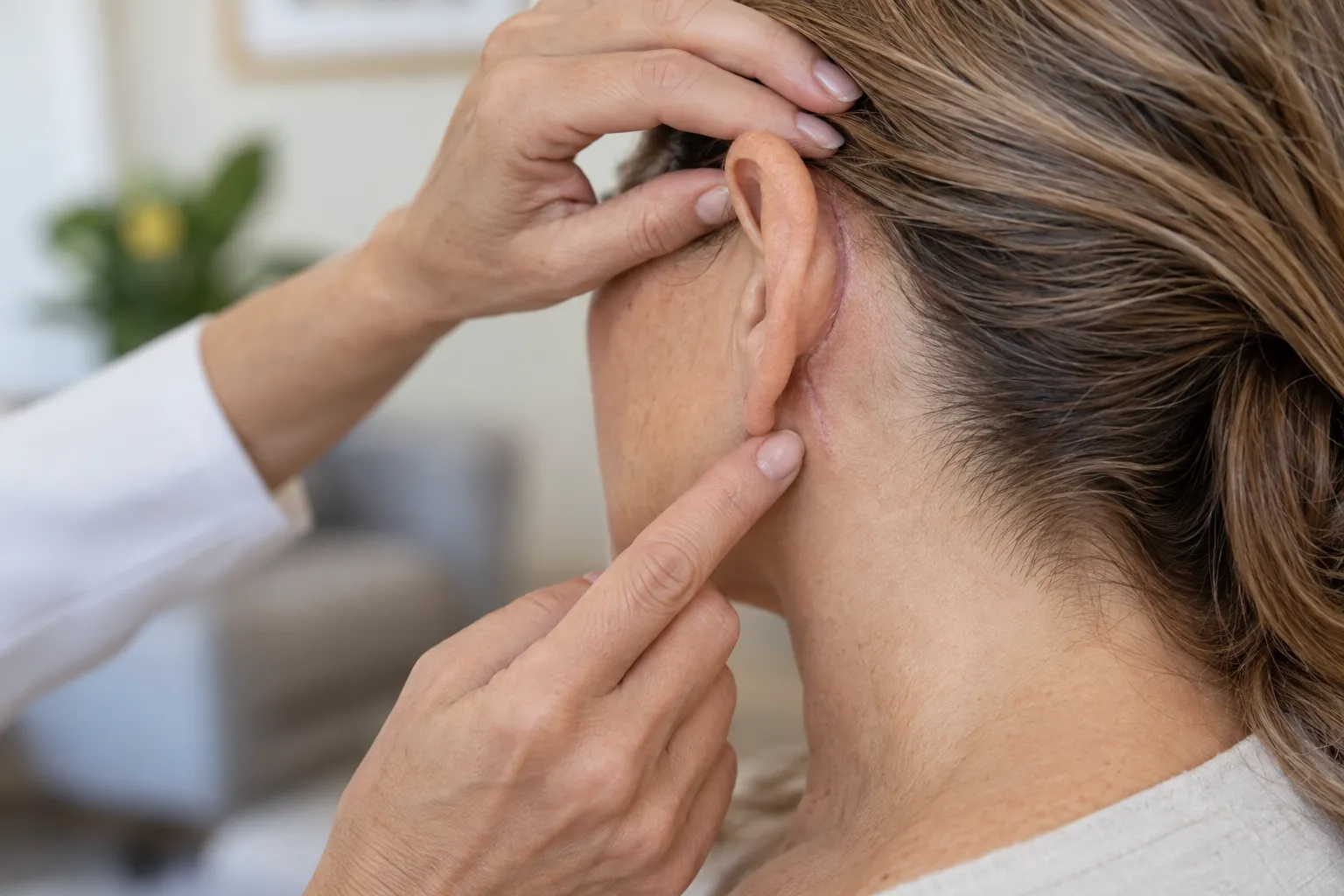
Photos can help you understand how an incision may look, but cannot predict your healing. When reviewing facelift scars behind the ears, check when the image was taken, whether hair covers the incision, and whether lighting and camera angle make the area easier or harder to see. Ask whether the photo shows a typical healing stage or a selected example. A close-up taken months after surgery is not directly comparable to an image from early recovery.
How to judge before-and-after scar photos: lighting, angle, and timing
Look for consistent lighting, a similar head position, and views that show the ear and hairline clearly. Images labeled facelift scars before and after may focus on facial changes rather than the incision, so ask to see views of the area that concerns you. Face lift scars pictures and facelift scars behind ears pictures can help you form questions, not decide what your scar will look like. Dr. Mark Albert can discuss how a proposed Facelift plan relates to your anatomy and hairline during an individualized consultation.
FAQ: Will people see my scars? What if my scar heals badly?
Will people be able to see the scars? They may be difficult to notice in some situations, but visibility varies with the incision, hairstyle, lighting, skin tone, and scar maturation. No surgeon can promise an invisible scar.
What if a scar heals badly? A widened, raised, discolored, or distorted scar should be assessed by your surgeon. Healing variation does not establish the cause. After examination, your clinician can explain whether observation or treatment may be appropriate and discuss the limits and risks of any option.
When to contact your surgeon and when to seek in-person care
Contact your surgical team if the incision opens, drainage develops, redness spreads, discomfort worsens, or you notice a change that concerns you. Fever or rapidly worsening symptoms warrant prompt medical advice; seek urgent care if symptoms are severe or you cannot reach your surgeon. Photos and online guidance cannot determine the cause or urgency for an individual. An in-person assessment lets a qualified clinician examine the incision and advise you based on your healing and medical history.
Frequently Asked Questions
Where do surgeons hide facelift scars?
Surgeons typically hide facelift scars around the ear, along the crease behind it (the retroauricular crease) and sometimes into the hairline behind the ear. This placement helps conceal the incision when the ear is viewed from the front or side, though the scar may still be visible if hair is pulled back, cut short, or wet.
Why do ears look weird after a facelift?
Ears can look different after a facelift because incisions pass near the earlobe and behind the ear, and early swelling, bruising, or crusting may temporarily change how the ear appears. In most cases these changes settle as healing progresses. Any persistent or concerning change in ear shape should be assessed in person by your surgeon.
What do facelift scars look like behind the ears?
Facelift scars behind the ears usually follow the natural crease behind each ear and may extend into the hairline. In the first weeks they often look red, raised, or firm, then gradually soften and fade over 6 to 12 months. A mature scar may remain visible at close range, and no incision can be promised to become invisible.
How long does it take for facelift scars behind the ears to heal?
Facelift scars behind the ears generally take 6 to 12 months to mature, fade, and soften. Early healing brings redness, swelling, and firmness in the first weeks, with gradual improvement over the following months. Individual healing varies, so your surgeon's in-person assessment takes priority over any general timeline.
Does skin age faster after a facelift?
Skin does not necessarily age faster after a facelift, but the procedure does not stop the natural aging process. A facelift repositions lifted tissues, and skin continues to change over time as it would otherwise. Ongoing sun protection, skin care, and healthy habits support your results, and long-term expectations are best discussed during a consultation.
What happens 10 years after a facelift?
Ten years after a facelift, most patients still look younger than they would have without surgery, though natural aging has continued. Tissue descent, skin changes, and volume loss may gradually return. Results vary widely by patient, skin quality, and lifestyle, so longevity is best discussed during an individualized consultation with a qualified clinician.
How does incision placement differ for a mini facelift, deep plane facelift, or neck lift?
Incision patterns are tailored to the operation and the areas being treated. A mini facelift may use a more limited pattern, a deep plane facelift still requires incisions planned around the ear and hairline, and a neck lift may include an incision behind the ear when the neck is part of the plan. Your surgeon explains the proposed locations during consultation.
Leave a Reply