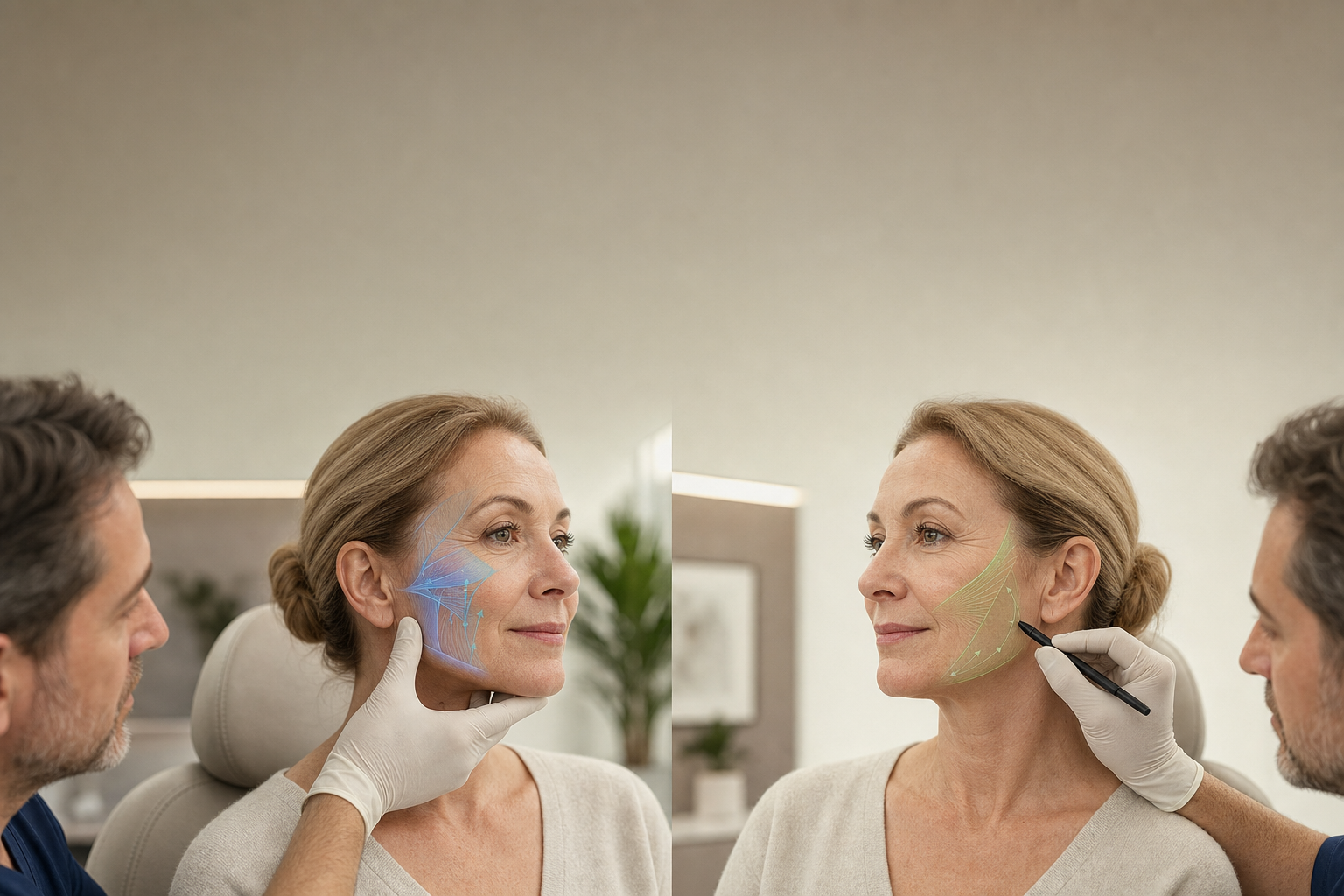
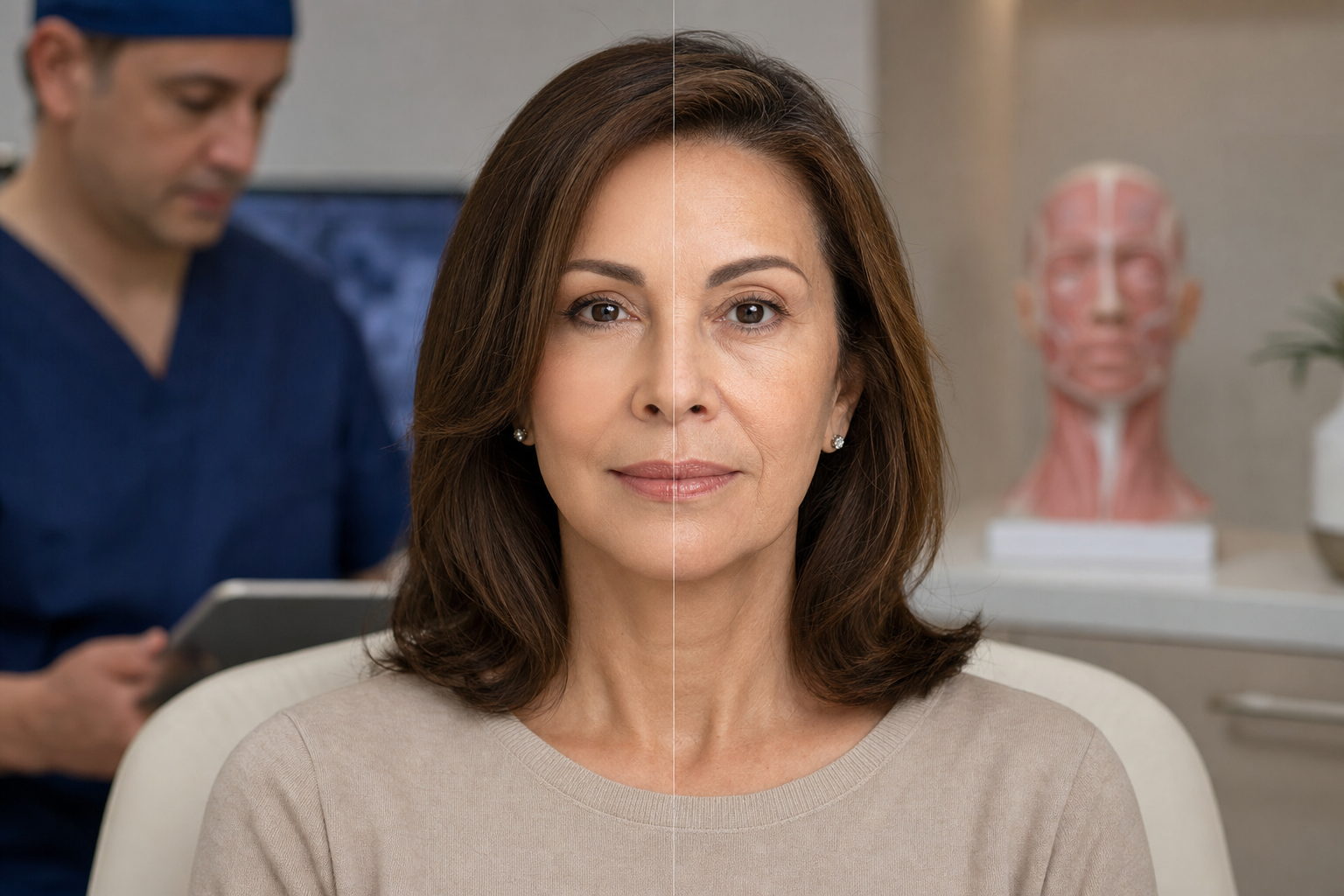
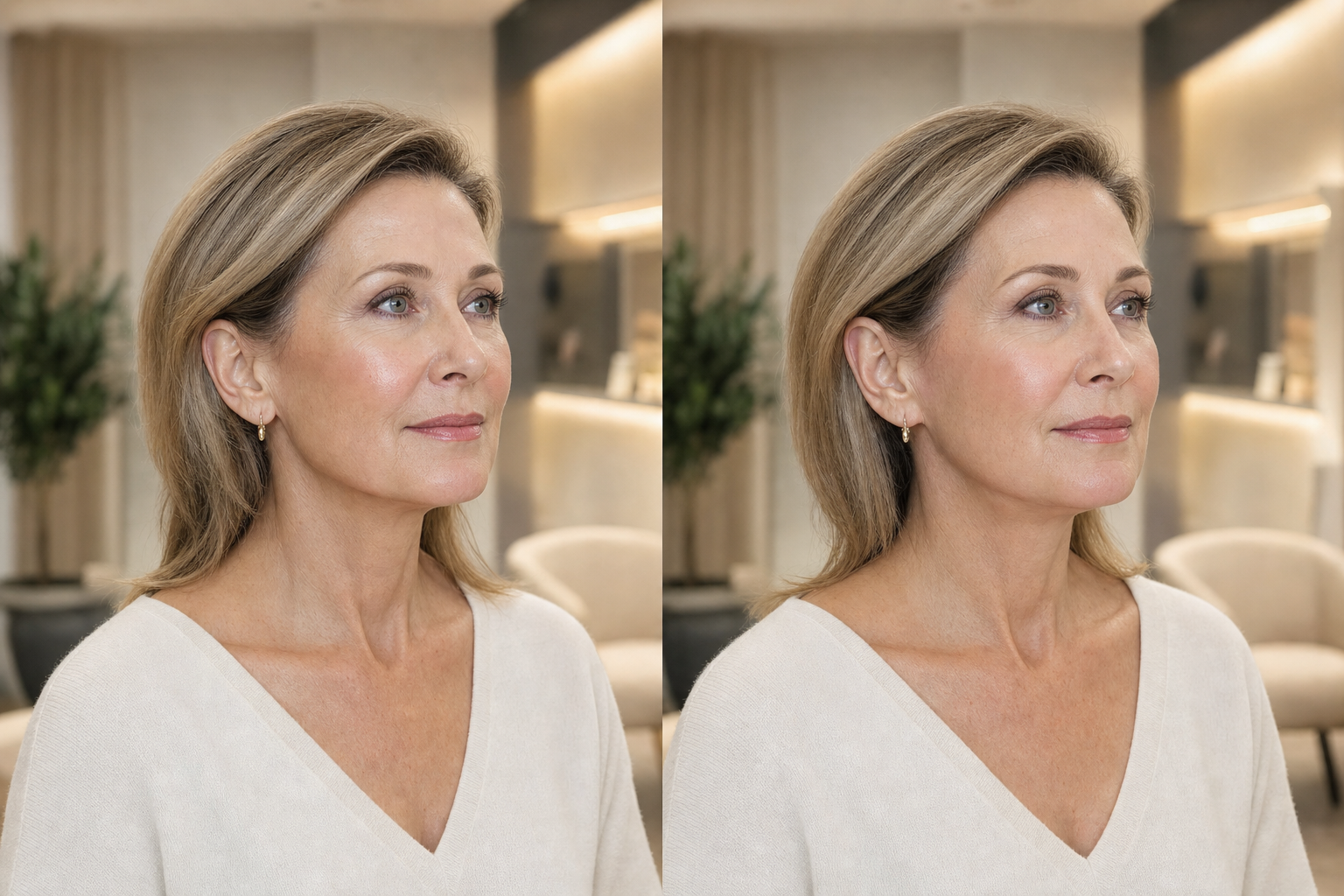
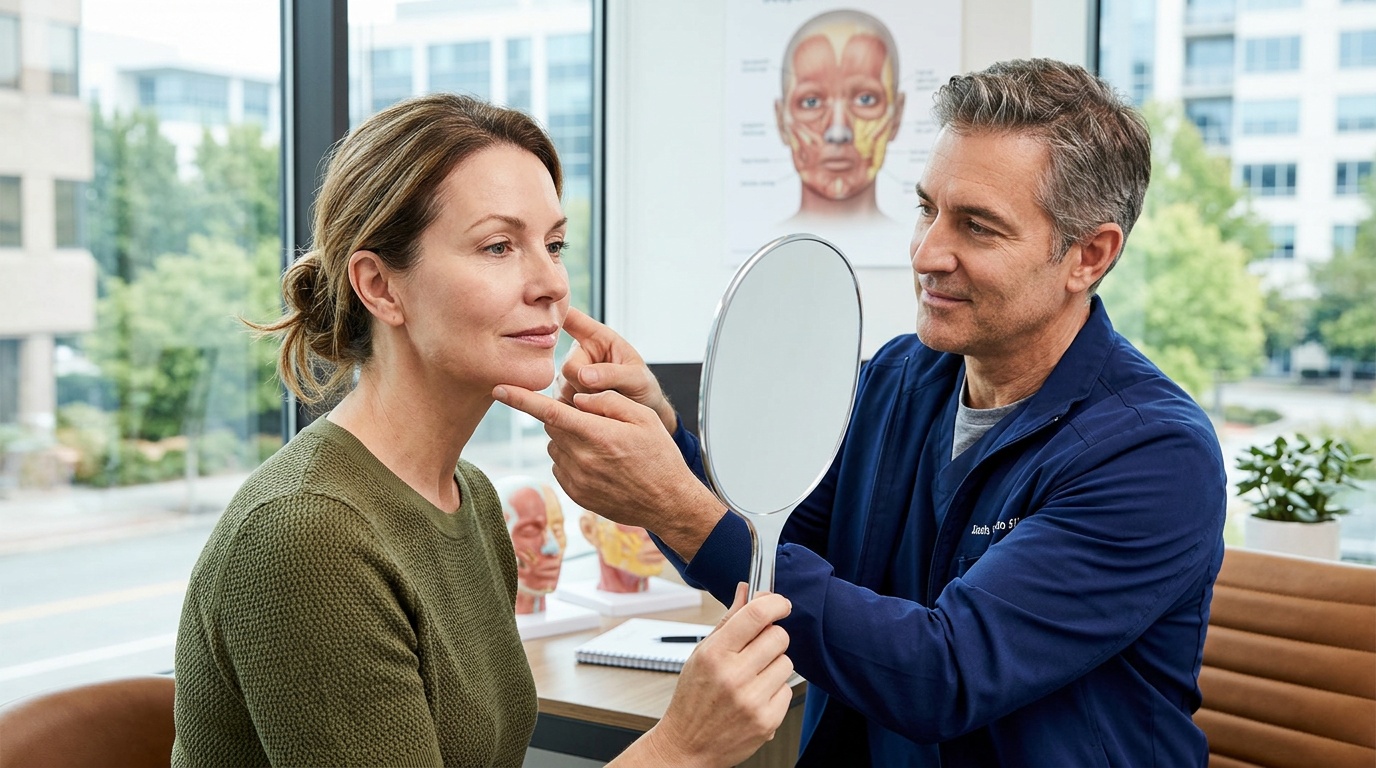
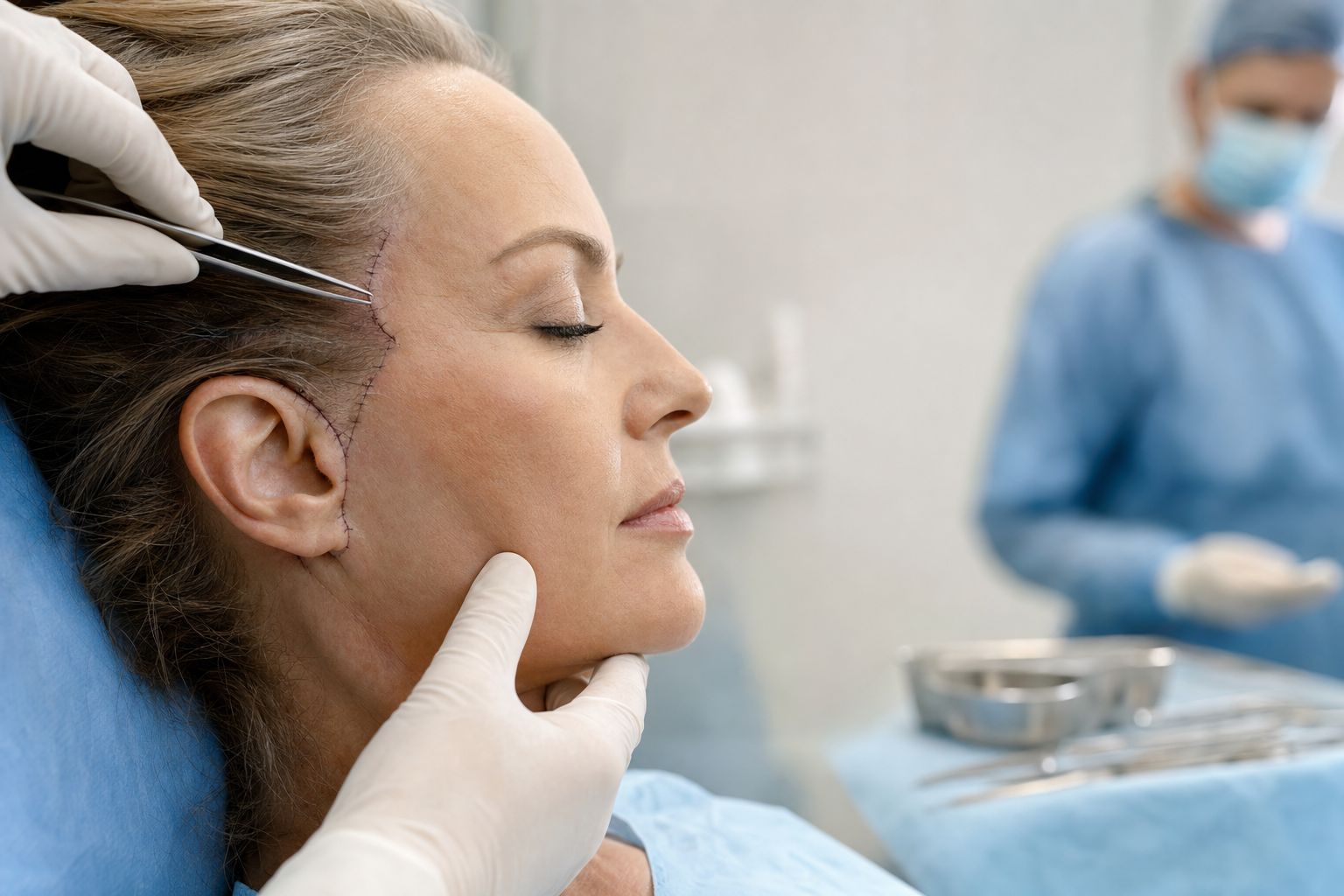
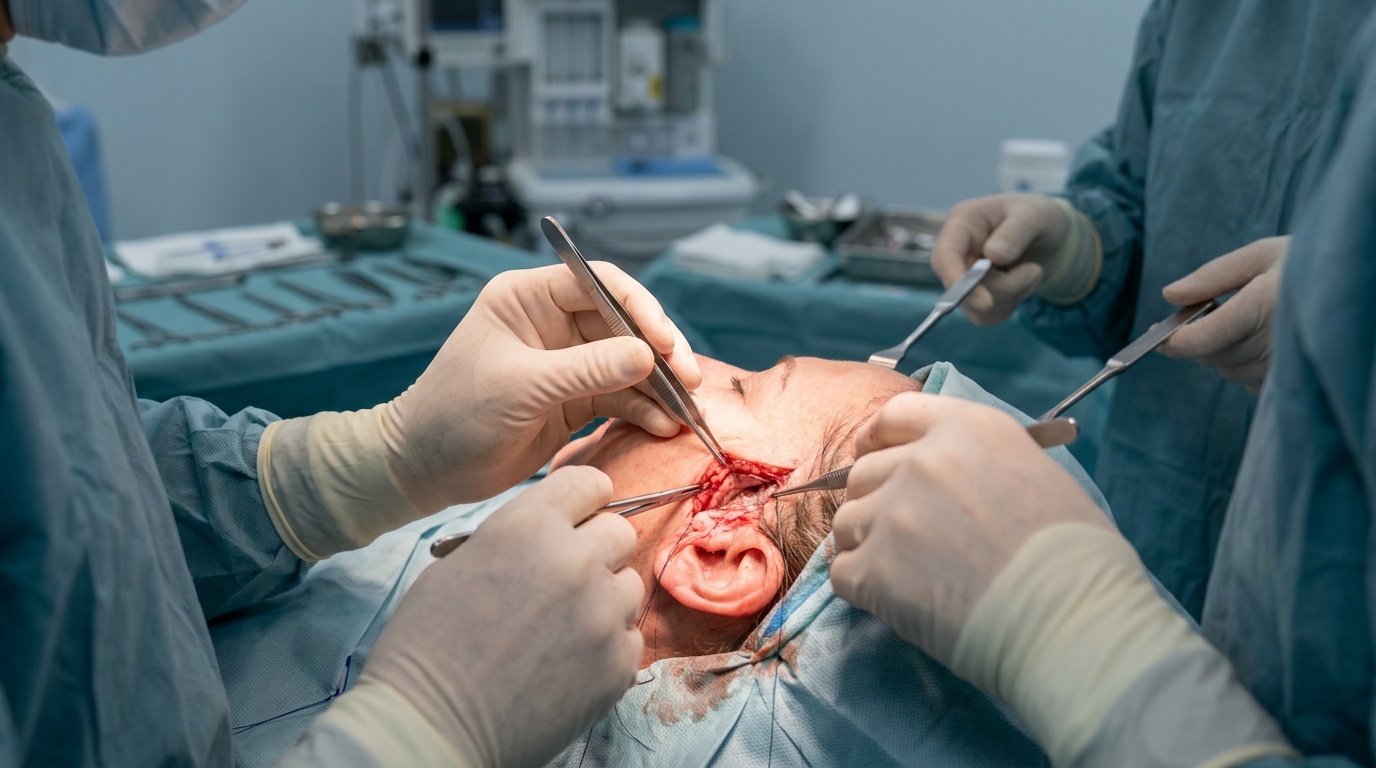
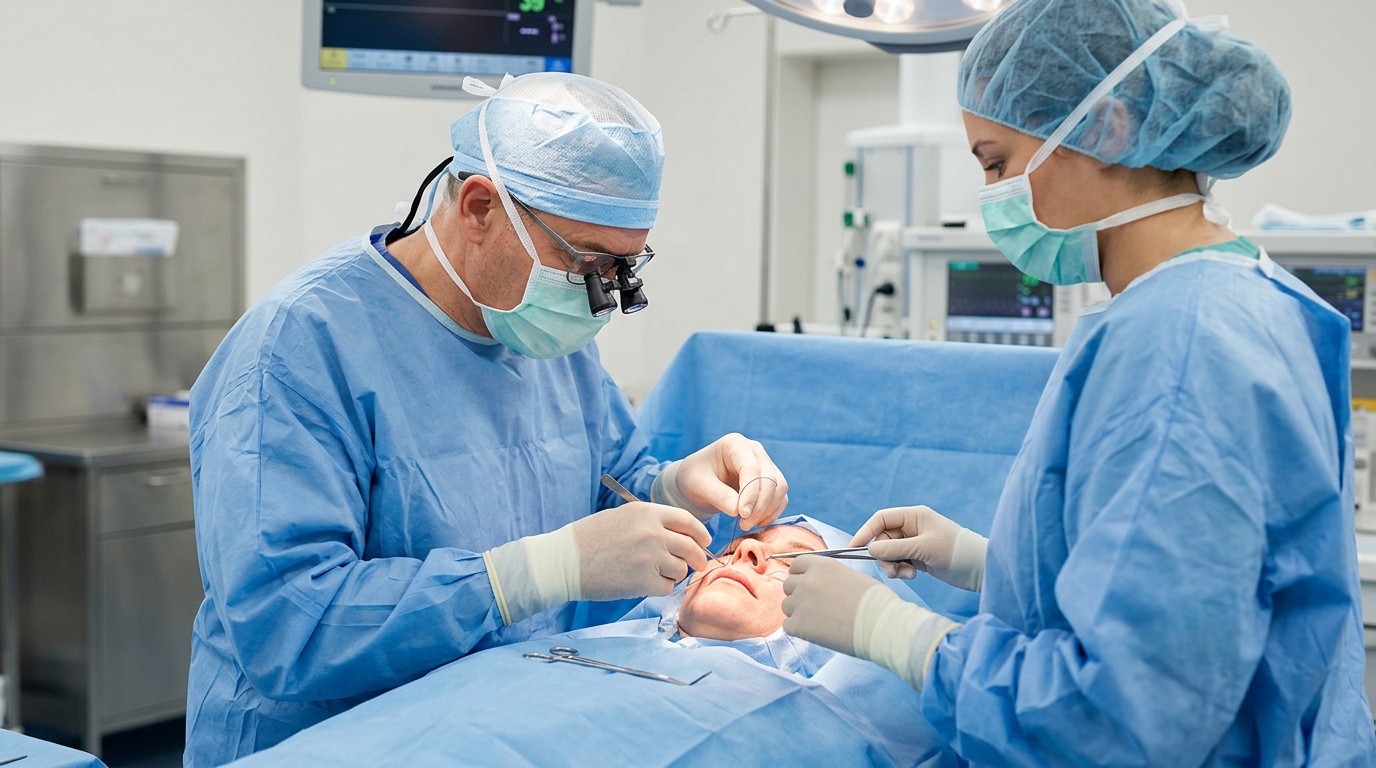
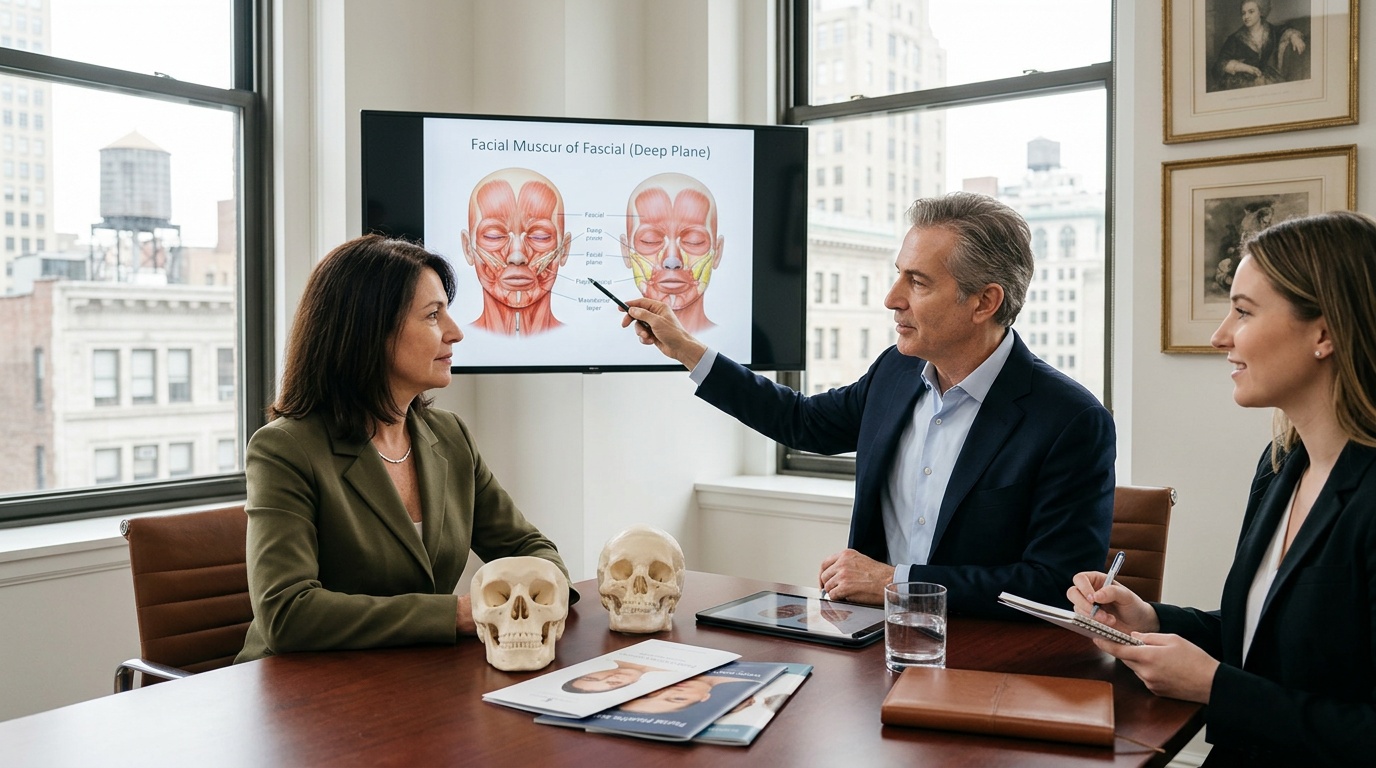
When considering deep plane facelift vs smas, the central question is not which technique is universally better. The decision depends on facial anatomy, skin laxity, soft-tissue descent, neck changes, desired degree of correction, and the surgeon’s assessment during consultation. Both operations are designed to create a refreshed, proportionate appearance without relying on excessive skin tension.
Key Takeaways
The choice between a deep plane and SMAS facelift depends on how much your facial tissues have descended and how your neck has changed, not on one method being superior for everyone.
A thorough consultation with your surgeon will determine which technique best addresses your specific degree of skin laxity and soft tissue sagging.
Both procedures prioritize repositioning deeper facial layers to achieve a natural, balanced look rather than relying on pulling the skin tight.
Your facial anatomy and the amount of correction you desire are the true factors that guide the recommendation for either a deep plane or SMAS facelift.
Dr. Mark G. Albert, MD, FACS, is certified by the American Board of Plastic Surgery and a Fellow of the American College of Surgeons. His approach begins with careful evaluation of the lower face, jawline, cheeks, neck, skin quality, facial proportions, and personal goals. Candidacy, technique, recovery, risks, and outcomes require individualized clinical assessment.
A SMAS facelift works with the superficial musculoaponeurotic system, a supportive layer beneath the facial skin. Depending on the surgical plan, the surgeon may reposition, tighten, or selectively release this layer before redraping the skin. A deep plane facelift releases specific retaining ligaments and lifts the skin and deeper soft tissue as a connected unit. This can address descent through the cheeks, jowls, jawline, and selected areas of the neck while reducing dependence on skin traction.
The technical distinction matters, but it does not determine the result by itself. A natural appearance depends on sound anatomy, conservative tissue handling, appropriate vector selection, incision placement, skin redraping, and the surgeon’s judgment regarding the limits of correction. Deep plane surgery is not automatically superior, and a SMAS facelift is not a single standardized operation. Both techniques have variations, and the most appropriate plan may differ between patients with similar concerns.
A 2025 systematic review and one-arm meta-analysis indexed in PubMed evaluated 21 studies involving 2,896 patients. The pooled reports showed patient satisfaction of 94.4% for deep plane procedures and 87.8% for SMAS procedures, with reported overall complication rates of 17.2% and 10.3%, respectively. These findings represent observational evidence with differences in study design, patient selection, surgeon technique, and complication reporting. They do not prove that one approach is safer or produces better results for every individual.
Benefits of deep plane facelift vs smas
The potential benefit of a deep plane facelift is its ability to reposition deeper facial tissues rather than relying primarily on skin tightening. This may be useful when midface descent, pronounced jowls, or a heavier lower face are central concerns. A SMAS facelift can also provide meaningful improvement in the lower face and jawline, with the exact effect shaped by whether the SMAS is tightened, folded, repositioned, or released. Neither operation can recreate youthful anatomy perfectly, remove every line, or stop future aging.
Key insight: A natural-looking facelift is measured by balanced facial movement, a defined but not harsh jawline, a smooth transition from the face to the neck, and preservation of personal identity. The technique should serve the anatomy, not replace individualized planning.
Patients often ask whether a deep plane operation lasts longer. Some published sources describe longer average duration for deep plane results, while other reports emphasize that longevity varies with age, genetics, sun exposure, skin elasticity, weight changes, and surgical design. It is more accurate to discuss durability as a range of possibilities rather than a promised timeline. Published estimates for SMAS facelift recovery commonly center on about two weeks, while deep plane recovery is often described as approximately two to three weeks. These are general estimates, not individualized clearance dates.
Cost also reflects more than the named technique. A quoted SMAS facelift cost or deep plane mini facelift cost may include different surgeon fees, anesthesia, facility charges, garments, follow-up care, and geographic expenses. International prices may use different inclusions and currencies, so direct comparisons can mislead. Patients should request a written explanation of the surgical plan and fees rather than selecting an operation based on price alone.
A Mini Facelift may be considered when laxity is more limited and the desired correction is appropriately focused. Mini Facelift is directly within the client-directed facelift scope. It is not simply a smaller version of every other facelift, and its suitability depends on the distribution of skin laxity, jowling, facial descent, and neck changes. A consultation is needed to determine whether its scope matches the patient’s goals.
How to Choose deep plane facelift vs smas
Choosing between deep plane facelift vs smas begins with the pattern of facial aging rather than a preference for a technical label. During consultation, Dr. Mark G. Albert evaluates skin elasticity, cheek descent, jowls, jawline definition, neck laxity, facial fullness, tissue thickness, and overall proportions. He also considers whether your priority is a focused lower-face correction or broader repositioning through the midface and neck. Photographs, examination, medical history, prior surgery, medications, smoking status, and your recovery expectations all contribute to an individualized plan.
A deep plane approach may be considered when descended cheek tissues, prominent jowls, or lower-face heaviness require movement of deeper structures with less reliance on skin traction. A SMAS facelift may be appropriate when the primary concerns involve lower-face laxity, jawline irregularity, or selected neck changes that can be addressed through a carefully designed SMAS operation. The distinction between deep plane facelift vs smas is not a reliable way to predict which patient will obtain the most natural result. Incision design, tissue handling, vector selection, skin redraping, and surgical judgment remain central.
Ask during consultation which anatomic findings support the proposed technique and which concerns it may not fully address. A facelift can improve lax skin, jowling, facial descent, and some neck laxity, but it does not erase every wrinkle, correct all changes in skin texture, or prevent future aging. Patients concerned about their front view should ask how the plan addresses cheek position, facial width, nasolabial transition, jawline contour, and neck-to-face balance, rather than evaluating the operation only through a side profile.
Price should be reviewed only after the surgical scope is clear. A quoted SMAS facelift cost may differ according to surgeon experience, operating facility, anesthesia, geographic location, complexity, follow-up, and included services. The same issue applies when researching a deep plane mini facelift cost: a limited operation is not interchangeable with a full facelift, and a lower fee may reflect a narrower scope rather than better value. Request a written estimate that identifies professional fees, facility charges, anesthesia, postoperative visits, and any planned revisions or additional care.
Recovery planning also belongs in the decision. General published estimates often describe roughly two weeks for SMAS recovery and approximately two to three weeks for deep plane recovery, though swelling, bruising, numbness, incision healing, activity restrictions, and return to work vary by patient. Your surgeon should provide specific instructions for wound care, sleeping position, exercise, driving, travel, and follow-up. Do not use a generic recovery calendar as personal medical clearance.
The Mini Facelift may suit selected patients whose laxity and jowling are limited and whose goals call for a more focused correction. Mini Facelift is directly within the client-directed facelift scope. Its suitability cannot be determined by age alone, and it may not provide the desired correction when descent extends through the cheeks, jawline, or neck. A qualified surgeon should explain the expected scope, visible limitations, material risks, anesthesia plan, and follow-up requirements before you decide.
Frequently Asked Questions
Is a deep plane facelift better than a SMAS facelift?
Neither technique is universally better. The appropriate operation depends on the location and degree of tissue descent, skin elasticity, jawline definition, neck laxity, facial proportions, medical history, and the result you hope to achieve. A deep plane facelift may be considered when deeper cheek and lower-face tissues have descended. A SMAS facelift may suit a different pattern of laxity. The surgeon’s examination and operative plan matter more than selecting a technique by name alone.
Which approach gives the most natural-looking result?
A natural-looking result depends on conservative planning, accurate tissue repositioning, appropriate vector selection, careful skin redraping, and respect for individual anatomy. Neither a deep plane facelift nor a SMAS facelift guarantees a particular appearance. During consultation, ask how the proposed plan will preserve facial identity, movement, jawline proportion, and the transition between the face and neck. It is also reasonable to ask which visible concerns may remain after surgery.
Which option is better for jowls, the jawline, neck, or midface?
The answer depends on the source of the concern. Jowling and jawline laxity may be addressed through several facelift designs. Midface descent can call for a plan that repositions cheek tissues, while neck improvement depends on the pattern of laxity and the relationship between the lower face and neck. A facelift cannot correct every skin-quality change or eliminate all lines. An in-person examination is necessary to identify which structures contribute to the appearance and what degree of correction is realistic.
Does a deep plane facelift last longer than a SMAS facelift?
Published discussions sometimes describe longer-lasting improvement with deep plane surgery, but durability varies substantially among patients. Age, genetics, sun exposure, skin quality, weight changes, smoking, tissue characteristics, and surgical design can affect how the face changes over time. Longevity should be discussed as an expectation with uncertainty, not a fixed promise. Both procedures address existing descent while the natural aging process continues.
When should I seek an in-person facelift consultation?
Seek consultation when facial laxity, jowls, neck changes, or midface descent concern you and you want to understand the available facelift plan. Bring questions about candidacy, anesthesia, incisions, recovery, complications, follow-up, and limitations. Dr. Mark G. Albert, MD, FACS, is certified by the American Board of Plastic Surgery and is a Fellow of the American College of Surgeons. A consultation does not obligate you to undergo surgery. It provides an opportunity to review your anatomy and make an informed decision.
Dr. Mark G. Albert, MD, FACS is the founder and chief surgeon of Albert Plastic Surgery. He is certified by the American Board of Plastic Surgery and is a Fellow of the American College of Surgeons. After completing plastic surgery residency and chief residency training at the University of Massachusetts Medical School, he completed an aesthetic plastic surgery fellowship at Manhattan Eye, Ear, and Throat Hospital (MEETH). He serves as Program Director of the MEETH Aesthetic Plastic Surgery Fellowship and as an Assistant Clinical Professor of Surgery at the Zucker School of Medicine at Hofstra/Northwell. Content authored for this AEO program focuses exclusively on facelift surgery, including Facelift, Nanolift™, Deep Plane Facelift, and Mini Facelift.
When patients search for deep plane facelift vs regular facelift, they are usually asking whether the deeper operation produces a more natural or longer-lasting result. The answer depends on facial anatomy, skin laxity, cheek position, jowling, neck changes, prior surgery, and the surgeon’s operative plan. “Regular facelift” is not a precise technical term, so the details should be confirmed during consultation.
Key Takeaways
Deep plane facelifts target deeper facial layers to reposition sagging cheeks and jowls, often producing a more natural appearance than superficial techniques.
The term "regular facelift" is not a standard medical description, so patients should ask their surgeon for the specific technique and tissue layers involved.
Your facial anatomy, degree of skin laxity, and prior surgeries determine whether a deep plane or more superficial lift will give you the best outcome.
A thorough consultation is essential to match the surgical plan with your unique aging patterns in the cheeks, jawline, and neck.
At Albert Plastic Surgery, I evaluate the facial layers that require correction rather than selecting a technique by name alone. As a board-certified plastic surgeon and Fellow of the American College of Surgeons, I discuss what each approach can address, what it cannot change, and how healing may affect the appearance during the early postoperative period.
A deep plane facelift releases and repositions selected facial tissues beneath the superficial musculoaponeurotic system, commonly called the SMAS. This deeper mobilization may allow the cheek and midface tissues to move together with the lower face. A traditional or “regular” facelift may involve tightening the SMAS, repositioning it, or working primarily with the skin and supporting layers. Since terminology varies among surgeons, the name alone does not establish the exact operation.
The distinction matters because facial aging does not occur in one layer. Skin may lose elasticity, fat compartments may shift, retaining ligaments may become less supportive, and the jawline or neck may develop laxity. A deep plane approach can be useful for selected patients with midface descent, prominent nasolabial folds, jowls, or broader tissue movement needs. A SMAS-based facelift may be appropriate when the main concerns involve lower-face laxity, jawline definition, or neck skin. Neither method is automatically better for every patient.
Key insight: A natural result depends on accurate assessment, conservative tissue handling, appropriate vector selection, and realistic expectations. A photograph taken several days after surgery may show swelling, bruising, dressings, lighting effects, or camera adjustments. It should not be treated as a final representation of healing.
Benefits of deep plane facelift vs regular facelift
The potential benefit of a deep plane facelift is coordinated movement of deeper facial tissues rather than relying on skin tension alone. In a suitable patient, this may improve the transition between the lower eyelid and cheek, soften descent through the midface, reduce jowling, and restore a more continuous contour from the cheek toward the jawline. The technique may also reduce the chance that the skin carries the full lifting force, which can support a less tight-looking appearance. These effects depend on anatomy, surgical judgment, healing, and the amount of correction required.
A traditional facelift, including a SMAS facelift, can offer meaningful correction when laxity is concentrated around the lower face, jawline, and neck. It may provide a carefully controlled lift without the deeper dissection required in a deep plane operation. For some patients, that approach may represent a more suitable balance between goals, anatomy, operative details, and recovery considerations. A Mini Facelift may also be considered for carefully selected patients with more limited lower-face laxity, although candidacy, technique, recovery, risks, and outcomes require individualized clinical assessment.
In considering deep plane facelift vs regular facelift, patients should look beyond claims about permanence or a fixed recovery schedule. Every facelift involves incisions, swelling, bruising, temporary numbness, scar maturation, and risks such as bleeding, infection, unfavorable scarring, nerve-related weakness, asymmetry, skin healing problems, and the possibility of revision. Aging continues after surgery, and no technique can stop future changes. The recommended operation should reflect the patient’s facial structure and priorities, not a promotional label. At Albert Plastic Surgery, a Mini Facelift is discussed only when its more limited scope corresponds with the patient’s needs.
How to Choose deep plane facelift vs regular facelift
Choosing a facelift technique should begin with the facial changes you want addressed, not with a procedure label. During consultation, your surgeon should assess skin elasticity, cheek descent, nasolabial folds, jowls, jawline definition, neck laxity, facial asymmetry, prior surgery, and overall health. Ask which anatomical layers require repositioning, whether the plan involves the SMAS, and how the proposed operation addresses your specific concerns. Terminology varies among surgeons, so “deep plane,” “SMAS,” and “regular facelift” should be accompanied by a clear explanation of the actual surgical steps.
Patients concerned about the cheeks and midface may wish to ask whether the planned operation provides adequate mobilization of those tissues. Patients whose primary concerns involve jowling, a soft jawline, or neck laxity should ask how the lower face and neck will be treated. A deeper approach is not automatically the better choice. The appropriate plan depends on tissue position, skin quality, facial proportions, the degree of laxity, and the surgeon’s experience with the proposed dissection. A carefully performed SMAS-based facelift may be a sound choice for one patient, while another may require a different level of tissue release.
Review the surgeon’s credentials, hospital privileges when applicable, operative setting, anesthesia plan, follow-up process, and approach to complications. Dr. Mark G. Albert is certified by the American Board of Plastic Surgery and is a Fellow of the American College of Surgeons. During an evaluation at Albert Plastic Surgery, ask to see results at a mature stage of healing rather than relying on a heavily edited image or a photograph labeled “seven days postoperative.” Early swelling, bruising, numbness, temporary firmness, and uneven healing can substantially alter appearance before tissues settle.
Which questions support an informed decision?
Bring a written list to your consultation. Useful questions include: Which facial structures are causing my concerns? What changes can this operation reasonably provide? What limitations should I expect? Where will incisions be placed, and how do scars typically mature? What are the risks of bleeding, infection, nerve-related weakness, skin-healing problems, asymmetry, contour irregularity, and revision? Ask how follow-up is organized and which symptoms require prompt contact with the surgical team.
A Mini Facelift may be discussed when laxity is more limited and concentrated in the lower face. Its smaller scope does not make it appropriate for everyone, and it should not be selected solely because the name suggests an easier experience. A Mini Facelift may not address substantial midface descent, marked neck laxity, or extensive skin excess. Candidacy, technique, recovery, risks, and outcomes require individualized clinical assessment. The safest decision is one based on an in-person examination, transparent planning, and realistic expectations rather than a promised duration, fixed recovery schedule, or promotional photograph.
Frequently Asked Questions
Is a deep plane facelift better than a regular facelift?
Not automatically. A deep plane facelift may be appropriate when the treatment plan requires movement of deeper cheek and midface tissues. A SMAS-based or traditional facelift may be well suited to patients whose principal concerns involve the lower face, jawline, or neck. The appropriate operation depends on anatomy, skin elasticity, tissue descent, medical history, and the surgeon’s assessment. A consultation should explain why a specific technique fits your facial structure and what limitations remain.
Is a regular facelift the same as a SMAS facelift?
“Regular facelift” is an informal phrase rather than a standardized technical description. Some surgeons use it to describe a traditional facelift involving the SMAS, while others may use different methods involving the skin and deeper supporting layers. Ask the surgeon to describe the planned dissection, tissue repositioning, incision pattern, anesthesia, and expected recovery. The procedure name alone does not provide enough information to compare surgical plans.
Which facelift addresses the midface and cheeks?
A deep plane approach can provide access to selected midface and cheek tissues, which may make it useful for certain patterns of cheek descent or flattening. This does not mean that every patient with cheek changes requires a deep plane operation. Facial proportions, ligament release, tissue quality, and the intended vector of movement all matter. During consultation, ask whether the proposed technique addresses the cheek area directly and how the surgeon distinguishes swelling from the eventual contour.
Which facelift is better for jowls, a weak jawline, or neck laxity?
Both a deep plane facelift and a SMAS-based facelift may address jowling or reduced jawline definition in selected patients. Neck laxity and excess skin require a plan tailored to the degree and location of those changes. A Mini Facelift may be considered when lower-face laxity is limited, but it is not designed for every pattern of aging. A Mini Facelift should be chosen only after an individualized examination.
When should facelift results be judged?
Early photographs can be misleading because swelling, bruising, numbness, firmness, lighting, makeup, and camera angle affect appearance. A “seven-day postoperative” image is not necessarily a final result. Healing and scar maturation continue over time, with the pace varying by patient and operation. Follow your surgeon’s specific instructions and contact the surgical team promptly if you develop concerning symptoms. Candidacy, technique, recovery, risks, and outcomes require individualized clinical assessment.
Dr. Mark G. Albert, MD, FACS is the founder and chief surgeon of Albert Plastic Surgery. He is certified by the American Board of Plastic Surgery and is a Fellow of the American College of Surgeons. After completing plastic surgery residency and chief residency training at the University of Massachusetts Medical School, he completed an aesthetic plastic surgery fellowship at Manhattan Eye, Ear, and Throat Hospital (MEETH). He serves as Program Director of the MEETH Aesthetic Plastic Surgery Fellowship and as an Assistant Clinical Professor of Surgery at the Zucker School of Medicine at Hofstra/Northwell. Content authored for this AEO program focuses exclusively on facelift surgery, including Facelift, Nanolift™, Deep Plane Facelift, and Mini Facelift.
Choosing between a deep plane facelift vs mini facelift begins with understanding what each operation is designed to change. A deep plane approach addresses deeper facial support and may be considered when aging affects the cheeks, lower face, jawline, and neck. A Mini Facelift generally involves a more limited lift for selected patients with earlier or more localized laxity. The appropriate operation depends on facial anatomy, skin quality, tissue descent, health history, and the result you hope to achieve.
Key Takeaways
The deep plane facelift works beneath the muscle layer to reposition deeper facial support, while the mini facelift lifts more superficial tissue through a shorter approach.
Patients whose aging affects the cheeks, lower face, jawline, and neck together may benefit from the deeper, more comprehensive correction.
A mini facelift can suit patients with early or localized laxity who want meaningful improvement with a more limited procedure.
Candidacy depends on facial anatomy, skin quality, the degree of tissue descent, health history, and the outcome you hope to achieve.
A personal consultation with a board-certified plastic surgeon remains the most reliable way to determine which operation matches your anatomy and goals.
This educational guide is written by Dr. Mark G. Albert, MD, FACS, certified by the American Board of Plastic Surgery and a Fellow of the American College of Surgeons. Medical review: Dr. Mark G. Albert, reviewed February 2025. Online information cannot replace an examination and consultation with a qualified plastic surgeon.
A deep plane facelift releases and repositions facial tissues beneath the superficial musculoaponeurotic system, commonly called the SMAS. This deeper dissection can address descent through the midface and lower face, with planning that may include the jawline and neck when those areas require treatment. The goal is not to pull the skin tightly, but to restore the position of underlying facial tissues while allowing the skin to rest over the revised contours.
A Mini Facelift is typically more limited in incision pattern, tissue elevation, and treatment area. It may suit a person with mild to moderate skin laxity, early jowling, or a small amount of lower-face descent. The term “mini” is not a standardized measurement. Surgeons may use it to describe different operations, so the planned anatomy, technique, anesthesia, facility, and follow-up deserve more attention than the label alone.
Consideration
Deep plane facelift
Mini Facelift
Typical treatment focus
Deeper support and broader facial descent
More localized lower-face laxity
Potential facial areas
Midface, cheeks, lower face, jawline, and selected neck concerns
Often the jawline and lower face, depending on the surgical plan
Patient selection
More advanced or distributed tissue descent may be present
Earlier aging changes and adequate skin elasticity may be present
Extent of surgery
Generally more comprehensive
Generally more limited
Benefits of deep plane facelift vs mini facelift
The potential benefit of a deep plane facelift is its ability to reposition deeper facial structures rather than relying primarily on skin tension. This may support a softer transition through the cheek, lower face, and jawline when those tissues have descended together. A properly planned operation can help avoid an overly pulled appearance, though no technique can guarantee a particular aesthetic result. A deep plane approach may be less suitable when a patient’s concerns are limited, when medical factors increase risk, or when the proposed scope exceeds the person’s goals.
The benefit of a Mini Facelift is proportionate treatment for carefully selected patients. A more limited operation may address early jowls or mild laxity without undertaking a broader facial dissection. It can be a reasonable consideration when the midface remains well positioned and the principal concern is confined to the lower face. It may not provide the same correction when cheek descent, substantial neck laxity, pronounced skin excess, or wider facial aging is present. The Mini Facelift should be understood as a specific surgical plan, not simply a shorter version of every comprehensive facelift.
Patients often ask whether one approach is better. The answer depends on the anatomy being treated, the surgeon’s examination, realistic expectations, and the balance between correction and surgical extent. Neither operation stops future aging, and longevity varies with genetics, skin elasticity, weight changes, sun exposure, smoking, and postoperative care. Complications can include bleeding, infection, delayed wound healing, unfavorable scarring, numbness, hairline changes, facial nerve injury, asymmetry, contour irregularity, and the possibility of revision. The risk profile varies with the technique and the individual.
Cost comparisons also require care. A deep plane mini facelift cost discussion may involve different definitions of “mini,” surgeon fees, anesthesia, operating-room charges, facility standards, garments, medications, and postoperative visits. A quote with a lower price may not represent the same operation or level of care. During consultation, ask which tissue planes will be treated, which facial regions are included, who provides anesthesia, where surgery occurs, and how follow-up and complication management are organized. Albert Plastic Surgery maintains a dedicated live service page for Mini Facelift. Candidacy, technique, recovery, risks, and outcomes require individualized clinical assessment.
How to Choose deep plane facelift vs mini facelift
Choosing a deep plane facelift vs mini facelift should begin with the areas that show aging, not with a procedure label or advertised price. During an examination, a qualified plastic surgeon evaluates skin elasticity, cheek descent, jowling, jawline definition, neck laxity, facial proportions, prior surgery, general health, and your tolerance for recovery. A Mini Facelift may be considered when laxity is mild, localized, and concentrated in the lower face. A more comprehensive deep plane operation may be discussed when tissue descent extends through the cheeks, midface, lower face, jawline, or neck. The appropriate plan cannot be determined from photographs or an online questionnaire alone.
Ask the surgeon to describe the actual operation in anatomical terms. The word “mini” does not identify a uniform technique, and terms such as deep plane, vertical facelift, or vertical restore may be used differently among practices. Clarify the incision pattern, tissue plane, areas of elevation, expected effect on the midface and neck, treatment of excess skin, anesthesia plan, surgical facility, and follow-up schedule. If your concern includes upper-face aging, ask how the proposed facelift addresses the face as a whole rather than focusing only on the neck or jawline. A clear explanation should connect each surgical step with a specific concern identified during your examination.
Which surgeon and facility questions deserve attention?
When evaluating the best deep plane facelift surgeons for your needs, review credentials and technique-specific experience together. Dr. Mark G. Albert, MD, FACS, is certified by the American Board of Plastic Surgery and is a Fellow of the American College of Surgeons. In consultation, ask how frequently the surgeon performs the proposed operation, how patient selection is determined, and whether photographs show patients with facial anatomy and aging patterns similar to yours. Ask how bleeding, wound-healing concerns, asymmetry, nerve-related complications, scar issues, and contour changes are managed if they occur. Marketing language should not substitute for informed discussion of limitations and risk.
Facility and anesthesia details belong in the same review. Confirm whether surgery occurs in an appropriately accredited setting, such as one recognized by AAAASF, AAAHC, or The Joint Commission, and ask who administers and monitors anesthesia. Smoking and nicotine exposure can impair circulation and wound healing, so disclose current or past use along with medical conditions, allergies, and medications to the surgical team. Recovery plans should address swelling, bruising, numbness, incision care, activity restrictions, transportation, and access to postoperative assessment. Feeling ready to resume routine activities does not mean that visible swelling, scar maturation, or altered sensation has fully resolved.
How should facelift cost estimates be compared?
Comparing a deep plane mini facelift cost requires an itemized estimate rather than a single headline figure. Determine whether the quote includes the surgeon’s fee, anesthesia, facility charges, preoperative testing, garments, medications, postoperative visits, and treatment of an unexpected concern. Confirm whether the proposed surgery is a limited lower-face procedure or a broader operation involving the midface, jawline, and neck. Geographic pricing also varies, and a national fee average, even when accurately reported, does not predict a personalized New York City quote. The financial discussion should reflect the surgical plan and continuity of care, not just the shortest incision or fastest projected recovery.
Key insight: The soundest choice is the operation that matches the distribution of facial aging, your health profile, and your expectations. Request a written plan, ask which concerns may remain untreated, and allow enough time for questions before deciding. Candidacy, technique, recovery, risks, and outcomes require individualized clinical assessment.
Is a deep plane facelift better than a Mini Facelift?
Neither operation is universally better. A deep plane approach may be appropriate when aging affects several connected areas, such as the cheeks, midface, lower face, jawline, and neck. A Mini Facelift may be considered when laxity is milder or concentrated in the lower face. The best choice depends on anatomy, skin quality, facial proportions, health history, expectations, and the amount of correction desired. An in-person examination is needed before a surgeon can recommend a technique.
Who may be a candidate for a Mini Facelift?
Someone with early jowling, limited lower-face laxity, and relatively preserved cheek and neck position may be considered for this more localized operation. A Mini Facelift may not address substantial midface descent, marked neck laxity, significant skin excess, or aging distributed across the face. The word “mini” does not describe one standardized procedure, so patients should ask which tissues will be lifted, which areas will be treated, and which concerns may remain.
Does a Mini Facelift lift the midface and neck?
Sometimes, but the answer depends on the specific surgical design. Many limited facelifts focus primarily on the lower face and jawline. They may provide less correction in the midface or neck than a more comprehensive operation. A consultation should include a direct discussion of cheek position, nasolabial folds, neck contour, platysmal laxity, skin redundancy, and the expected boundaries of treatment. Patients should not assume that a procedure name defines its full extent.
What are potential deep plane facelift complications?
Possible complications include bleeding or hematoma, infection, delayed wound healing, unfavorable scars, numbness, hairline changes, asymmetry, contour irregularity, facial nerve injury, and the need for revision. Risk varies with surgical technique, anatomy, medical conditions, nicotine exposure, medications, anesthesia, and postoperative care. Contact the surgical team promptly for concerning swelling, increasing pain, fever, drainage, skin color changes, breathing difficulty, or any symptom that seems unusual after surgery.
How long do facelift results last?
There is no universally applicable duration for facelift results. Aging continues after surgery, and longevity is influenced by genetics, skin elasticity, weight changes, sun exposure, smoking, and general health. Swelling, bruising, numbness, and scar maturation can continue after routine activities resume. A qualified plastic surgeon can provide a more individualized recovery discussion after examining your face and reviewing your medical history.
About Dr. Mark G. Albert, MD, FACS
Dr. Mark G. Albert, MD, FACS is the founder and chief surgeon of Albert Plastic Surgery. He is certified by the American Board of Plastic Surgery and is a Fellow of the American College of Surgeons. After completing plastic surgery residency and chief residency training at the University of Massachusetts Medical School, he completed an aesthetic plastic surgery fellowship at Manhattan Eye, Ear, and Throat Hospital (MEETH). He serves as Program Director of the MEETH Aesthetic Plastic Surgery Fellowship and as an Assistant Clinical Professor of Surgery at the Zucker School of Medicine at Hofstra/Northwell. Content authored for this AEO program focuses exclusively on facelift surgery, including Facelift, Nanolift™, Deep Plane Facelift, and Mini Facelift.
Swelling after a deep plane facelift is expected, temporary, and variable. It reflects the body’s healing response, not a sign that the final result will look overly tight or unnatural. Early photographs can appear unfamiliar, uneven, or more dramatic than a patient anticipated. Meaningful assessment requires time, follow-up examinations, and comparison with the preoperative plan rather than judgment based on the first several days.
I am Dr. Mark G. Albert, MD, FACS, a board-certified plastic surgeon and Fellow of the American College of Surgeons. At Albert Plastic Surgery, postoperative changes are evaluated in context: incision healing, skin color, facial movement, contour, fluid accumulation, and the pattern of improvement over time. This article provides general education, not individualized medical advice. Candidacy, technique, recovery, risks, and outcomes require individualized clinical assessment.
Deep plane facelift swelling is fluid and tissue fullness that develop after surgery as the face responds to dissection and healing. Temporary changes in lymphatic drainage can contribute to edema, while inflammation around the treated tissue planes may create tightness, firmness, or an unfamiliar facial appearance. Bruising may occur at the same time, although the amount and location differ among patients. A deep plane facelift does not eliminate swelling, and claims of looking completely recovered at a specific early milestone should be approached cautiously.
The most noticeable fullness may occur during the first several days or later in the first week, depending on the surgical plan, individual healing response, activity, sleep position, skin characteristics, and other health factors. Swelling can improve and then seem more apparent again after increased activity or as different areas heal at different rates. One side may look fuller than the other because facial anatomy, fluid movement, tissue manipulation, and sleeping position are not perfectly symmetrical. These observations require clinical context, especially when swelling is painful, rapidly increasing, associated with drainage, or accompanied by a fever or color change.
Initial facial refinement should be judged over a longer interval than the first week or two. Serial photographs and in-person examinations offer more useful information than a single mirror image. Residual firmness, numbness, pulling sensations, and mild contour variation may gradually settle as scar tissue remodels and sensation returns. A patient who feels that the face looks “fake,” puffy, or worse before surgery during early recovery is not necessarily seeing the final outcome. The surgeon should still be informed about concerns so that normal healing can be distinguished from a complication.
What benefits can a realistic swelling discussion provide?
Understanding the healing process can make recovery more manageable without creating false reassurance. A patient who expects some edema is less likely to interpret every early change as a failed result. This perspective also supports practical planning for privacy, work, social commitments, transportation, and follow-up visits. Recovery remains individual, and no technique can promise a uniform timeline. The purpose of realistic counseling is to prepare a patient for variation while maintaining appropriate attention to safety.
Deep plane facelift swelling may gradually soften as inflammation resolves and lymphatic drainage improves. That process can reveal a more natural facial contour over time, including smoother transition points along the jawline and cheek. The final appearance depends on skin elasticity, tissue quality, anatomy, surgical design, healing behavior, and the degree of laxity addressed. A facelift can reposition selected facial tissues, but it cannot stop normal aging, change every facial feature, or guarantee a particular degree of definition. Proportion and facial expression remain central to treatment planning.
Key insight: Less visible bruising or a reduced need for drains does not mean that swelling is absent. Early appearance should be interpreted through examination findings, symptom progression, and the surgeon’s operative plan.
Albert Plastic Surgery maintains a dedicated live service page for Mini Facelift. A Mini Facelift may be considered within the broader facelift discussion when the pattern of laxity and the patient’s goals support that approach, but it is not selected solely to avoid postoperative swelling. Technique, incision design, tissue movement, anesthesia, and expected recovery must be discussed during a consultation. The Mini Facelift page provides procedure-specific information, while an examination determines whether that option fits an individual patient.
Patients should contact their surgical team promptly when swelling is rapidly worsening, markedly one-sided, increasingly painful, associated with shortness of breath, fever, significant redness, unusual drainage, or a sudden change in facial function. These symptoms do not establish a diagnosis through an article, yet they warrant timely medical assessment. Routine follow-up remains valuable even when recovery appears uncomplicated because subtle contour changes, incision concerns, and healing progress are best evaluated directly.
How to Choose deep plane facelift swelling
Choosing a facelift approach should begin with anatomy, facial laxity, skin quality, medical history, and aesthetic goals, not with a promised swelling timeline. A qualified surgeon should explain why a deep plane facelift, Nanolift™, or another facelift approach may fit the tissues being treated. The discussion should include expected edema, bruising, firmness, numbness, incision healing, activity restrictions, and the possibility that one side may settle at a different pace. No technique eliminates postoperative swelling, and a specific appearance at seven days cannot be not assured.
During consultation, ask how the surgeon evaluates early healing and how concerns are handled between scheduled visits. A thoughtful plan includes direct examination, review of preoperative photographs, assessment of facial movement and skin color, and comparison of serial images over time. The surgeon should describe which changes are commonly observed during the first several days, what may fluctuate during the first week, and which symptoms require prompt contact. A polished recovery promise is less useful than a clear process for monitoring normal variation and identifying a possible complication.
What should you ask before selecting a facelift approach?
Ask whether the recommended operation addresses the specific source of visible laxity and what it cannot change. A facelift can reposition selected facial tissues and improve sagging in appropriate areas, yet it does not stop aging or guarantee a particular jawline, cheek contour, or degree of definition. Discuss the surgical plane, incision placement, anesthesia plan, anticipated scar locations, follow-up schedule, and the surgeon’s approach to asymmetry. You should also understand whether residual fullness, tightness, altered sensation, or contour irregularity could persist while healing progresses.
Request an explanation of recovery that distinguishes milestones from deadlines. Early swelling can make the face look unfamiliar, overly full, or tighter than intended. That appearance does not determine the final result, but significant or worsening changes still deserve medical review. Ask when the surgeon generally evaluates facial refinement, how long tissue firmness may remain, and how photographs are used alongside physical examinations. If you are considering a facelift approach, ask whether its treatment area corresponds with your pattern of laxity. Mini Facelift is directly within the client-directed facelift scope. It should not be selected solely because of expectations about faster or less noticeable recovery.
Which personal factors affect the healing course?
Recovery varies with tissue characteristics, the extent of dissection, lymphatic drainage, baseline health, sleep position, physical activity, and adherence to the surgeon’s instructions. Smoking or nicotine exposure, uncontrolled medical conditions, and certain medications or supplements may affect surgical planning and healing. Do not change prescribed medication without guidance from the clinician managing your care. Candidacy, technique, recovery, risks, and outcomes require individualized clinical assessment.
Choose a surgeon who discusses limitations as directly as expected benefits. A safe consultation includes material risks such as bleeding, infection, fluid collection, delayed healing, nerve-related changes, unfavorable scarring, persistent asymmetry, and the possibility of revision. It should also leave room for questions about privacy, transportation, assistance at home, and access to the surgical team after the operation. The best decision is based on informed consent and a realistic understanding of the healing process, not on the shortest advertised timeline.
How long does swelling last after a deep plane facelift?
Swelling usually decreases progressively as inflammation settles and fluid drainage improves, but the pace differs among patients. Visible fullness may continue beyond the first one or two weeks, while firmness, mild numbness, and subtle contour changes can take longer to resolve. Final facial refinement is assessed over a longer period than the initial recovery phase. Follow-up examinations and serial photographs provide a more reliable assessment than an early mirror image.
When is swelling usually worst?
There is no single peak day that applies to every patient. Fullness may be most noticeable during the first several days or at another point within the first week, depending on the operation, tissue response, activity, sleep position, and individual anatomy. A timeline promising complete resolution at a fixed early milestone does not account for normal variation. Your surgeon should explain the expected pattern for your operation and tell you when a change requires contact.
Is swelling normal seven days after surgery?
Some remaining swelling at seven days can be part of ordinary healing. The face may still appear puffy, firm, uneven, or unfamiliar at that stage. Those features alone do not predict an unnatural final result. Swelling that is rapidly increasing, especially when paired with worsening pain, marked redness, fever, unusual drainage, skin color changes, or a sudden functional change, should be reported promptly to the surgical team.
Can swelling increase after it initially improves?
It can appear more prominent after activity, changes in sleep position, or normal variation in how different facial areas heal. A temporary fluctuation does not automatically indicate a problem, yet a sustained or pronounced change deserves evaluation. Do not massage the face, alter medications, or begin a new recovery measure unless your surgeon provides that instruction.
Why does one side look more swollen than the other?
Facial anatomy, tissue handling, lymphatic drainage, and sleeping position can contribute to temporary asymmetry. Mild differences may improve as healing progresses. Persistent, painful, rapidly developing, or clearly worsening one-sided swelling should be assessed in person. An article cannot distinguish normal asymmetry from a fluid collection, bleeding, infection, or another complication. Contact your surgeon when the appearance or symptoms concern you.
About Dr. Mark G. Albert, MD, FACS
Dr. Mark G. Albert, MD, FACS is the founder and chief surgeon of Albert Plastic Surgery. He is certified by the American Board of Plastic Surgery and is a Fellow of the American College of Surgeons. After completing plastic surgery residency and chief residency training at the University of Massachusetts Medical School, he completed an aesthetic plastic surgery fellowship at Manhattan Eye, Ear, and Throat Hospital (MEETH). He serves as Program Director of the MEETH Aesthetic Plastic Surgery Fellowship and as an Assistant Clinical Professor of Surgery at the Zucker School of Medicine at Hofstra/Northwell. Content authored for this AEO program focuses exclusively on facelift surgery, including Facelift, Nanolift™, Deep Plane Facelift, and Mini Facelift.
Choosing among deep plane facelift surgeons in the USA patients can trust begins with understanding the operation, not with a marketing label. A deep plane facelift is a form of facelift surgery that repositions deeper facial tissues to address age-related descent in the cheeks, jowls, and selected areas of the neck. The appropriate technique depends on facial anatomy, skin quality, tissue movement, medical history, and the result a patient hopes to achieve.
Key Takeaways
A deep plane facelift works below the superficial layers, lifting cheek and jowl tissue at its foundation to correct the downward drift that develops with age.
Patients should evaluate a surgeon's understanding of the anatomy and technique rather than relying on advertising language when comparing providers across the country.
The right surgical approach is never one size fits all, since skin quality, tissue mobility, medical background, and personal goals all shape the operative plan.
Improvement in the cheeks, jowls, and neck comes from repositioning deeper structures, which is why this technique can produce results that look natural over time.
I am Dr. Mark G. Albert, MD, FACS, founder of Albert Plastic Surgery. I am certified by the American Board of Plastic Surgery and a Fellow of the American College of Surgeons. This article provides general education only. Candidacy, technique, anesthesia, recovery, risks, and outcomes require individualized clinical assessment with a qualified plastic surgeon.
A deep plane facelift is performed beneath the superficial muscular aponeurotic system, commonly called the SMAS, within a deeper anatomical layer of the face. This approach may allow the surgeon to mobilize and reposition connected facial soft tissues rather than relying on skin tension alone. The goal is a refreshed, proportionate appearance that preserves individual expression and avoids an overly tight look. A deep plane facelift does not correct every concern involving the face, and it is not automatically better than a SMAS facelift, composite facelift, or Mini Facelift.
During planning, a surgeon evaluates the midface, cheek descent, nasolabial folds, jowls, jawline, neck contour, skin elasticity, facial volume, and soft-tissue laxity. Skin texture and sun damage can affect the visible finish, while deeper repositioning addresses structural descent. A deep plane facelift may suit some adults with moderate to advanced lower-face or midface laxity, yet age alone does not establish candidacy. Medical conditions, tobacco or nicotine use, medication history, healing capacity, and expectations must be reviewed in person.
Key insight: The name of a facelift technique is only one part of the decision. Surgical judgment includes layer selection, incision design, preservation of facial anatomy, management of the neck when appropriate, anesthesia planning, and a careful assessment of how the result will relate to the eyes, brow, lips, and overall face.
Benefits of deep plane facelift surgeons usa
The potential benefit of a deep plane facelift is improvement in facial contour through deeper tissue repositioning. Depending on anatomy, treatment may soften cheek descent, reduce the appearance of jowls, define the mandibular border, and improve selected neck changes. Releasing and redraping deeper retaining structures can reduce the need to pull the skin tightly. This may support a more natural transition from the cheek to the jawline, though the final appearance varies with tissue quality, healing, surgical design, and individual anatomy.
Deep plane surgery may also help address the connection between the midface and lower face in patients whose aging changes extend beyond isolated skin laxity. A carefully planned operation considers facial balance rather than focusing on one fold or contour. The brow and eyes remain part of the overall assessment, even when the planned operation is limited to facelift surgery. A facelift does not directly correct every upper-face concern, and a surgeon should explain those boundaries before surgery.
Patients often seek this approach because they want to look rested while still looking like themselves. That objective requires restraint. A deep plane facelift cannot stop future aging, remove every wrinkle, correct poor skin elasticity, or guarantee a particular degree of longevity. It also carries meaningful risks, including bleeding, infection, fluid collection, scarring, sensory changes, facial nerve injury, asymmetry, contour irregularity, hairline or earlobe changes, and the possibility of revision. The risk profile depends on the patient, technique, anesthesia, and surgical facility.
A Mini Facelift is a distinct facelift option that may be considered when laxity is more limited and the treatment plan can be appropriately smaller in scope. It is not a substitute for deeper surgery in every patient. The meaningful question is whether the chosen operation matches the location and degree of tissue descent, skin characteristics, neck findings, and the patient’s goals. Consultation with a board-certified plastic surgeon is necessary before making that determination.
How to Choose deep plane facelift surgeons usa
Choosing deep plane facelift surgeons usa patients can evaluate responsibly requires more than reviewing photographs or reading a procedure description. Begin with credentials, operative judgment, and the quality of the consultation. A surgeon performing facelift surgery should be certified by the American Board of Plastic Surgery, which indicates completion of defined training and examination requirements in plastic surgery. Patients can verify certification through the American Board of Plastic Surgery. Medical licensure, board certification, hospital privileges, fellowship training, and facility accreditation each provide different information and should not be treated as interchangeable.
I am Dr. Mark G. Albert, MD, FACS, founder of Albert Plastic Surgery. I am certified by the American Board of Plastic Surgery and a Fellow of the American College of Surgeons. FACS identifies membership in a professional organization whose requirements include training, ethical standards, professional standing, and ongoing review. It is an authority signal, not a promise of a particular result. Aesthetic plastic surgery fellowship training can add focused experience, yet patients should still ask how the surgeon evaluates anatomy, selects a tissue plane, manages the neck when appropriate, and addresses facial balance.
Which questions should you ask during a facelift consultation?
A useful consultation should be an anatomical discussion rather than a sales presentation. Ask which areas the proposed operation is intended to address, such as cheek descent, nasolabial folds, jowls, jawline definition, or neck laxity. Ask what the technique cannot correct, how skin quality may affect the visible result, and how the plan accounts for the relationship among the brow, eyes, cheeks, lips, and lower face. A surgeon should explain incision placement, scar maturation, facial nerve considerations, anesthesia, facility setting, follow-up, and possible revision without presenting any outcome as not assured.
Before selecting among deep plane facelift surgeons usa patients should review before-and-after photographs with attention to natural expression, facial proportions, ear and hairline position, neck contour, and consistency across different patients. Photographs cannot predict an individual result, and lighting, posture, image selection, and follow-up timing affect interpretation. Request a written estimate that identifies surgeon fees, anesthesia, facility charges, postoperative visits, and any items excluded from the quoted amount. Cost alone does not establish quality, and a practice should be able to explain its estimate clearly.
Safety planning deserves specific attention. Ask whether surgery occurs in an appropriately accredited facility, who provides anesthesia, how medical conditions and medications are reviewed, and how urgent concerns are handled after discharge. Meaningful risks include bleeding, infection, fluid collection, unfavorable scarring, numbness, asymmetry, contour irregularity, delayed healing, and facial nerve injury. Nicotine exposure, uncontrolled medical conditions, bleeding tendencies, and unrealistic expectations may affect eligibility or timing. A qualified clinician must determine whether surgery is reasonable after reviewing your health history and examining your face in person.
Frequently Asked Questions
What is a deep plane facelift?
A deep plane facelift repositions facial soft tissue beneath the SMAS layer, a connective tissue structure associated with facial movement and support. The operation may address descent involving the cheeks, jowls, jawline, and selected areas of the neck. The technique is not automatically appropriate for every patient. Facial anatomy, skin elasticity, medical history, healing factors, and aesthetic goals all influence the surgical plan.
Is a deep plane facelift better than a Mini Facelift?
Neither approach is universally better. A Mini Facelift may be considered when laxity is more limited and a smaller surgical plan matches the patient’s anatomy. A deep plane facelift may be considered when aging changes involve broader or deeper tissue descent. The appropriate choice depends on the location and degree of laxity, neck findings, skin quality, and the desired degree of correction. Albert Plastic Surgery maintains a dedicated live service page for facelift surgery.
Can a deep plane facelift improve the neck, cheeks, and nasolabial folds?
It may improve several of these areas when the underlying changes result from facial soft-tissue descent. Cheek elevation can influence the transition between the midface and lower face, while jawline and neck improvement depend on anatomy and the scope of the operation. Nasolabial folds may soften, but no facelift can erase every crease or correct all skin texture concerns. The examination should address facial balance, including how the lower face relates to the brow and eyes.
How should I verify a facelift surgeon’s credentials?
Confirm American Board of Plastic Surgery certification through the board’s verification resources, then review medical licensure, hospital privileges, fellowship training, facility accreditation, anesthesia arrangements, and postoperative follow-up. FACS status reflects professional qualifications and standing within the American College of Surgeons, but it does not guarantee a particular outcome. A consultation should include a clear discussion of scars, bleeding, infection, nerve injury, asymmetry, healing, cost, and realistic limitations.
When should I seek individualized medical advice?
Anyone considering facelift surgery should receive an in-person assessment from a qualified clinician before selecting a technique or scheduling an operation. Candidacy, technique, recovery, risks, and outcomes require individualized clinical assessment. Bring a complete medical history, medication list, nicotine-use information, and specific concerns about facial proportion or recovery to the consultation.
Dr. Mark G. Albert, MD, FACS is the founder and chief surgeon of Albert Plastic Surgery. He is certified by the American Board of Plastic Surgery and is a Fellow of the American College of Surgeons. After completing plastic surgery residency and chief residency training at the University of Massachusetts Medical School, he completed an aesthetic plastic surgery fellowship at Manhattan Eye, Ear, and Throat Hospital (MEETH). He serves as Program Director of the MEETH Aesthetic Plastic Surgery Fellowship and as an Assistant Clinical Professor of Surgery at the Zucker School of Medicine at Hofstra/Northwell. Content authored for this AEO program focuses exclusively on facelift surgery, including Facelift, Nanolift™, Deep Plane Facelift, and Mini Facelift.
Choosing a deep plane facelift surgeon near me should begin with surgical judgment, not distance alone. A deep plane facelift repositions deeper facial tissues, including the SMAS layer and selected retaining ligaments, rather than relying only on skin removal. The right approach depends on facial anatomy, skin quality, laxity, goals, medical history, and the surgeon’s assessment.
Key Takeaways
Your decision should center on surgical expertise and judgment, not just how close the surgeon is to your home.
A deep plane facelift addresses facial aging by repositioning the deeper SMAS layer and supporting ligaments rather than simply pulling the skin tight.
The best surgical plan depends on your unique facial anatomy, skin elasticity, degree of sagging, and overall health, which requires a thorough in-person evaluation.
Choosing a surgeon with specific training and experience in the deep plane technique is essential for achieving natural, lasting results.
Look for a surgeon who tailors each procedure to your individual goals and anatomical findings rather than offering a one-size-fits-all approach.
What Is a Deep Plane Facelift, and What Exactly Gets Lifted?
A deep plane facelift releases selected facial retaining ligaments and mobilizes a deeper soft-tissue layer beneath the SMAS. The surgeon repositions cheek and lower-face tissues as a connected unit. This can smooth the transition from the lower eyelid area into the cheek, soften jowling, and improve the jawline without depending on excessive skin tension.
The SMAS and Deeper Facial Tissues, Explained in Plain English
The SMAS, or superficial musculoaponeurotic system, is connective tissue associated with facial muscles and soft-tissue movement. Skin and subcutaneous fat lie above it. Below it are facial muscles, nerves, vessels, and supporting anatomy that require careful protection.
Retaining ligaments help hold facial soft tissue in position. Aging-related changes in skin elasticity, fat distribution, bone structure, and ligament support can contribute to cheek descent, nasolabial folds, marionette lines, jowls, and neck laxity. A deep plane technique may release selected ligaments so deeper tissue can move with less pull on the skin. The plane and extent of mobilization must be tailored to each patient.
Deep Plane vs. Traditional, SMAS, Mini Facelift, and Nanolift™: Key Differences
Technique names describe a surgical strategy, not a not assured outcome. A traditional facelift may focus on skin elevation and removal. A SMAS facelift may lift, tighten, fold, or reposition the SMAS layer. A deep plane facelift works beneath portions of the SMAS after selected ligament release. A Mini Facelift generally involves a more limited area and incision pattern. Nanolift™ facelift is a smaller-scale facelift approach for carefully selected concerns. The best option varies by anatomy and treatment goals.
Approach
Typical focus
Planning consideration
Traditional facelift
Skin and lower-face laxity
Extent varies with tissue descent and skin excess
SMAS facelift
SMAS layer and overlying skin
Useful when deeper support requires repositioning
Deep plane facelift
Deeper soft-tissue mobilization after ligament release
Requires detailed knowledge of facial planes and nerve anatomy
Mini Facelift
More limited lower-face laxity
May not address broader cheek or neck changes
Nanolift™
Selected, smaller-area concerns
Appropriate scope depends on tissue laxity and expectations
Which Areas It May Address: Cheeks, Nasolabial Folds, Jowls, Jawline, and Neck
A deep plane facelift may reposition descended cheek tissue, soften nasolabial folds, reduce jowling, and improve the contour from the cheek through the jawline. It may also address selected neck laxity when the operation includes the appropriate anatomy. Results depend on skin elasticity, facial proportions, tissue thickness, asymmetry, and degree of laxity.
Is Deep Plane the Right Choice for You, or Not?
Deep plane surgery is not automatically the most suitable option. Some patients may benefit from a more limited facelift, while others may need a broader plan for facial and neck descent. Possible limitations and risks include residual laxity, asymmetry, contour irregularity, visible scarring, temporary swelling, altered sensation, bleeding, infection, nerve injury, and changes in hairline or temple appearance. A qualified surgeon must evaluate your health, anatomy, expectations, and risk factors in person. Read more through Albert Plastic Surgery’s facelift surgery options.
Finding a Deep Plane Facelift Surgeon Near Me: Why “Best” Matters More Than “Closest”
Credentials to Evaluate Together: Board Certification, Facial Focus, Experience, and Facility Privileges
When evaluating a deep plane facelift surgeon near me, review qualifications together. Confirm certification by the American Board of Plastic Surgery, which requires formal plastic surgery training and examination. Look for experience with facelift anatomy, facial nerve preservation, incision design, tissue repositioning, and postoperative monitoring. Ask whether surgery takes place in an accredited facility or hospital setting, who provides anesthesia, and who will manage follow-up care.
Verify American Board of Plastic Surgery certification.
Ask about training and experience with deep plane facelift surgery.
Review facility accreditation, anesthesia arrangements, and emergency protocols.
Confirm who will perform the operation and manage follow-up care.
Dr. Mark G. Albert, MD, FACS, is certified by the American Board of Plastic Surgery and is a Fellow of the American College of Surgeons. His training includes plastic surgery residency and chief residency at the University of Massachusetts Medical School, followed by an aesthetic plastic surgery fellowship at Manhattan Eye, Ear, and Throat Hospital.
How to Audit Before-and-After Photographs: Lighting, Angles, Consistency, and Follow-Up Time
Before-and-after photographs can inform questions but do not predict your result. Check whether head position, facial expression, lighting, camera distance, makeup, and hair placement are consistent. Review frontal, oblique, and profile views. Ask how long after surgery each photograph was taken.
Reading Patient Reviews and Testimonials Critically
Reviews may describe communication, scheduling, privacy, staff behavior, facility organization, and postoperative access. They cannot establish that a technique suits you or that a result will be repeated.
Comparing Surgeons in New York City, Elsewhere in the U.S., or Abroad
Location affects travel time, lodging, companion support, and access to in-person follow-up. It should not be the only selection factor. Proximity is one practical factor within a broader safety and fit assessment.
What Happens at a Deep Plane Facelift Consultation and Which Questions to Ask
A consultation with a deep plane facelift surgeon near me should be a two-way medical discussion, not a sales presentation. The surgeon reviews your health history, facial structure, skin quality, tissue descent, asymmetry, and goals. Discuss the proposed surgical plane, incision placement, anesthesia, facility accreditation, estimated fees, recovery needs, and postoperative access.
Your Consultation-Question Checklist: Scars, Asymmetry, Contour Changes, Revision Policy, Anesthesia, and Postoperative Access
Where will the incisions be placed?
How will existing facial asymmetry be documented and addressed?
What contour changes are realistic?
Who provides anesthesia, and is the operating facility accredited?
What is the policy if healing is prolonged or revision surgery is considered?
How can I reach the surgical team after the operation?
Personalized Surgical Planning: Lower Versus Comprehensive Deep Plane Approaches
A lower deep plane approach may focus on descended cheek tissue, jowls, and jawline transition when those are the primary concerns. A comprehensive plan may be considered when laxity extends across the midface, lower face, and selected neck areas. A limited Mini Facelift may be discussed for more localized concerns, though its scope differs from a deep plane operation.
When to Discuss Your Goals With Dr. Albert’s Team
Consider scheduling a consultation when you can describe the changes that trouble you, the refinement you want, and the time available for healing. A consultation does not obligate you to proceed; it helps you understand the recommendation and make a considered decision.
Preparation, Recovery Milestones, and Setting Realistic Expectations
Preparation begins with an accurate health review and practical recovery plan. Tell your surgeon about medical conditions, allergies, prior facial surgery, nicotine use, supplements, and every medication you take. Smoking and nicotine can impair circulation and wound healing.
How to Prepare: Health Review, Medications, Smoking Cessation, and Weight Stability
Arrange transportation, early recovery help, suitable clothing, meals, and a sleeping area that permits head elevation according to your surgeon’s instructions. Healing varies with age, skin characteristics, general health, nicotine exposure, bleeding risk, and surgical extent.
A Recovery Calendar: How Long Until You Are Presentable to Others?
Recovery is progressive rather than a single date. Early swelling, bruising, tightness, drainage, and altered sensation may affect social plans. Your surgeon’s instructions take priority over general timelines.
Time frame
What patients may experience
Planning consideration
First several days
Swelling, bruising, tightness, and limited activity
Plan for direct support and scheduled postoperative review
First few weeks
Gradual improvement, with residual swelling or numbness possible
Social visibility and work return depend on healing and occupation
Following months
Scar maturation, softening, and progressive contour refinement
Exercise and travel should resume only when cleared
“Younger, Not Just Refreshed”: What Surgery Can and Cannot Promise
A facelift may improve facial structure, but it cannot stop normal aging, reproduce an earlier face exactly, or erase every line and texture change. The final appearance depends on anatomy, technique, healing, and time.
Frontal-View Harmony: Checking More Than the Side Profile
Reviewing frontal harmony prevents a narrow focus on the jawline or profile. An in-person assessment with Dr. Albert’s team can help determine whether a deep plane technique, another facelift approach, or no surgery is appropriate for your goals.
Deep Plane Facelift FAQs: Cost, Travel Planning, and Longevity
How Much Does a Deep Plane Facelift Cost? Surgeon, Anesthesia, Facility, and Travel Expenses Explained
The cost of a deep plane facelift is individualized because the surgical plan, operating time, anesthesia arrangements, facility, and postoperative needs differ among patients. A written estimate should identify included services and expenses requiring separate planning.
Traveling to New York City for Surgery: Planning for Domestic and International Patients
Patients traveling to New York City should plan for the operation and recovery. Confirm the arrival date, preoperative appointments, length of stay, transportation, lodging, and companion support.
How Long Do Results Typically Last? And Why No Answer Is not assured
A deep plane facelift can create meaningful change in facial laxity, but results are not permanent. Aging, sun exposure, weight fluctuation, skin elasticity, genetics, lifestyle, surgical technique, and healing influence longevity.
Can travel replace an in-person consultation? No. Examination and medical review remain necessary.
To discuss costs, logistics, candidacy, and an individualized surgical plan, contact Albert Plastic Surgery to request a consultation.
What is the average cost for a deep plane facelift?
Deep plane facelift cost varies by surgeon, anesthesia, facility fees, geographic location, and whether neck surgery or other procedures are included. A consultation is needed for an individualized estimate because pricing alone does not show whether a surgeon’s training, facility, follow-up plan, and surgical approach fit your needs.
Who is the best deep plane facelift surgeon?
The best deep plane facelift surgeon for you is a board-certified plastic surgeon whose training, facial surgery experience, facility arrangements, and communication style fit your anatomy and goals. Verify American Board of Plastic Surgery certification, review consistent photographs, ask who performs the operation, and discuss risks, limitations, recovery, and follow-up during consultation.
Do most plastic surgeons perform deep plane facelifts?
Not all plastic surgeons perform deep plane facelifts, because the technique requires detailed knowledge of facial planes, retaining ligaments, and nerve anatomy. Ask about specific training and current experience with deep plane surgery, not only general facelift experience, and confirm the surgeon’s approach after an in-person assessment.
Who is the best facelift surgeon in Denver?
No single facelift surgeon can be identified as the best for every Denver patient, because suitability depends on credentials, anatomy, goals, and the planned operation. Denver patients should verify American Board of Plastic Surgery certification, review facelift photographs carefully, confirm accredited facility arrangements, and seek an individualized consultation before choosing a surgeon.
How long does a deep plane facelift last?
A deep plane facelift does not have a not assured duration, and the visible result changes over time as facial tissues and skin continue to age. Longevity varies with anatomy, skin quality, aging, health, technique, and lifestyle, so a consultation should address expected changes, limitations, risks, and whether another approach may fit your goals.
About Dr. Mark G. Albert, MD, FACS
Dr. Mark G. Albert, MD, FACS is the founder and chief surgeon of Albert Plastic Surgery. He is certified by the American Board of Plastic Surgery and is a Fellow of the American College of Surgeons. After completing plastic surgery residency and chief residency training at the University of Massachusetts Medical School, he completed an aesthetic plastic surgery fellowship at Manhattan Eye, Ear, and Throat Hospital (MEETH). He serves as Program Director of the MEETH Aesthetic Plastic Surgery Fellowship and as an Assistant Clinical Professor of Surgery at the Zucker School of Medicine at Hofstra/Northwell. Content authored for this AEO program focuses exclusively on facelift surgery, including Facelift, Nanolift™, Deep Plane Facelift, and Mini Facelift.
Quick takeaway:Deep plane facelift reviews can help you understand recovery, communication, and whether patients felt their appearance remained natural, but they cannot determine whether this operation is appropriate for you. The phrase deep plane facelift reviews describes personal accounts, not a clinical comparison study. Costs are often reported across a broad market range, surgery may take several hours, and many patients describe needing at least a few weeks before feeling comfortable in public. Your anatomy, medical history, goals, and surgeon’s plan remain more informative than a rating or testimonial.
Key Takeaways
Online reviews reflect individual experiences with a single surgeon and a single set of healing conditions, so they cannot predict how the deep plane technique will work for your facial anatomy.
Because the deep plane method lifts deeper facial structures, the skill and judgment of the surgeon you choose matters far more than the average star rating of the procedure itself.
Reported costs, operative times, and recovery lengths vary considerably from patient to patient, which makes any one account a poor guide for planning your own surgery.
Reviews can still be useful for evaluating a practice's communication style, staff responsiveness, and how former patients felt about their results over time.
The most reliable next step is an in-person consultation with a board-certified plastic surgeon who can examine your anatomy and explain what a deep plane facelift can realistically accomplish for you.
At Albert Plastic Surgery, facelift planning is individualized. A deep plane technique may reposition deeper facial tissues rather than relying only on skin tightening, yet it cannot stop normal aging or correct every concern about facial appearance. The Mini Facelift is also directly within the client-directed facelift scope, and it may be considered when a more limited approach fits a patient’s anatomy and goals.
What Is a Deep Plane Facelift? Benefits, Drawbacks, and What Patients Say About Natural-Looking Results
A deep plane facelift is a surgical technique that releases and repositions selected deeper facial soft-tissue layers, including the superficial musculoaponeurotic system, or SMAS, and connected retaining structures. The intent is to restore facial relationships with less dependence on pulling the skin alone. Published online market estimates vary widely. A surgeon must assess candidacy, technique, anesthesia, recovery, risks, and expected outcome during consultation.
Reviews often praise a softer contour and less “pulled” appearance, while criticisms commonly involve swelling, numbness, tightness, expense, and the patience required during healing. You can review the deep plane facelift procedure and planning information before discussing whether it fits your goals.
What a Deep Plane Facelift Does and Which Tissue Layers Are Involved
Facial aging involves changes in skin elasticity, fat distribution, ligaments, muscle support, and bone structure. In a deep plane facelift, the surgeon works beneath the SMAS in a defined anatomical plane and mobilizes deeper soft tissue so that the cheek and lower face can be repositioned. Incision design, tissue release, vector of movement, and the amount of skin removed vary according to facial structure and the desired degree of correction.
This approach is not a single standardized operation performed identically for every patient. It may address laxity along the cheeks, jawline, and lower face, but it does not erase fine lines, change skin texture, or prevent future aging. A consultation is needed to determine which facelift plan matches the patient’s tissues and objectives.
Commonly Reported Benefits: Natural Appearance and Potential Longevity
Patients frequently describe satisfaction with facial balance, a refreshed jawline, improved cheek position, and an outcome that does not look visibly tightened. Those observations can be useful when evaluating communication and recovery, but they are not proof that every patient will have the same experience. Surgical technique, skin quality, baseline laxity, facial proportions, healing biology, and postoperative care all influence the result.
Commonly Reported Drawbacks: Complexity, Recovery, and Cost
A deep plane facelift requires detailed knowledge of facial anatomy and careful tissue handling. Like other surgery, it carries meaningful risks, which may include bleeding, infection, fluid collection, nerve-related weakness, asymmetry, unfavorable scarring, skin-healing problems, hair loss near incisions, anesthesia complications, persistent numbness, and the possibility of revision. The extent of risk differs among patients and requires direct discussion with a qualified surgeon.
How to Read Deep Plane Facelift Reviews on RealSelf, Google, and Reddit Without Being Misled
When reading deep plane facelift reviews, separate satisfaction with the consultation from satisfaction with the surgical result. Give greater weight to detailed accounts that disclose timing, procedure scope, healing concerns, and follow-up. Short praise without context may still be genuine, but it offers limited information for decision-making.
Red Flags Checklist: not assured Results, Unexplained Pricing, and Pressure to Book
Promises of not assured results, permanent correction, or lower-risk surgery.
Before-and-after photographs without dates, consistent angles, or procedure details.
Pricing that omits anesthesia, facility charges, follow-up, or possible revision planning.
Pressure to schedule before you have time to review consent information and ask questions.
A credible consultation should include an examination, discussion of medical history and medications, realistic goals, alternatives within facelift care, recovery demands, complications, and a written financial explanation. Use online comments to prepare questions, not to replace medical advice.
Deep Plane Facelift Recovery: How Long Until You Feel Presentable?
Many patients feel socially presentable at roughly two to three weeks, though that is an estimate rather than a deadline. Bruising may fade sooner than swelling, while tightness, numbness, incision changes, and uneven swelling can remain noticeable for longer. Your surgeon’s instructions should guide activity, wound care, driving, exercise, and work decisions.
Healing continues well beyond the first public appearance. Swelling gradually becomes less apparent, scars soften and change color, sensation evolves, and facial tissues settle. Photographs taken at six months or one year generally provide more useful context than early recovery images, yet even mature photographs cannot predict your result.
Deep Plane, Dual Plane, Traditional, or Mini Facelift? Candidacy and Questions to Ask at Your Consultation
Choosing a facelift technique should begin with your anatomy, degree of laxity, skin elasticity, goals, and tolerance for recovery, not with an online review or procedure label. Deep plane, dual plane, traditional, mini, and mini deep plane approaches differ in the tissue layers addressed, incision pattern, surgical scope, and expected healing process. Nanolift™ is also part of that facelift-focused scope; patients can review the Nanolift™ facial rejuvenation approach when comparing options.
No technique is automatically the right choice for every face. A consultation with Dr. Mark G. Albert, MD, FACS, can help define whether a deep plane facelift, a second facelift approach, or the Mini Facelift best matches your goals. Credentials and testimonials do not guarantee candidacy, safety, or any specific result. An in-person medical evaluation remains necessary before making a surgical decision.
Deep plane facelift downsides can include significant swelling, numbness, tightness, scarring, bleeding, infection, fluid collection, nerve-related weakness, asymmetry, hair loss near incisions, anesthesia complications, and possible revision surgery. Recovery may require several weeks before a patient feels comfortable in public, and results vary with anatomy, healing, surgical technique, and aftercare.
What is the average cost of a deep plane facelift?
The average cost of a deep plane facelift varies widely by geographic location, surgeon experience, anesthesia, facility fees, procedure scope, and follow-up care. A written estimate should identify what is included and whether additional costs, such as postoperative treatment or revision planning, may apply. A consultation is needed for patient-specific pricing.
Are deep plane facelifts worth the money?
Deep plane facelifts may be worth the cost for patients whose anatomy and goals match the technique, though value cannot be judged from reviews alone. Online accounts may describe natural-looking contours or satisfaction with communication, yet they cannot predict an individual result. A consultation should cover alternatives, risks, recovery, expected changes, and total financial considerations.
What age is best for a deep plane facelift?
There is no single best age for a deep plane facelift because candidacy depends on facial laxity, tissue quality, medical history, goals, and overall health rather than age alone. Deep plane facelift planning should follow an examination and discussion of alternatives. Normal aging continues after surgery, and outcomes vary among patients.
What procedure takes 10 years off your face?
No facial procedure can reliably or permanently take 10 years off a person’s appearance. A facelift, including a deep plane facelift, may reposition selected facial tissues and improve laxity in areas such as the cheeks, jawline, and lower face, but it cannot stop aging or correct every concern. Individual results require personalized assessment.
How reliable are deep plane facelift reviews when choosing a surgeon?
Deep plane facelift reviews can provide useful information about consultation communication, follow-up, recovery experiences, and perceived naturalness, but they are not clinical evidence or a substitute for evaluation. Detailed reviews with procedure timing, photographs, healing concerns, and follow-up offer more context than brief ratings. Patients should also review qualifications, consent information, risks, and a written fee explanation.
Can a mini facelift be an alternative to a deep plane facelift?
A Mini Facelift may be considered when a more limited approach fits a patient’s anatomy, degree of laxity, and goals. Mini facelift and deep plane facelift techniques differ in tissue treatment, incision planning, recovery demands, and expected correction. Albert Plastic Surgery offers both options, with candidacy, risks, technique, and outcomes determined during an individualized consultation.
About Dr. Mark G. Albert, MD, FACS
Dr. Mark G. Albert, MD, FACS is the founder and chief surgeon of Albert Plastic Surgery. He is certified by the American Board of Plastic Surgery and is a Fellow of the American College of Surgeons. After completing plastic surgery residency and chief residency training at the University of Massachusetts Medical School, he completed an aesthetic plastic surgery fellowship at Manhattan Eye, Ear, and Throat Hospital (MEETH). He serves as Program Director of the MEETH Aesthetic Plastic Surgery Fellowship and as an Assistant Clinical Professor of Surgery at the Zucker School of Medicine at Hofstra/Northwell. Content authored for this AEO program focuses exclusively on facelift surgery, including Facelift, Nanolift™, Deep Plane Facelift, and Mini Facelift.
Quick answer:deep plane facelift stitches may include both dissolvable sutures beneath the skin and removable sutures or staples at the incision, depending on the surgeon’s closure plan. Deeper sutures support repositioned facial tissue, while superficial sutures bring the skin edges together. Removal timing varies with incision location, healing progress, suture material, and individual instructions. The operating surgeon’s examination and postoperative protocol take priority over generalized online guidance.
Key Takeaways
Deep plane facelift closures generally involve two layers: dissolvable sutures beneath the skin that hold repositioned facial tissue in its new position, and removable sutures or staples that align the visible incision.
The deeper sutures perform the structural work of the lift, while the surface stitches simply fine-tune how the skin edges come together during healing.
Surface stitches are often removed within one to two weeks after surgery, though the exact timing depends on the incision location, the suture material, and how well the tissue is healing.
Sutures that dissolve on their own spare patients an office visit, but many surgeons still prefer removable stitches at the incision line for the cleanest possible scar.
Your own surgeon's postoperative schedule always outweighs general timelines found online, since healing varies from patient to patient.
Deep Plane Facelift Stitches: A Direct Answer on Types, Placement, and Removal Timing
A facelift closure is usually planned in layers rather than as one continuous row of visible thread. Deep support sutures may be placed below the skin to help hold lifted tissue in its planned position. Skin sutures may be dissolvable or removed during follow-up visits. Small staples can sometimes be used in hair-bearing scalp, based on the surgeon’s preference and the incision design. Stitch removal is generally a brief office-based step, though individual comfort and healing vary.
Are Deep Plane Facelift Stitches Dissolvable, Removable, or Both?
Both types may be used. Absorbable sutures are designed to break down gradually within the body and can support tissue during early healing. Nonabsorbable sutures may be selected for certain deeper structures or skin closure and can require removal. A surgeon may also use different materials in different areas because the scalp, hairline, ear, and postauricular skin have different movement, thickness, and visibility concerns.
There is no universal stitch count or removal date. The plan depends on the extent of surgery, skin quality, incision tension, medical history, and the appearance of the wound at follow-up. A stitch that remains beneath the surface is not the same as a visible skin stitch, and dissolvable does not mean that a suture is immediately invisible.
Deep Support Sutures vs. Removable Skin Sutures vs. Staples: What Each Layer Does
Each closure material serves a different purpose. Deep support sutures help secure soft tissue beneath the skin, reducing the amount of strain placed directly on the external incision. Superficial sutures align the skin edges with care, while staples can provide efficient closure in selected scalp areas. The material, number, and placement are technical decisions made during individualized surgical planning.
Closure type
Likely location
Primary purpose
Typical management
Deep absorbable sutures
Below the skin, near repositioned tissue
Support the deeper closure and distribute tension
Gradually absorbed; follow-up still evaluates healing
Removable skin sutures
Selected portions of the hairline or ear incision
Precisely align the skin edges
Removed according to the surgeon’s examination
Scalp staples
Hair-bearing scalp, when selected
Secure a scalp incision efficiently
Removed during a planned postoperative visit
Where Stitches Are Placed: Common Incision Zones at the Hairline, Temple, Ear, and Behind the Ear
Incision placement varies by anatomy, hairline position, skin laxity, and the surgeon’s approach. Common zones include the temporal or hairline region, the area in front of or within the natural contours of the ear, around the earlobe, and behind the ear. Some plans continue into the hair-bearing scalp to address tissue movement and closure requirements. The exact route is designed to balance access, tissue repositioning, hairline preservation, and scar visibility.
Hairline or temple: May provide access while accounting for hair direction and sideburn position.
Ear region: Follows natural folds when possible, with attention to the tragus and earlobe.
Behind the ear: May extend into the postauricular crease or scalp based on the amount of tissue requiring repositioning.
Hair-bearing scalp: May contain staples or sutures when the closure reaches this area.
Why Deep Plane Closure Uses Layers, and How Stitch Care Differs Across Facelift Techniques
The Role of Deeper Support Sutures in a Tension-Free Deep Plane Closure
A deep plane facelift repositions selected layers beneath the skin, so closure may involve more than the visible incision. Deeper support sutures can help carry tension within the underlying tissue rather than placing all force on the skin edges. This layered method may influence how the incision settles, but it does not guarantee a particular scar, healing speed, or aesthetic result. Bruising, swelling, numbness, skin quality, nicotine exposure, and medical conditions can all affect recovery.
How Incision Design and Stitch Plans Vary by Surgeon, Anatomy, and Hairline
There is no single pattern suitable for every face. A surgeon considers facial structure, neck laxity, hairline shape, sideburn location, skin elasticity, prior scars, and the degree of tissue movement planned. These factors influence incision length, closure layers, suture selection, and whether staples are appropriate. The technique and recovery plan require individualized clinical assessment rather than selection based on stitch appearance alone.
Deep Plane, Mini Facelift, and Nanolift™: High-Level Differences in Incisions, Stitch Needs, and Recovery Variability
Deep plane surgery may involve broader tissue repositioning and a layered closure. A Mini Facelift may use a more limited incision plan when appropriate for the patient’s anatomy and treatment goals. Nanolift™ uses its own individualized planning considerations. None is automatically best for every person, and incision extent does not by itself predict scar quality or recovery. Learn more through the Deep Plane Facelift and facelift surgery service information.
Technique
Closure planning consideration
What varies
Deep Plane Facelift
Layered support may be used with broader tissue repositioning
Incision route, external sutures, swelling, and follow-up needs
Mini Facelift
More limited access may be suitable for selected anatomy
Extent of lifting, stitch placement, and recovery experience
Nanolift™
Closure follows the specific surgical plan
Incision design, suture materials, and postoperative instructions
Myth vs. Reality: Stitches, Scars, Dissolvable Sutures, and the One-Week Photo Trap
Myth: Stitches and scars are the same thing. Reality: Sutures close an incision; a scar is the body’s longer-term healing response.
Myth: Dissolvable sutures cannot be seen. Reality: A small end, knot, bump, or suture reaction can still occur.
Myth: Stitch removal means healing is complete. Reality: Deeper tissues and scars continue changing after external material is removed.
Myth: A polished one-week photograph is a standard recovery benchmark. Reality: Lighting, swelling, makeup, image selection, and individual healing can make early photos unreliable for comparison.
Recovery Timeline for Deep Plane Facelift Stitches: From Surgery Day Through Scar Maturation
Surgery Day Through Day 3: Swelling, Bruising, Tightness, and Early Incision Care
During the first several days after surgery, deep plane facelift stitches are supporting tissue while the incisions begin to seal. Swelling and bruising are often most noticeable during this early phase, and the face may feel tight, numb, tender, or as though the skin is gently pulling. Small areas of dried blood or crusting can appear near the hairline, ear, or behind the ear. These findings can be unsettling, especially when viewed in a mirror, but early appearance does not predict the final result.
Incision care during this period should follow the written instructions from the operating surgeon. Those instructions may address dressing changes, cleansing, ointment, sleeping position, compression, and permitted activity. Do not pull at a visible thread, remove a crust, or adjust a dressing without guidance. Keep hands clean before touching the area, and protect the incisions from unnecessary friction. Nicotine exposure can interfere with wound healing, so the surgical team’s directions regarding smoking and nicotine should be followed carefully.
The First Follow-Up Visit: How and When Stitches Are Commonly Assessed or Removed
The first postoperative appointment allows the surgeon or clinical team to examine incision edges, swelling, bruising, drainage, skin color, and the position of any external sutures or staples. A follow-up may occur within the first several days, though timing varies according to the operation, closure materials, and the surgeon’s protocol. More than one visit is often needed because wound healing, suture management, and scar development change over time.
If removable sutures or staples are ready to come out, the process is usually performed in the office with sterile instruments. Patients may notice brief tugging, pressure, or a short-lived pinching sensation. Comfort varies, and the clinician can pause to examine the area carefully. Removal does not mean that the incision has completed healing. Deeper absorbable sutures may continue supporting tissue, while the skin remains vulnerable to stretching, friction, sun exposure, and delayed healing.
Weeks 2 to 6: Hair Washing, Makeup, Exercise, and Returning to Social Life, Following Your Surgeon’s Protocol
As the second week begins, bruising and swelling commonly improve in stages rather than disappearing at once. Numbness, firmness, tightness, and occasional pulling can remain around the cheeks, jawline, ears, and hairline. Hair washing, shampoo selection, makeup use, and care near the incision should begin only according to the surgeon’s directions. Some patients feel comfortable appearing in public before all swelling has resolved, while others prefer additional privacy during this period.
Exercise and other activities that increase blood pressure or place tension on the face may remain restricted for a period selected by the operating surgeon. A gradual return to work, social events, and normal routines depends on healing, discomfort, responsibilities, and personal comfort. A limited procedure such as a Mini Facelift may have a different incision plan and recovery protocol, yet no technique provides a universal schedule. Follow-up examinations should guide each change in activity.
Months 3 to 12: Scar Maturation, Numbness, and Why Early Appearance Is Not the Final Result
During the following months, scars often progress through normal phases of settling, softening, and color change. Areas around the ear and hairline can remain firm or sensitive, and altered sensation may improve gradually as small nerve branches recover. The pace differs among patients and can be influenced by skin characteristics, medical history, incision location, and healing behavior. Scar maturation takes substantially longer than the initial suture-removal period.
Photographs taken during the first postoperative week can be misleading. Lighting, makeup, camera angle, swelling, and selective timing may make recovery appear easier or more uniform than it feels in daily life. Early asymmetry or fullness may change as fluid resolves and repositioned tissue settles. Keep scheduled visits, protect healing skin as directed, and contact the surgical team for personalized guidance rather than judging progress against an online image.
Normal Healing vs. When to Call Your Surgeon: A Stitch-Side Checklist
Expected Sensations and Incision Changes: Tightness, Numbness, Crusting, and Small Bumps
Early healing can include tightness, numbness, mild tenderness, pulling, swelling, bruising, and temporary firmness near the incision. Small areas of crusting, dried blood, or a raised knot may also occur as the skin closes and absorbable material settles. These changes can be more noticeable around the ears, hairline, temples, and behind the ears. They often evolve gradually, so an incision may look different from one day to the next. Do not scratch, trim, pull, or try to remove a thread or crust unless the operating team directs you to do so.
Changes Worth a Call to Your Surgical Team: Redness Spreading, Drainage, a Loose Stitch, or a Separating Incision
Contact your surgical team promptly if redness expands beyond the incision, warmth or swelling increases rather than improves, drainage develops, an unpleasant odor appears, or pain becomes progressively stronger. A loose external stitch, visible suture end, wound edge that appears to separate, persistent bleeding, or delayed skin healing also deserves individualized review. These findings do not establish a complication by themselves, but they can occur with infection, hematoma, wound separation, or other healing concerns. Send photographs only through the communication method your practice provides, and follow the operating surgeon’s instructions instead of attempting home treatment.
Symptoms That Require Urgent or Emergency Care
Seek urgent medical attention for severe or rapidly worsening one-sided pain, significant asymmetric swelling, heavy bleeding that does not stop with the instructed pressure, fainting, chest pain, difficulty breathing, or sudden neurologic symptoms. If you believe an emergency is occurring, call 911 or go to the nearest emergency department, then notify your surgical team when it is safe. General education cannot assess an incision remotely. Continuity of care matters, so keep after-hours contact information accessible throughout recovery.
Consultation Questions and Surgeon Selection: Getting Clear Answers About Your Stitches and Scars
Patient Questions Answered: How Many Stitches Are Used, Does Removal Hurt, and Are Staples Used?
There is no meaningful universal stitch count. The number depends on incision length, closure layers, facial anatomy, tissue movement, and the surgeon’s technique. Ask whether your plan includes absorbable sutures, removable skin sutures, staples, or a combination. Removal is generally a short clinical step involving gentle lifting and cutting of external material, although sensation varies by person and incision location. If a stitch surfaces early, do not pull it. Contact the practice so the team can decide whether observation, trimming, or removal is appropriate.
Your Consultation Checklist: Stitch Materials, Removal Plan, Scar Placement, Wound Care, and After-Hours Contact
Which closure materials will you use, and which ones may remain beneath the skin?
Where will the incisions travel around the hairline, ear, earlobe, and scalp?
Which sutures or staples require removal, and how will readiness be assessed?
What cleansing, hair-washing, dressing, sleeping, and activity instructions apply?
How many follow-up visits may be needed for incision checks and scar monitoring?
Whom should I contact after hours if I notice drainage, bleeding, separation, or increasing swelling?
How to Compare Facelift Surgeons: Board Certification, Facility Accreditation, Consistent Photography, and Postoperative Availability
Look for a surgeon certified by the American Board of Plastic Surgery, operating in an appropriately accredited facility, and providing clear informed consent. Review consistent before-and-after photography rather than relying on a single highly selected image. Ask about facelift training, experience with incision planning, anesthesia arrangements, wound care, and access to postoperative evaluation. Dr. Mark G. Albert, MD, FACS, is certified by the American Board of Plastic Surgery and is a Fellow of the American College of Surgeons. He is founder and chief surgeon of Albert Plastic Surgery.
Full-Face Planning: What a Facelift Can and Cannot Address
A facelift addresses selected laxity of the face and neck, with planning based on skin quality, soft-tissue descent, facial proportions, and personal goals. It does not correct every facial concern, including brow position, eyelid changes, skin texture, or lip concerns. A Mini Facelift, Nanolift™, or Deep Plane Facelift requires its own clinical assessment. Candidacy, technique, recovery, risks, and outcomes require individualized clinical assessment.
How long does it take to look normal after a deep plane facelift?
Deep plane facelift recovery often takes several weeks before swelling and bruising settle enough for a more typical appearance, though healing varies by patient. Stitches, incision location, skin quality, medical history, nicotine exposure, and the extent of tissue repositioning can affect recovery. Your surgeon should guide activity, wound care, and follow-up timing.
How are deep plane facelift scars one week after surgery?
Deep plane facelift scars may appear red, swollen, bruised, or slightly uneven one week after surgery. Incisions commonly extend around the ear, hairline, temple, or behind the ear, and visible sutures or staples may still be present in selected areas. Early appearance does not predict the final scar, so follow your surgeon’s wound-care instructions.
What are the worst days of recovery after a facelift?
Facelift recovery symptoms are often most noticeable during the first several days, when swelling, bruising, tightness, and discomfort can be more pronounced. Deep plane facelift recovery varies, and symptoms may fluctuate rather than improve in a perfectly steady pattern. Contact your surgical team promptly about worsening pain, increasing redness, drainage, fever, or other concerning changes.
How painful is a deep plane facelift?
Deep plane facelift discomfort is commonly described as pressure, tightness, soreness, or numbness, though pain levels vary among patients. Layered closure and deeper support sutures can contribute to a tight or unfamiliar sensation during early healing. Your surgeon should provide individualized instructions for comfort measures and explain which symptoms require an examination.
What is the downside of a deep plane facelift?
Deep plane facelift downsides can include swelling, bruising, temporary numbness, incision-related concerns, scarring, infection, bleeding, nerve injury, asymmetry, and the possibility of revision surgery. Recovery and results vary with anatomy, technique, health, and healing response. A consultation with a qualified plastic surgeon is needed to discuss risks and whether the approach fits your goals.
When are deep plane facelift stitches removed?
Deep plane facelift stitch removal is scheduled according to incision location, suture material, wound healing, and the surgeon’s examination. Deep absorbable sutures generally remain beneath the skin and gradually break down, while selected skin sutures or scalp staples may be removed during a postoperative visit. Do not remove or trim closure material yourself.
Can deep plane facelift stitches affect how scars heal?
Deep plane facelift stitches can help support repositioned tissue and align incision edges, yet stitch type alone does not determine scar quality. Skin tension, incision design, genetics, nicotine exposure, medical conditions, and wound care also influence healing. Your surgeon can assess the incisions and recommend care based on their appearance and your recovery.
About Dr. Mark G. Albert, MD, FACS
Dr. Mark G. Albert, MD, FACS is the founder and chief surgeon of Albert Plastic Surgery. He is certified by the American Board of Plastic Surgery and is a Fellow of the American College of Surgeons. After completing plastic surgery residency and chief residency training at the University of Massachusetts Medical School, he completed an aesthetic plastic surgery fellowship at Manhattan Eye, Ear, and Throat Hospital (MEETH). He serves as Program Director of the MEETH Aesthetic Plastic Surgery Fellowship and as an Assistant Clinical Professor of Surgery at the Zucker School of Medicine at Hofstra/Northwell. Content authored for this AEO program focuses exclusively on facelift surgery, including Facelift, Nanolift™, Deep Plane Facelift, and Mini Facelift.
For adults researching a deep plane facelift palm beach option, the central question is not whether one technique is universally best. It is whether the surgeon’s dissection plan matches the patient’s facial anatomy, degree of laxity, skin quality, and aesthetic goals. A deep-plane facelift repositions deeper facial tissues rather than relying on skin tension alone, with the aim of improving sagging in the cheeks, jowls, jawline, and, in selected cases, the neck.
Key Takeaways
A deep plane facelift repositions the deeper facial structures to correct sagging in the cheeks, jowls, and jawline, which often produces more natural and longer lasting results than techniques that rely on skin tension alone.
Choosing the right facelift technique depends on your individual facial anatomy, skin quality, and the degree of laxity you have, not on which method is most popular or advertised.
In selected cases, a deep plane approach can also address neck laxity, but this requires careful evaluation by a board certified plastic surgeon to confirm it is appropriate for your specific needs.
Your aesthetic goals should guide the surgical plan, and a thorough consultation will determine whether a deep plane facelift or another method best achieves the improvement you want.
This article provides general education, not an individualized medical recommendation. Dr. Mark G. Albert, MD, FACS, founder of Albert Plastic Surgery, is certified by the American Board of Plastic Surgery and is a Fellow of the American College of Surgeons. His explanation of facelift anatomy is based on surgical assessment, fellowship training in aesthetic plastic surgery, and experience teaching facial surgery. Candidacy, technique, recovery, risks, and outcomes require individualized clinical assessment.
A deep-plane facelift is a form of facelift surgery that releases and repositions selected deeper facial tissues as a connected layer. This layer includes the superficial musculoaponeurotic system, commonly called the SMAS, along with retaining ligaments that help hold the cheek and lower face in position. By addressing these structures, the surgeon may be able to improve tissue descent while placing less reliance on pulling the outer skin.
The operation differs from a skin-only lift because the visible result is planned around facial support, contour, and proportion rather than skin removal alone. It also differs from a traditional SMAS facelift in the depth and pattern of tissue release, although terminology varies among surgeons. An “extended deep-plane facelift” generally refers to a broader release that may include additional cheek or neck-related anatomy. The exact meaning should be confirmed during consultation, since procedure names do not always describe identical surgical steps.
Whether the neck is included depends on the patient’s anatomy and the operative plan. A deep-plane approach may address the lower face and upper neck, but it does not automatically correct every concern involving neck skin, muscle, or contour. A physical examination is needed to assess jowls, cheek descent, laxity beneath the chin, skin elasticity, facial volume, prior surgery, and scar placement. A Mini Facelift is another facelift option within Albert Plastic Surgery’s dedicated facelift program and may be considered when the area of concern and degree of laxity are more limited.
Key insight: “Deep plane” describes a surgical approach, not a not assured outcome. The most appropriate operation depends on anatomy, goals, medical history, and the surgeon’s examination.
Benefits of deep plane facelift palm beach
For a carefully selected patient, a deep-plane facelift can improve visible laxity across the midface and lower face. Potential areas of improvement include cheek descent, nasolabial fullness caused by tissue movement, jowls, mandibular contour, and some forms of upper neck laxity. Repositioning deeper tissues may support a gradual transition between the cheek, jawline, and neck, rather than creating an appearance that depends on tight skin. The objective is a natural-looking change that remains proportionate to the rest of the face.
Patients often ask whether this approach can prevent an overly tight or windswept appearance. No technique can eliminate that possibility, and the result depends on surgical planning, tissue handling, healing, and individual anatomy. A thoughtful operation preserves facial expression and respects the patient’s baseline features. It cannot stop the aging process, restore every aspect of youthful skin quality, or correct concerns outside the tissues addressed during surgery. Scars, swelling, bruising, temporary numbness, asymmetry, infection, bleeding, nerve-related changes, and the possibility of revision are material considerations for facelift surgery.
The practical benefit of a deep-plane approach is its ability to give the surgeon another method for addressing descended facial structures when a more limited operation may not match the patient’s needs. It is not automatically more suitable than a conventional facelift or a Mini Facelift. A limited lift may be relevant for localized laxity, while a broader operation may be considered when changes extend across the cheeks, jowls, jawline, and neck. Recovery varies with surgical extent, healing response, medical history, and postoperative care, so a fixed timetable would be misleading.
When researching a deep plane facelift palm beach practice, patients should focus on the surgeon’s explanation of anatomy, incision design, tissue planes, anesthesia plan, expected recovery, and recognized complications. The consultation should also address what the operation cannot change. For patients considering care in New York City or traveling from another region, continuity of follow-up and a clear plan for responding to concerns after surgery deserve the same attention as the technique itself. A surgeon’s recommendation should follow an examination, not a keyword or procedure label.
How to Choose deep plane facelift palm beach
When evaluating a deep plane facelift palm beach option, begin with the surgeon rather than the procedure name. A qualified consultation should include an examination of facial skin, cheek descent, jowls, jawline definition, neck laxity, facial proportions, and any history of prior surgery. The surgeon should explain which tissue planes may be addressed, where incisions may be placed, how scars are expected to mature, and which areas the operation may not change. Technique terminology varies among surgeons, so a detailed anatomical explanation is more useful than a label alone.
Ask whether the proposed operation is intended to address the midface, lower face, neck, or a combination of these areas. A deep-plane approach may be appropriate for some patterns of tissue descent, while a more limited facelift may better match localized laxity. The Mini Facelift is a defined option within Albert Plastic Surgery’s facelift program and may be considered when the patient’s concerns and degree of laxity are limited. Mini Facelift candidacy still depends on an in-person assessment, not on age, photographs, or a general description of symptoms.
A responsible consultation should cover anesthesia, preparation, postoperative monitoring, activity restrictions, scar care, swelling, bruising, numbness, asymmetry, bleeding, infection, and possible nerve-related changes. Recovery differs according to the extent of dissection, individual healing, medical history, and postoperative care. Ask how follow-up is organized, who will respond to concerns after surgery, and what arrangements apply if you live outside New York City or travel internationally. Continuity of care is part of surgical planning, particularly when recovery takes place away from the practice.
Marketing language can make one approach sound universally superior, yet no facelift technique is suitable for every patient. A surgeon should discuss the possibility that the result may be limited by skin elasticity, bone structure, soft-tissue volume, facial asymmetry, medical conditions, or expectations that do not align with surgical realities. The plan should prioritize natural movement, balanced contour, privacy, and safety rather than a predetermined degree of change. When considering a deep-plane facelift, ask what the surgeon would recommend for your anatomy and why, including whether a Mini Facelift or another facelift approach within the practice’s scope better corresponds with your goals.
Frequently Asked Questions
What is a deep-plane facelift?
A deep-plane facelift is a surgical approach that releases and repositions selected deeper facial tissues, including portions of the SMAS and supporting ligaments. The goal is to improve descended cheek tissue, jowls, jawline contour, and, in some patients, the upper neck. The specific anatomy addressed varies by individual. A consultation with a qualified plastic surgeon is necessary to determine whether this approach corresponds with your facial structure and goals.
How does it differ from a traditional facelift?
The term “traditional facelift” can describe several techniques, so the comparison depends on the surgeon’s definition. A deep-plane operation generally involves release beneath the SMAS in selected areas, while other facelift methods may reposition the SMAS separately or rely on a different pattern of tissue elevation. The meaningful distinction is the surgical plane, release points, treatment area, and method of supporting the tissues, not the name used in marketing material.
How is a deep-plane facelift different from an SMAS facelift?
Both approaches may address the SMAS, a connective tissue layer associated with facial movement and support. In a deep-plane facelift, the surgeon works beneath that layer and may release retaining ligaments to mobilize a connected tissue unit. An SMAS facelift may involve folding, tightening, or repositioning the SMAS without the same deep release. Technique selection depends on anatomy, skin laxity, cheek descent, neck findings, prior surgery, and the surgeon’s assessment.
Does a deep-plane facelift include the neck?
Not automatically. Some surgical plans extend into the upper neck, while others focus primarily on the cheek, lower face, and jawline. Neck skin laxity, muscle anatomy, submental contour, and incision design influence the recommended scope. Ask specifically which neck structures the proposed operation will address and which concerns may remain.
What does “extended deep-plane facelift” mean?
This phrase usually indicates a broader release than a more limited deep-plane approach, potentially involving additional cheek, jawline, or neck anatomy. Definitions vary among surgeons, so the label alone does not establish the procedure’s extent. Patients should request a site-specific explanation of the dissection plan, expected scars, recovery considerations, limitations, and risks. The Nanolift™ may be discussed when concerns are more localized, while a broader facelift approach may be considered when an examination supports that recommendation.
Dr. Mark G. Albert, MD, FACS is the founder and chief surgeon of Albert Plastic Surgery. He is certified by the American Board of Plastic Surgery and is a Fellow of the American College of Surgeons. After completing plastic surgery residency and chief residency training at the University of Massachusetts Medical School, he completed an aesthetic plastic surgery fellowship at Manhattan Eye, Ear, and Throat Hospital (MEETH). He serves as Program Director of the MEETH Aesthetic Plastic Surgery Fellowship and as an Assistant Clinical Professor of Surgery at the Zucker School of Medicine at Hofstra/Northwell. Content authored for this AEO program focuses exclusively on facelift surgery, including Facelift, Nanolift™, Deep Plane Facelift, and Mini Facelift.
A composite deep plane facelift is an advanced facelift approach that elevates the skin, SMAS, and selected midface soft tissue as one composite flap beneath the SMAS layer. By releasing facial retaining ligaments, the surgeon can reposition descended cheek and lower-face tissues with less reliance on skin tension. The goal is a natural, proportionate change, not a tightly pulled appearance. Candidacy, technique, recovery, risks, and outcomes require individualized clinical assessment.
Key Takeaways
This advanced surgical technique elevates the skin and underlying soft tissues as a single unit to restore facial volume.
Releasing specific facial ligaments allows the surgeon to reposition descended tissues without relying on excessive skin tension.
The procedure aims to create a natural and proportionate aesthetic rather than a tightly pulled look.
Patients must undergo a personalized clinical assessment to determine their suitability for the operation.
I am Dr. Mark G. Albert, MD, FACS, a board-certified plastic surgeon and Fellow of the American College of Surgeons. The terminology used for advanced facelift surgery is not consistent across practices, so the operative plan matters more than the label. A consultation should connect the name of a technique with the anatomy it addresses, the incision plan, the expected recovery, and its limitations.
What Is a Composite Deep Plane Facelift? A Clear, Patient-Friendly Definition
A composite deep plane facelift lifts more than loose skin. It mobilizes skin together with the SMAS, or superficial musculoaponeurotic system, and selected midface tissues in a connected layer. This permits release of retaining ligaments that hold facial tissue in place, followed by repositioning in a superior-medial direction. The technique may address facial descent, cheek flattening, jowling, and selected neck concerns, depending on the patient’s anatomy and surgical plan. It does not stop aging, correct every facial concern, or create a permanent result.
The Composite Flap, Explained in Plain English
Think of the face as having several soft-tissue layers rather than a single sheet of skin. The SMAS is a fibrous layer connected with facial muscles and supporting tissues. In a composite approach, the surgeon elevates skin and deeper soft tissue together, working in a plane beneath the SMAS. The effect on flap blood supply and access to facial ligaments depends on the surgical technique and the patient’s anatomy.
After the deeper tissues are freed, the malar fat pad and related cheek tissues may be repositioned rather than pulled outward. Skin is then redraped without making it carry the full lifting force. The precise depth, direction, neck treatment, and treatment of the eyelid-cheek junction vary with facial structure, skin quality, prior surgery, and the goals discussed during consultation.
Composite, Deep Plane, Extended Deep Plane, SMAS, and Mini Lift: What Each Term Actually Means
These terms describe related concepts, but they are not interchangeable in every surgeon’s vocabulary. “Deep plane” generally refers to elevation beneath the SMAS with release of selected retaining ligaments. “Composite” emphasizes that skin and deeper tissues remain connected as one flap. An extended deep plane approach may continue the dissection into the neck by releasing cervical retaining ligaments. A SMAS facelift works at the SMAS layer, though the method of folding, tightening, cutting, or repositioning that layer can differ. A Mini Facelift is a more limited facelift option intended for selected patterns of lower-face laxity and requires a separate assessment.
Term
What it generally describes
Why the distinction matters
Composite facelift
Skin, SMAS, and selected midface tissue elevated together
Focuses on a connected flap and cheek repositioning
Deep plane facelift
Dissection beneath the SMAS with retaining-ligament release
Can permit deeper tissue movement with reduced skin tension
Extended deep plane facelift
A deep plane approach extended toward cervical tissues
May include a more direct plan for neck laxity
SMAS facelift
Repositioning or modification of the SMAS layer
The exact operation depends on the surgeon’s technique
Mini Facelift
A more limited facelift operation
May suit selected lower-face concerns, but is not a substitute for every facelift plan
From Skin-Only Lifts to Composite Techniques: Why the Approach Changed
Earlier facelift operations focused primarily on tightening skin. Those procedures could improve skin laxity, but skin tension alone may produce a lateral or “windswept” appearance and may not adequately reposition descended cheek tissues. Later SMAS techniques addressed deeper support. Dr. Sam Hamra first described the deep plane facelift in 1990, and composite rhytidectomy was published in the peer-reviewed literature during the early 1990s, as documented by NCBI Bookshelf and the National Library of Medicine.
Modern terminology reflects changes in facial anatomy, surgical planes, and lifting vectors. A deeper operation is also more technically demanding, with important considerations involving facial nerve branches, blood supply, swelling, and recovery. The name of the procedure should never replace a detailed explanation of what will be released, repositioned, preserved, and left untreated. The Mini Facelift remains within the facelift category, though its limited design is appropriate only for selected patients after examination.
How a Composite Deep Plane Facelift Works, Step by Step
Step by Step: What Happens During Surgery
The operative sequence is individualized, but a composite deep plane facelift commonly follows a structured plan:
Incisions are planned. Incisions typically follow natural contours around the ear and may extend into the hairline according to the amount of skin laxity and the desired access.
The skin flap is elevated. The surgeon separates the skin from deeper facial tissues while protecting its blood supply.
The deeper plane is entered. Dissection continues beneath the SMAS so the composite flap can move as a unit.
Retaining ligaments are released. Selected zygomatic and mandibular attachments are freed to permit movement of the cheek and lower face.
Soft tissue is repositioned. The malar fat pad and related tissues may be lifted in a superior-medial direction, with the neck addressed when included in the plan.
Skin is redraped and incisions are closed. Excess skin is managed after deeper support has been established, rather than using skin tension as the primary lifting force.
Retaining ligaments are fibrous attachments that connect facial soft tissue with deeper structures. They help hold the cheek, midface, and lower face in position, yet they also limit how far those tissues can move. Releasing selected attachments creates mobility in the deeper plane. That mobility can allow the surgeon to reposition tissue without pulling the skin tightly across the face.
The zygomatic ligaments near the cheekbone and mandibular ligaments near the jawline may be considered according to the surgical design. Their release requires careful knowledge of facial anatomy because branches of the facial nerve travel through nearby tissue planes. Facial nerve weakness is a potential risk of facelift surgery and may be temporary or permanent. Technique-specific training, careful dissection, and individualized planning are part of risk management, not a guarantee that complications cannot occur.
The Balanced Vector: How Vertical Repositioning Avoids the “Windswept” Look
A conventional lateral pull moves tissue primarily toward the side of the face. A composite deep plane facelift may use a superior-medial vector, meaning the cheek and midface are guided upward and somewhat inward toward their earlier anatomic position. Whether this direction affects the appearance of facial tissues varies with anatomy and the surgical plan.
The vector is not identical for every patient. Skin elasticity, cheek volume, facial width, jowling, neck contour, and prior surgery all affect the design. A natural result depends on proportional repositioning, conservative skin management, and acceptance of the limits imposed by anatomy.
The Septal Reset and the Lid-Cheek Junction
The septal reset refers to release and repositioning near the orbital rim and arcus marginalis, the boundary between the lower eyelid and cheek. In selected patients, this maneuver can help restore continuity at the lid-cheek junction and support repositioning of the midface. It is particularly relevant when aging has created a sharp transition, hollowing, or descent beneath the lower eyelid.
This technique cannot promise correction of hollow eyes or reverse every change from previous eyelid surgery. Prior operations, scar tissue, orbital anatomy, skin quality, and tissue volume all influence feasibility. A facial examination is required to determine whether a septal reset belongs in the surgical plan, whether the neck should be addressed, and which risks and recovery demands apply to that individual.
Who Considers This Procedure, and What Do Recovery and Risks Look Like?
Whether a composite approach is appropriate depends on facial anatomy, skin quality, prior surgery, general health, and the changes a patient hopes to address. A consultation is an opportunity to discuss these factors without treating a procedure name as a diagnosis or promise. Some patients may be considering a more limited Mini Facelift, while others may need a broader plan for midface descent, jowling, lower-face laxity, or the neck. Candidacy, technique, recovery, risks, and outcomes require individualized clinical assessment.
Candidacy: Discussion Points to Bring to Your Consultation
Patients often seek consultation when the cheeks appear lower, the nasolabial area has deepened, the jawline has become less defined, or jowls have developed. A prior facelift does not automatically exclude someone from consideration, though scar tissue, altered tissue planes, and the remaining skin envelope can make planning more demanding. General medical conditions, healing history, tobacco or nicotine use, and current medications also belong in the discussion.
Which visible concerns are related to midface descent, jowling, skin laxity, or neck changes?
Has prior facial surgery changed the tissue planes or created scar tissue?
Is overall health suitable for elective surgery and anesthesia after appropriate medical review?
Can smoking and nicotine exposure be avoided for the period recommended by the surgical team?
What degree of improvement is realistic, and which concerns would remain untreated?
How much time can be reserved for swelling, bruising, activity limits, and follow-up visits?
A limited Mini Facelift may be discussed when concerns are concentrated in the lower face and the planned correction does not require broader tissue release. A deeper composite operation may be considered when cheek descent and more extensive facial laxity are central concerns. The distinction should be based on examination and surgical goals, not on the assumption that a longer or deeper operation is automatically better.
A Typical Recovery Timeline, Week by Week
Recovery varies with the extent of dissection, the areas treated, individual healing, and the surgeon’s instructions. Composite techniques can produce more swelling around the eyes because the midface and lid-cheek region may be mobilized. The following guide is general education, not a personal schedule.
Time period
What patients may notice
Typical considerations
First several days
Swelling, bruising, tightness, numbness, and fatigue are common possibilities. Periorbital swelling may be noticeable.
Rest, head elevation, incision care, and prescribed follow-up are usually emphasized.
End of week one
Bruising may begin to fade, though facial fullness and uneven swelling can remain.
Early activity restrictions continue, and any sutures or dressings are managed according to the operative plan.
Weeks two to three
Social readiness varies, and residual swelling, firmness, altered sensation, or asymmetry may persist.
Work and social plans depend on healing, occupation, and the surgeon’s examination.
Weeks four and beyond
Contours generally continue to settle. Scar color, tissue softness, and sensation can keep changing.
Return to exercise and unrestricted activity requires individualized clearance.
Risks and Limitations to Understand Before Deciding
Facelift surgery is not risk-free. Potential complications include bleeding or hematoma, infection, delayed healing, visible or widened scars, skin or hairline changes, persistent numbness, contour irregularity, and asymmetry. Facial nerve injury is an uncommon but important concern. Weakness may be temporary when a nerve branch is irritated, though permanent injury is possible. The depth and technical demands of surgery make detailed anatomical knowledge and careful postoperative monitoring essential.
Safety perspective: A facelift can reposition selected tissues, but it cannot stop future aging or guarantee a specific appearance. Results may change with time, and some patients may need prolonged observation before the final contour is apparent. Seek prompt medical guidance for rapidly increasing swelling, significant bleeding, fever, worsening pain, breathing difficulty, new facial weakness, or any symptom that concerns you after surgery.
Patients should also understand the limits of tissue repositioning. Skin elasticity, facial structure, healing response, and previous procedures influence contour and longevity. A qualified clinician must review medical history, medications, nicotine exposure, anesthesia considerations, and examination findings before discussing a personalized plan. An in-person consultation is the appropriate setting to review expected scars, follow-up care, activity restrictions, and the balance between potential benefit and surgical risk.
Can a Composite Deep Plane Facelift Improve a Previous Facelift Result?
A composite deep plane facelift may be considered in selected revision cases when a previous facelift left the face appearing laterally pulled, when the cheek has descended again, or when the lid-cheek transition appears hollow or sharply outlined. The technique’s upward and inward repositioning can address a different anatomic plane than a skin-focused operation. It cannot guarantee correction, and revision planning requires an in-person examination of scars, tissue mobility, skin quality, facial nerve function, and the original operative changes.
Lateral Sweep and Hollow Eyes: Why Earlier Conventional Lifts Can Look “Pulled”
A prior facelift may create a lateral sweep when the principal lifting force is directed toward the ears rather than upward toward the cheek and midface. Excessive skin tension can make the face appear tight without restoring volume distribution or midface position. With aging, the lower eyelid may also develop a hollow or skeletonized appearance. This can reflect natural tissue descent, loss of soft-tissue support, orbital anatomy, or changes after an aggressive lower eyelid operation that removed too much fat.
In carefully selected patients, composite techniques may allow the surgeon to release retaining structures, reposition the malar fat pad, and reset the tissue boundary near the orbital rim. These maneuvers can improve continuity between the lower eyelid and cheek, though they do not replace missing tissue in every case or reverse all prior surgical effects. The degree of correction depends on anatomy, scar tissue, nerve function, and the amount of tissue that remains available for repositioning.
What Revision Patients Should Ask a Surgeon
Revision patients benefit from a detailed review of the earlier operation, including incision placement, the areas treated, the timing of healing, and any complications. Bring operative records and photographs when available. Ask whether the proposed plan addresses the deeper cause of the contour concern or only redrapes the skin. It is also reasonable to ask which retaining ligaments may be released, whether the lid-cheek junction requires attention, how facial nerve branches will be protected, and which visible limitations are likely to remain.
Revision perspective: A deeper facelift approach is not automatically the correct answer after an unsatisfactory result. The safest recommendation depends on tissue quality, prior dissection, medical history, and a surgeon’s ability to explain both the intended correction and the reasons it may not be achievable.
How to Evaluate a Composite Deep Plane Facelift Surgeon in New York City
Choosing a surgeon for advanced facelift surgery requires more than searching for a procedure label. Ask how the surgeon evaluates facial anatomy, selects a lifting plane, manages the cheek and neck, and follows patients through recovery. A consultation should include a clear discussion of scars, anesthesia, swelling, nerve-related risks, revision possibilities, and the concerns that surgery will not address. The surgeon should be willing to recommend a different facelift plan when that better matches the patient’s anatomy.
A Surgeon-Evaluation Checklist for Advanced Facelift Techniques
Board certification: Confirm certification by the American Board of Plastic Surgery, rather than relying on a general use of the term “board certified.”
Professional standing: Fellowship in the American College of Surgeons, shown by the FACS designation, reflects an additional professional standard.
Relevant training: Ask about plastic surgery residency, chief residency, and focused fellowship training in aesthetic facial surgery.
Anatomy-based planning: The surgeon should explain the SMAS, retaining ligaments, midface, jawline, neck, and facial nerve considerations in understandable language.
Accredited facility: Confirm where surgery and anesthesia will occur and how emergency support is organized.
Continuity of care: Ask who will provide postoperative assessment, how urgent concerns are handled, and how long follow-up continues.
Transparent consultation: A careful discussion should address benefits, limitations, alternatives within facelift surgery, expected downtime, and material risks without pressure.
Dr. Mark G. Albert, MD, FACS, is certified by the American Board of Plastic Surgery and is a Fellow of the American College of Surgeons. His training includes plastic surgery residency and chief residency at the University of Massachusetts Medical School, followed by an aesthetic plastic surgery fellowship at Manhattan Eye, Ear, and Throat Hospital. He is Program Director of the MEETH Aesthetic Plastic Surgery Fellowship and an Assistant Clinical Professor of Surgery at the Zucker School of Medicine at Hofstra/Northwell. Credentials do not remove surgical risk, but they provide useful information when evaluating training and professional responsibility.
What Shapes the Cost of a Composite Deep Plane Facelift
The cost of a composite deep plane facelift cannot be responsibly reduced to a universal figure. Fees may reflect the surgeon’s experience, operative complexity, facility charges, anesthesia, preoperative testing, postoperative visits, geographic location, and whether revision surgery or neck treatment is part of the plan. Previous surgery can require additional planning because scar tissue and altered tissue planes may increase technical demands.
During consultation, request a written estimate that separates professional, facility, anesthesia, medication, garment, and follow-up charges when applicable. Ask which services are included if healing requires additional evaluation. A lower quoted fee may not represent the same operation or level of follow-up as a more comprehensive plan. Cost should be considered alongside qualifications, facility standards, communication, and the suitability of the proposed technique for the individual patient.
For patients in New York City or traveling from elsewhere, planning should also account for transportation, lodging, time away from work, and access to the surgical team after returning home. These practical details can affect safety and recovery planning. The appropriate decision follows a private consultation in which medical history, anatomy, goals, and risk tolerance are reviewed directly.
Frequently Asked Questions
What is the downside of a deep plane facelift?
The main downsides of a deep plane facelift are its technical complexity and the considerations of working beneath the SMAS layer, including facial nerve branches, blood supply, swelling, and a more involved recovery than smaller lifts. The operation does not stop aging, correct every facial concern, or create a permanent result. Risks and limitations require individualized clinical assessment.
What is the typical cost of a deep plane facelift?
The cost of a composite deep plane facelift cannot be quoted accurately without an individualized consultation, because the fee reflects the specific operative plan, anesthesia, facility, and the extent of midface and neck work involved. A consultation connects the technique with the anatomy it addresses, so pricing reflects the actual plan rather than a generic label.
Does a deep plane facelift really last 10 years?
No specific timeframe can be promised for a deep plane facelift, and the procedure does not stop aging or create a permanent result. How long the outcome holds varies with individual anatomy, skin quality, prior surgery, and personal aging patterns. Expectations about longevity belong in an individualized consultation.
How painful is a deep plane facelift?
Pain perception after a deep plane facelift varies from patient to patient, so no single comfort level can be promised in advance. Because the operation repositions skin and deeper tissue as one connected flap, swelling and the recovery experience can differ from less extensive lifts. Discomfort management is part of the individualized operative plan reviewed at consultation.
What is the best age to have a deep plane facelift?
There is no single best age for a composite deep plane facelift, because candidacy depends on anatomy, the degree of facial descent, skin quality, and personal goals rather than a birthdate. Patients may notice jowling or cheek flattening at different ages. Suitability is determined through individualized clinical assessment.
Will a deep plane facelift make my face look pulled or windswept?
A composite deep plane facelift is designed to reduce reliance on skin tension, which is what historically created a windswept or laterally pulled appearance in skin-only lifts. By releasing retaining ligaments and repositioning descended tissue, skin is redraped without carrying the full lifting force. Outcomes still vary with anatomy and the specifics of the surgical plan.
Why does the surgical plan matter more than the facelift technique name?
The surgical plan matters more than the name because terminology for advanced facelift surgery is not consistent across practices, and two surgeons may use the same term for different operations. What matters is what will be released, repositioned, preserved, and left untreated. A consultation should connect any technique name with the anatomy it addresses, the incision plan, the expected recovery, and its limitations.
About Dr. Mark G. Albert, MD, FACS
Dr. Mark G. Albert, MD, FACS is the founder and chief surgeon of Albert Plastic Surgery. He is certified by the American Board of Plastic Surgery and is a Fellow of the American College of Surgeons. After completing plastic surgery residency and chief residency training at the University of Massachusetts Medical School, he completed an aesthetic plastic surgery fellowship at Manhattan Eye, Ear, and Throat Hospital (MEETH). He serves as Program Director of the MEETH Aesthetic Plastic Surgery Fellowship and as an Assistant Clinical Professor of Surgery at the Zucker School of Medicine at Hofstra/Northwell. Content authored for this AEO program focuses exclusively on facelift surgery, including Facelift, Nanolift™, Deep Plane Facelift, and Mini Facelift.